
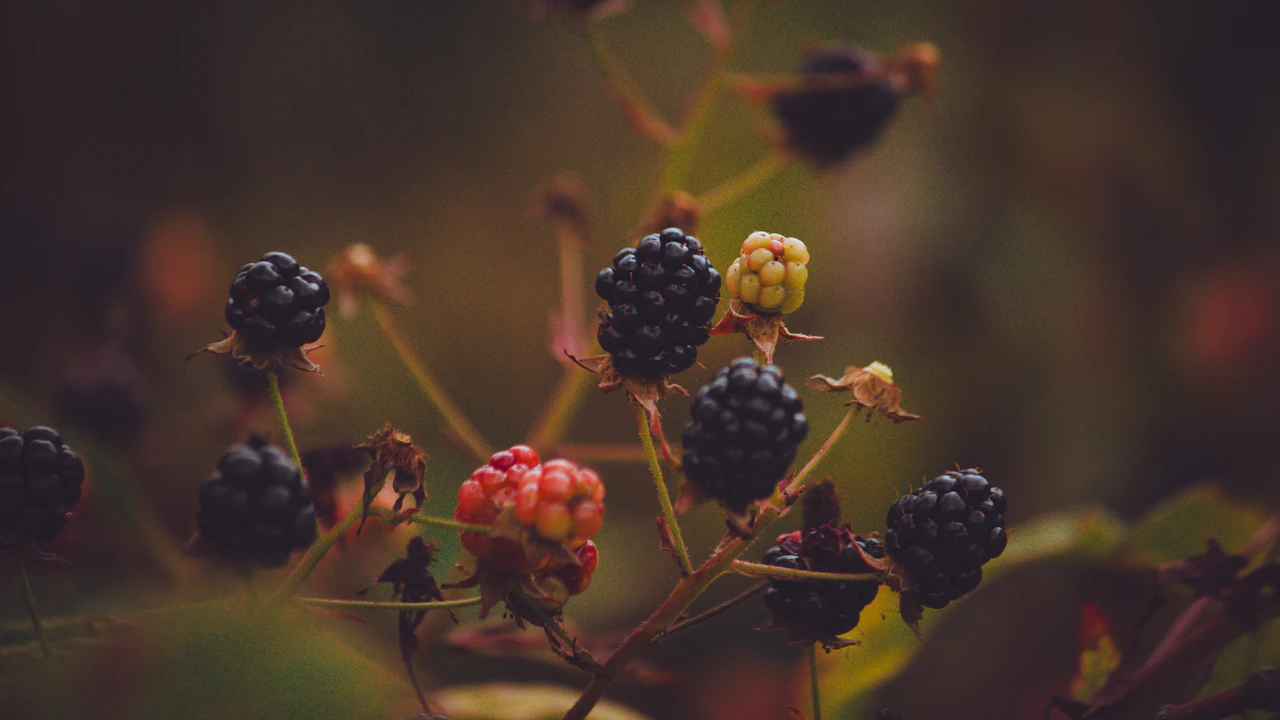
North America is home to many kinds of wild berries, from familiar blueberries and raspberries to regional fruits such as salmonberries, serviceberries, and cloudberries. Their colors and growing seasons can help you narrow down what you are seeing, but appearance alone is never enough to confirm that a wild fruit is safe to eat.
This guide introduces 25 wild berry types and berry-like fruits found in parts of North America, with notes on habitat, season, and identification. It is an educational starting point—not a field-identification key. Never eat a wild plant unless it has been positively identified using a reliable regional guide or by a qualified expert.
How to Identify Wild Berries Safely
- Look at the whole plant. Check leaves, stems, growth habit, flower structure, fruit clusters, and habitat—not just berry color.
- Use several identifying features. Many unrelated plants produce similar-looking red, blue, or black fruits.
- Confirm the region and season. A species may be common in one area and absent from another, and ripening dates vary with elevation and weather.
- Do not rely on wildlife behavior. Birds or mammals eating a fruit does not mean it is safe for people.
- Never taste-test an unknown plant. Some toxic fruits can cause serious illness. If ingestion is suspected, contact Poison Control in the United States at 1-800-222-1222 or seek urgent medical advice.
25 Types of Wild Berries in North America
1. Wild Blueberries
Typical range: Northeastern and northern North America, with other species occurring in western regions. Habitat: Heaths, open woods, acidic soils, and mountain slopes. Season: Usually summer, depending on species and location.
Wild blueberries are generally small, blue to blue-black fruits with a pale, powdery bloom. Several Vaccinium species occur across the continent, so leaf shape, plant height, and habitat help distinguish them. Read our blueberry growing and identification guide for more context.
2. Huckleberries
Typical range: Especially the Pacific Northwest and western mountains, with additional species elsewhere. Habitat: Forest edges, mountain meadows, and woodland understories. Season: Commonly mid- to late summer.
Huckleberry is a common name used for multiple species. Fruits may be blue, purple, red, or nearly black. Some western huckleberries are important regional wild foods, but not every plant with a similar-looking fruit is the same species. Compare plant details and local field references rather than relying on color alone.
3. Wild Blackberries
Typical range: Much of the United States and southern Canada. Habitat: Thickets, roadsides, forest margins, and disturbed ground. Season: Late spring through summer, varying by region.
Blackberries grow on often thorny canes and form aggregate fruits made of many small drupelets. Ripe fruit is usually dark and comes away from the plant as a solid cluster. Species and hybrids can be difficult to distinguish. See our blackberry guide.
4. Wild Red Raspberries
Typical range: Broadly distributed across northern and temperate North America. Habitat: Open woods, forest clearings, and field edges. Season: Usually summer.
Red raspberries are aggregate fruits that typically detach from the central receptacle, leaving a hollow center. Their canes, leaf undersides, prickles, and fruit structure help separate them from look-alikes. Cultivated and wild plants may overlap in appearance.
5. Black Raspberries
Typical range: Eastern and central North America, with distribution varying by species. Habitat: Woodland edges, hedgerows, and clearings. Season: Often early to midsummer.
Black raspberries resemble blackberries, but the ripe fruit usually pulls away with a hollow center. Canes may have a bluish or whitish coating. Do not identify a plant from fruit color alone; examine the cane and leaves as well.
6. Salmonberries
Typical range: Coastal areas of the Pacific Northwest and parts of Alaska. Habitat: Moist forests, streambanks, and disturbed coastal sites. Season: Often late spring to summer.
Salmonberries grow on upright shrubs with thorny stems and produce yellow-orange to reddish aggregate fruits. They are especially associated with moist coastal environments. Explore our salmonberry guide for more information.
7. Thimbleberries
Typical range: Western North America, including parts of the Pacific Coast and mountain regions. Habitat: Moist forest openings and woodland margins. Season: Usually summer.
Thimbleberries have broad, soft, maple-like leaves and large, soft red fruits with a hollow center. Their stems are generally less prickly than many blackberry canes. The fruit is delicate and bruises easily. See the thimbleberry guide.
8. Cloudberries
Typical range: Arctic and subarctic parts of Alaska and Canada, with localized northern habitats. Habitat: Bogs, tundra, and cool, wet areas. Season: A short summer season.
Cloudberries are low-growing plants that produce amber or golden-orange aggregate fruits. They are associated with cool northern environments and are not widespread across the lower 48 states. See our cloudberry guide.
9. Serviceberries
Typical range: Many parts of North America, depending on species. Habitat: Woodlands, open slopes, hedgerows, and gardens. Season: Late spring to summer.
Serviceberries, also called juneberries or Saskatoon berries for some species, grow on shrubs or small trees. The fruits are usually purple to dark blue and have a small crown-like remnant at the blossom end. Species vary, so confirm the leaves, growth form, and local range.
10. American Elderberries
Typical range: Much of eastern and central North America, with related species elsewhere. Habitat: Moist thickets, stream edges, and open woodland. Season: Summer to early fall.
American elderberry plants carry clusters of small dark purple fruits. Correct identification matters because other elderberry species and similar plants can be confused with them. Raw elderberry plant parts and unripe fruits can cause illness; preparation guidance should come from a reliable extension or food-preservation source. Do not eat an unidentified elderberry.
11. Chokecherries
Typical range: Across much of North America. Habitat: Woodland edges, stream corridors, prairie margins, and roadsides. Season: Summer to early fall.
Chokecherries are small trees or shrubs that produce clusters of dark red to purple-black drupes. The leaves and fruit clusters are useful identification features. The pits, leaves, and other plant parts contain compounds that can release cyanide; never chew or crush the pits. See our chokecherry guide and consult a trusted regional reference before handling for food.
12. Buffaloberries
Typical range: Parts of western and central North America. Habitat: Dry slopes, open areas, and riparian locations. Season: Late summer to fall, depending on species.
Buffaloberries grow on shrubs, often with silvery or scaly-looking leaves. The fruits are typically red or orange and can be tart. Common names cover more than one species, so use a regional botanical guide to verify the plant. Our buffaloberry guide provides additional background.
13. Wintergreen Berries
Typical range: Eastern North America and other suitable northern habitats, depending on species. Habitat: Acidic woodland floors and shaded forests. Season: Fruits can persist into colder months.
Eastern teaberry or wintergreen is a low-growing evergreen with glossy leaves and red berries. The plant has a distinctive wintergreen scent when its leaves are crushed, but scent alone is not a safe identification method. Learn more in our wintergreen berry guide.
14. Mayhaw Fruits
Typical range: Primarily the southeastern United States. Habitat: Wet woods, swamps, and lowland areas. Season: Often spring, earlier than many other wild fruits.
Mayhaws are small hawthorn fruits, usually red to yellowish, produced on thorny trees or shrubs. They are commonly used in regional jellies and preserves. Identification should include the thorny growth habit, leaves, flowers, and fruit—not just the small apple-like shape. Read our mayhaw guide.
15. Wild Cranberries
Typical range: Northern North America, with species and distribution varying by region. Habitat: Bogs, peatlands, and other acidic, wet habitats. Season: Commonly late summer into fall.
Cranberry plants are low-growing, trailing shrubs with small evergreen leaves and red fruits. Several cranberry species exist, and wild bog habitats can be fragile or protected. Never enter unsafe wetlands or harvest where it is prohibited.
16. Salal Berries
Typical range: Coastal western North America, particularly the Pacific Northwest. Habitat: Moist coastal forests and forest understories. Season: Summer to early fall.
Salal is an evergreen shrub with thick, leathery leaves and dark purple berries. It is a familiar native plant in parts of the Pacific coastal region. Confirm the plant’s identity with a local flora before considering any wild fruit for food.
17. Oregon Grape Fruits
Typical range: Western North America, with related species across different regions. Habitat: Woodlands, slopes, and shaded forest edges. Season: Summer to early fall.
Oregon grape is an evergreen shrub with holly-like, spiny leaflets and clusters of blue-purple berries. The fruits are notably tart. Common names and species vary by region; identification should include the distinctive leaves and plant structure.
18. Wild Dewberries
Typical range: Parts of the eastern, southern, and central United States. Habitat: Low thickets, field edges, and open disturbed areas. Season: Often spring to early summer in warmer regions.
Dewberries are trailing brambles that produce aggregate fruits resembling small blackberries. Their low, sprawling growth habit can help distinguish them from more upright blackberry canes, although species overlap and hybridization can complicate identification.
19. Wild Gooseberries
Typical range: Various regions of North America, depending on species. Habitat: Woodlands, rocky slopes, and cool or moist sites. Season: Usually late spring through summer.
Gooseberries are shrubs that often have sharp spines and round fruits that may be green, red, purple, or nearly black. Some species have hairy or veined fruits. Do not handle an unknown spiny shrub carelessly, and verify the species before harvesting.
20. Wild Currants
Typical range: Many regions of North America. Habitat: Forest margins, moist ravines, and mountain areas. Season: Late spring to summer.
Currants grow in clusters and may be red, black, purple, or translucent. They are related to gooseberries, and their leaves and growth habit can be important identification clues. Some native species are protected or restricted in particular locations, so check local rules.
21. Lingonberries
Typical range: Northern and subarctic parts of North America, including Alaska and northern Canada. Habitat: Cool forests, heathlands, and acidic soils. Season: Late summer into fall.
Lingonberries are low evergreen plants with small, leathery leaves and red fruits. They are more likely in northern habitats than in warm regions. Similar red berries occur on other plants, so confirm the leaves and growth pattern with a local guide.
22. Wild Mulberries
Typical range: Several native and naturalized species occur in different parts of North America. Habitat: Woodland edges, floodplains, fields, and urban areas. Season: Late spring to summer.
Mulberries grow on trees and produce elongated clusters of small fruit units. Ripe fruits may be red, purple, or nearly black depending on species. Leaf shapes can vary substantially even on the same tree, so use several traits when identifying it.
23. Wild Strawberries
Typical range: Many parts of North America, depending on species. Habitat: Meadows, open woods, lawns, and forest edges. Season: Usually spring to early summer.
Wild strawberries are small plants with three-part leaves and red fruits bearing tiny seeds on the outer surface. Several low-growing plants can resemble strawberries, including species with dry or unpalatable fruits. Confirm the flowers, leaf margins, and fruit structure before identification.
24. Partridgeberries
Typical range: Eastern North America, with a range that varies by species. Habitat: Shaded forest floors and acidic woodland soils. Season: Fruits may persist into fall and winter.
Partridgeberry is a creeping evergreen groundcover with paired leaves and small red fruits. Its low growth habit differs from that of most brambles. Do not confuse it with other red-fruited groundcovers; consult a regional botanical key.
25. Red Baneberries — A Poisonous Look-Alike Example
Typical range: Woodlands across parts of North America. Habitat: Shaded forests and moist woodland soils. Season: Fruits generally appear in summer.
Red baneberry is included as a safety example, not a food recommendation. It produces conspicuous red berries on herbaceous plants, and ingestion can cause poisoning. The fruit arrangement and plant structure are useful clues, but never attempt to identify or test it by taste. The U.S. Forest Service’s species review of red baneberry provides additional safety information.
Wild Berry Types by Region
| Region | Examples you may encounter | Habitat notes |
|---|---|---|
| Pacific Northwest | Salmonberry, thimbleberry, salal, Oregon grape, huckleberries | Coastal forests, moist woodland edges, and mountain habitats |
| Northeast and Great Lakes | Wild blueberries, raspberries, wintergreen, cranberries, serviceberries | Acidic soils, forest edges, bogs, and open clearings |
| Western mountains | Huckleberries, serviceberries, buffaloberries, wild raspberries | Elevation and exposure strongly affect fruiting season |
| Southeast | Mayhaw, dewberries, wild blackberries, elderberries | Warm-season thickets, wetlands, and woodland margins |
| Alaska and northern Canada | Cloudberries, lingonberries, cranberries, blueberries | Short growing seasons, tundra, bogs, and cool forests |
This table is a broad regional overview, not a guarantee that a species occurs at a particular location. Check local field guides, herbarium resources, and extension publications for a confirmed range.
When Is Wild Berry Season?
There is no single wild berry season across North America. In many southern areas, some fruits ripen in late spring or early summer. In northern states and Canada, peak fruiting often arrives later in summer. Mountain elevations, rainfall, temperature, and the species itself can shift the season by weeks.
Use local phenology or extension guidance rather than a nationwide calendar. If you are planning a walk, treat berries as a seasonal observation opportunity—not a promise of an edible harvest.
How to Learn More About Wild Berries
For safe, region-specific information, consult a university extension service, a current regional plant-identification guide, or a qualified botanist. Oregon State University Extension’s resource on preserving wild berries and fruits explains important food-safety considerations. The U.S. Forest Service also provides educational material about plants and public lands.
Before collecting anything, check land-access rules and local harvesting restrictions. Avoid roadsides, areas treated with pesticides, polluted sites, and protected habitats. Wash correctly identified fruit with clean water, and follow trusted food-safety instructions for any fruit that requires cooking.
Frequently Asked Questions
What are the most common wild berries in North America?
Depending on the region, people may encounter wild blueberries, blackberries, raspberries, strawberries, serviceberries, elderberries, and huckleberries. Local species differ, so a regional guide is more useful than a single continent-wide list.
Can you identify a wild berry by its color?
No. Color is not enough to identify a plant safely. Different species can produce similar-looking fruit, and some poisonous plants have red, blue, or black berries. Check the leaves, stem, flowers, fruit structure, habitat, and regional range.
Are all wild berries edible?
No. Some wild fruits are toxic, some require specific preparation, and others are easily confused with hazardous look-alikes. Never eat an unknown wild plant or rely on an online photo alone for identification.
What should I do if someone eats an unknown berry?
Do not wait for symptoms or try home remedies. In the United States, contact Poison Control at 1-800-222-1222 for guidance; call emergency services for severe symptoms. If possible, keep a photo or sample of the plant for qualified identification without exposing anyone else.
Final Thoughts
North America’s wild berries are diverse, and learning about them can make outdoor walks more rewarding. The safest approach is to use several identifying features, consult reliable local references, respect harvesting rules, and never taste an unknown fruit. Use this list to guide further research—not as permission to forage or eat any plant.
Editorial note: Common names and ranges can vary by region. Confirm the scientific identity and local distribution of any plant using current regional references before publishing field-identification or food-use advice.