
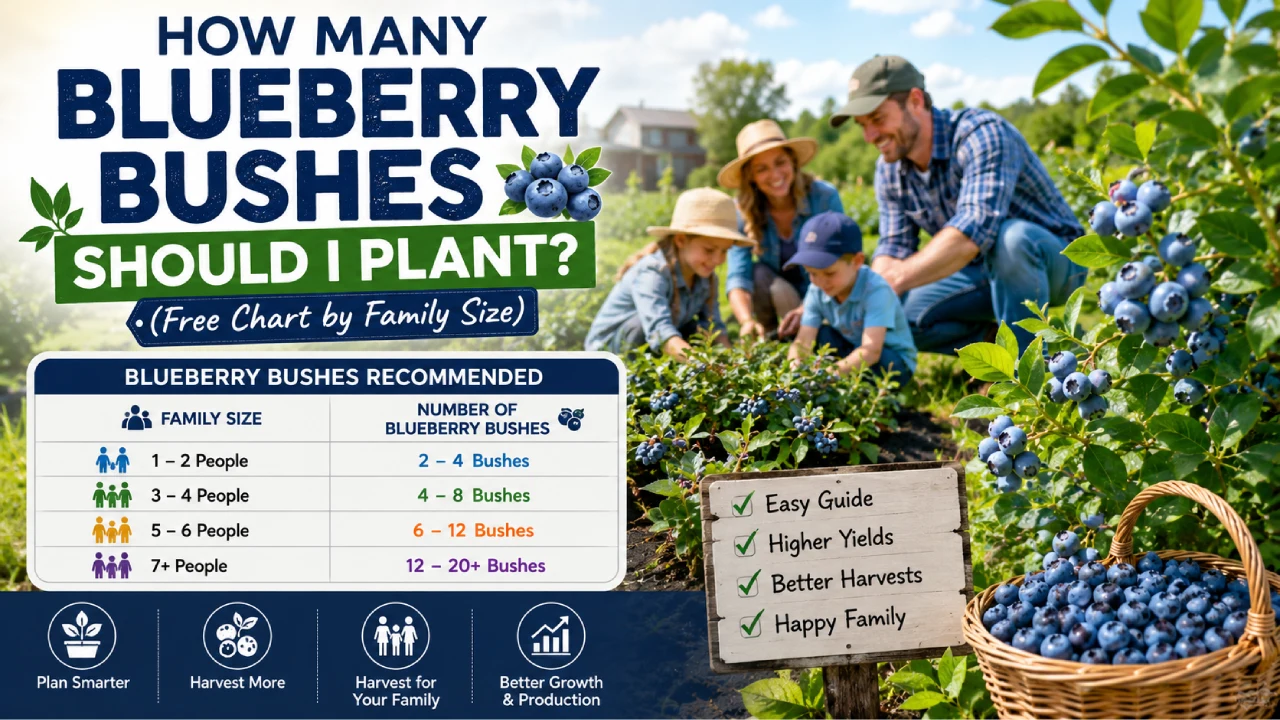
If you’re planning a home berry patch, the short answer is: plant 2 blueberry bushes per person who eats blueberries regularly, with a minimum of 2 bushes total (even if you live alone) for cross-pollination. A family of four typically does well with 6–8 mature bushes, which can produce 30–80 pounds of fruit per year once established. But the “right” number for your yard depends on how you plan to eat your berries, how much space you have, and which varieties you choose.
In this guide, we’ll walk through exact bush counts for every household size, how much fruit to expect from a single mature bush, spacing requirements, why blueberries need a pollination partner, and how to plan a productive backyard patch whether you’re growing in raised beds, containers, or open ground.
Quick Answer: Blueberry Bushes By Household Size
| Household Size | Bushes to Plant | Expected Mature Yield (lbs/year) | Best Use |
|---|---|---|---|
| 1 person (occasional snacker) | 2 bushes | 10–20 lbs | Fresh eating, some freezing |
| 2 people | 3–4 bushes | 15–35 lbs | Fresh eating, smoothies, jam |
| Family of 4 | 6–8 bushes | 30–80 lbs | Fresh, baking, freezing for winter |
| Family of 6 | 10–12 bushes | 50–120 lbs | Heavy freezing, canning, gifting |
| Serious preserver / hobby homestead | 15–20+ bushes | 75–200+ lbs | Canning, selling at market, bulk freezing |
These numbers assume mature bushes, which take 4–6 years to hit full production. In the first two years after planting, expect little to no fruit as the plant establishes its root system — most growers even recommend removing early flowers so the bush channels energy into roots rather than berries.
Why You Can’t Just Plant One Bush
This is the single most common mistake first-time growers make. While some blueberry varieties are technically self-fertile, nearly every variety — especially highbush and rabbiteye types — produces significantly more fruit, larger berries, and earlier ripening when planted alongside a different variety for cross-pollination. Rabbiteye blueberries in particular require a second variety to produce any meaningful crop at all.
Cross-pollination happens when bees move pollen between two genetically different blueberry varieties that bloom at the same time. Even self-fertile northern highbush varieties like ‘Bluecrop’ or ‘Patriot’ will produce noticeably bigger, more abundant berries when a compatible partner variety is nearby.
Rule of thumb: Always plant a minimum of 2 different varieties, ideally 3–4 if you have the space, choosing varieties that bloom in overlapping windows (early, mid, and late season) so you extend your harvest and guarantee pollination overlap.
How Much Fruit Does One Blueberry Bush Actually Produce?
Yield depends heavily on bush age, variety, climate, and care. Here’s a realistic breakdown:
| Bush Age | Yield Per Bush |
|---|---|
| Year 1–2 (establishing) | 0–1 lb (remove blossoms to strengthen roots) |
| Year 3 | 1–3 lbs |
| Year 4–5 | 3–6 lbs |
| Year 6+ (fully mature) | 5–10 lbs (highbush); up to 15–20 lbs for vigorous rabbiteye varieties |
According to University of Minnesota Extension, well-maintained mature highbush blueberry plants can be expected to yield in this same general 5–10 pound range annually under good growing conditions, though yields vary by cultivar and site.
For context: a pound of fresh blueberries is roughly 3–3.5 cups. If your family eats a cup of blueberries a few times a week plus uses them in baking and smoothies, you’re looking at 25–40 pounds a year — which lines up neatly with the 6–8 bush recommendation for a family of four above.
Spacing: How Much Room Do Blueberry Bushes Need?
Spacing requirements vary by type:
- Highbush blueberries (most common for home gardens, USDA zones 4–7): space 4–5 feet apart within a row, with rows 8–10 feet apart.
- Half-high blueberries (compact, cold-hardy hybrids for zones 3–4): space 2–3 feet apart.
- Rabbiteye blueberries (vigorous, heat-tolerant, zones 7–9): space 6–8 feet apart, as these can eventually reach 10–15 feet tall and wide.
- Lowbush blueberries (groundcover type, zones 3–6): space 1–2 feet apart, as they spread by underground rhizomes and fill in naturally.
A simple planning formula: multiply your bush count by 25–40 square feet per bush (including walking space) to estimate the total garden footprint you’ll need. Six highbush bushes, for example, will realistically need a 20 x 10-foot bed once you account for mature spread and access paths.
Sample Backyard Blueberry Patch Layouts
Small Yard / Starter Patch (2–4 Bushes)
Plant 2 rows of 2 highbush varieties (e.g., one early-season and one mid-season) 5 feet apart in each direction. This fits comfortably in an 10 x 10-foot bed and produces enough fresh fruit for 1–2 people with occasional freezing.
Family Patch (6–8 Bushes)
Plant 2 rows of 3–4 bushes using 3 different varieties (early, mid, late season) for a longer harvest window and reliable cross-pollination. This layout needs roughly a 20 x 15-foot area and comfortably feeds a family of four with extra for freezing.
Homestead / Market Patch (15–20+ Bushes)
Plant in rows of 8–10 feet apart with 4–5 varieties staggered by ripening time, extending your harvest from early June through late August depending on your region. This scale is appropriate for serious canning, freezing, or selling at a farmers market.
Container Growing: How Many Bushes Fit in Pots or Raised Beds?
Don’t have in-ground space? Blueberries grow well in containers, provided you choose compact varieties and use an acidic potting mix (blueberries need soil pH between 4.5 and 5.5).
- Use a container at least 18–24 inches in diameter and 18 inches deep per bush.
- Even in containers, plant a minimum of 2 varieties for pollination — you can place pots side by side.
- A patio with 4–6 large containers can realistically produce 15–30 pounds of fruit per year once established.
Factors That Change Your Ideal Bush Count
1. How You Plan to Use the Berries
Fresh snacking only? You can get away with fewer bushes. Planning to freeze, can, or bake all winter? Double your estimate — preserving uses far more fruit than most people expect.
2. Your Climate and Growing Season
Longer growing seasons and staggered variety selection (early, mid, late) let you harvest for 6–10 weeks instead of a single 2–3 week window, effectively increasing your usable yield without adding bushes.
3. Bird and Wildlife Pressure
If birds are a significant problem in your area and you don’t plan to net your bushes, consider planting 20–30% more bushes than the chart suggests to offset losses, or budget for bird netting instead.
4. Available Sun and Soil
Blueberries need at least 6 hours of full sun and acidic, well-drained soil. If your best growing spot is limited, it’s better to plant fewer bushes with proper spacing than to overcrowd — crowded bushes compete for light and produce less fruit per plant.
Best Blueberry Varieties to Pair for Home Gardens
| Season | Northern Highbush (Zones 4–7) | Rabbiteye (Zones 7–9) |
|---|---|---|
| Early | Duke, Earliblue | Climax, Austin |
| Mid | Bluecrop, Patriot | Tifblue, Premier |
| Late | Elliott, Jersey | Powderblue, Ochlockonee |
Pairing one early, one mid, and one late variety not only guarantees strong pollination but stretches your harvest across the entire summer instead of ending it in a single overwhelming two-week window.
Related Berry Growing Guides
- Complete Blueberry Growing Guide: Planting to Harvest
- Huckleberry vs. Blueberry: What’s the Difference?
- Serviceberry (Juneberry): The Complete Growing Guide
- Gooseberry Growing Guide for Beginners
- Currant Berry Guide: Red, Black, and White Varieties
Frequently Asked Questions
Can I grow just one blueberry bush?
You can, but you’ll get far less fruit. Even self-fertile varieties produce bigger, more abundant berries when cross-pollinated with a second variety. If space only allows for one bush, choose a self-fertile northern highbush variety like ‘Sunshine Blue’ or ‘Legacy’ and expect a modest harvest.
How many years until a blueberry bush produces full-size crops?
Most blueberry bushes reach full production between years 5 and 6. You’ll typically see a small harvest by year 3, with yields increasing steadily each year after.
Do blueberry bushes need a specific soil pH?
Yes. Blueberries require acidic soil, ideally between pH 4.5 and 5.5. According to USDA Forest Service resources on blueberry cultivation, soil acidity is one of the most critical factors for healthy plant growth, and soil should be tested and amended with sulfur or acidic organic matter before planting if pH is too high.
How far apart should I plant two different blueberry varieties for pollination?
Bees typically forage within a 100-foot range, so as long as your varieties are within the same garden bed or yard — even 20–30 feet apart — pollination will occur effectively. You don’t need the varieties to be planted side by side.
How many blueberry bushes do I need to sell fruit at a farmers market?
Plan for a minimum of 20–30 mature bushes to generate a consistent, sellable surplus after accounting for household use, though many small-scale market growers start with 50+ bushes across multiple varieties to extend the sales season.
Can blueberry bushes overproduce and go to waste?
It’s rare, since ripe blueberries freeze exceptionally well for up to a year without losing flavor or nutrition. Most home growers find that even a “too big” harvest simply becomes a full freezer rather than wasted fruit.
What’s the minimum space needed for 2 blueberry bushes?
A 5 x 10-foot bed is enough for 2 mature highbush blueberry bushes with proper spacing, or a pair of large containers if you’re growing on a patio.
The Bottom Line
For most home gardeners, 6–8 highbush blueberry bushes across 3 varieties strikes the right balance between manageable space, reliable cross-pollination, and enough fruit to enjoy fresh, freeze, and bake with all year. Start smaller if you’re new to growing berries — you can always add more bushes in future seasons once you see how much your household actually eats.
1 thought on “How Many Blueberry Bushes Should I Plant? (Free Chart by Family Size)”