
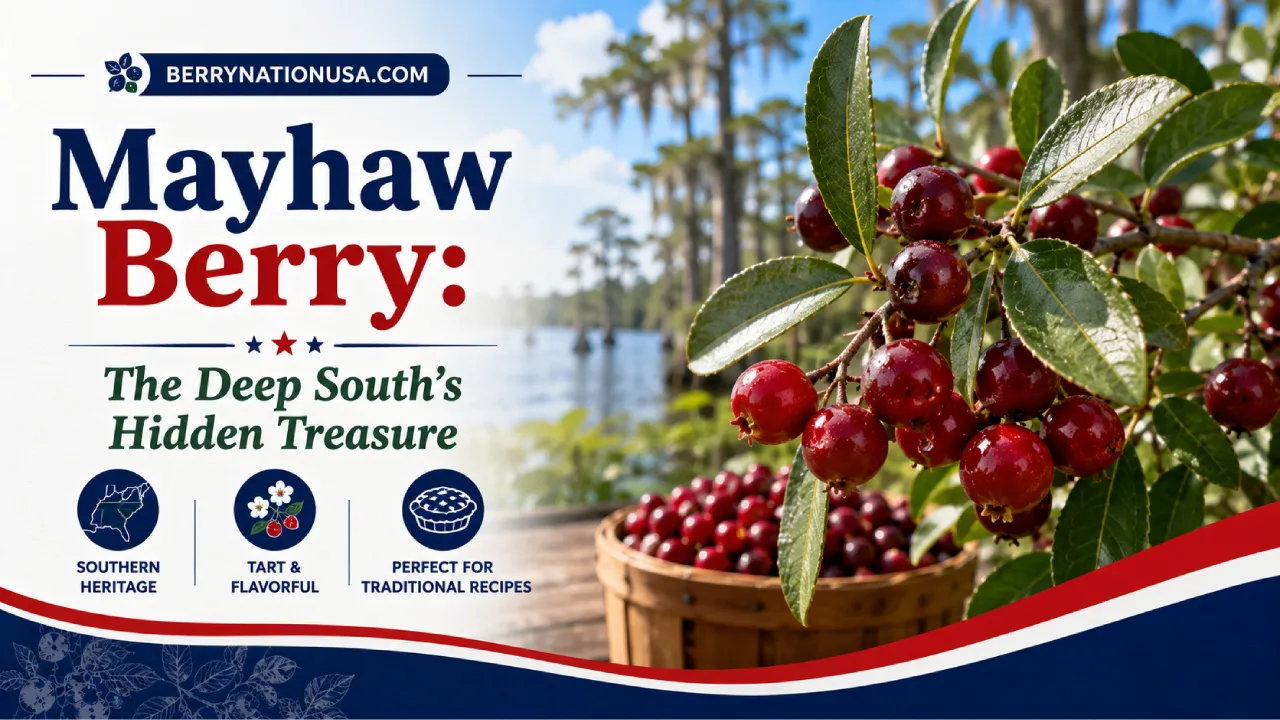
Every April, in the bottomland swamps of Louisiana and East Texas, something remarkable happens. Mayhaw trees growing in floodplains and alongside bayous drop their small red berries into the rising spring water, and families who have been doing this for generations arrive with long-handled nets to scoop the floating berries off the surface. What follows is a jelly-making tradition so beloved in the Deep South that towns hold festivals in its honor, jars are given as wedding gifts, and grown adults will drive hours to secure a case from a trusted source. Outside the Gulf South, almost nobody has heard of it. This is the mayhaw — the South’s best-kept culinary secret.
This complete guide covers everything about mayhaw berries: the botanical profile of Crataegus aestivalis and related species, where mayhaw trees grow across the Gulf South, full nutritional breakdown, health benefits, the cultural significance of mayhaw in Louisiana and Texas, traditional and modern harvesting techniques, where to find and buy mayhaws, and the definitive mayhaw jelly recipe that has been passed down through Southern families for over a century.
What Is a Mayhaw? Botanical Profile
The mayhaw is the fruit of several native hawthorn species in the genus Crataegus, primarily Crataegus aestivalis (the common mayhaw) and Crataegus opaca (the western mayhaw). These are native trees of the Gulf Coastal Plain — members of the rose family (Rosaceae) and close relatives of apples, pears, and serviceberries. The fruit is a small pome — the same type of fruit as an apple or pear — rather than a true berry in the botanical sense, though it is universally called a berry in Southern food culture.
The name “mayhaw” combines two elements: “May” for the month when the berries traditionally ripen, and “haw” — an old English term for the berry of any hawthorn tree, derived from the Old English haga meaning hedge or enclosure (hawthorns were traditionally used as hedgerow plants in England). The name is straightforward and descriptive: a hawthorn berry that ripens in May.
Primary species: Crataegus aestivalis (common mayhaw), Crataegus opaca (western mayhaw)
Family: Rosaceae | Fruit type: Pome (like a tiny apple) | Common names: Mayhaw, may hawthorn, spring haw
Tree height: 20–30 feet | Berry size: 8–16mm | Berry color: Bright red to orange-red
Season: April–May | Native range: Gulf Coastal Plain — LA, TX, GA, AL, MS, AR, FL
Mayhaw trees are medium-sized deciduous trees growing 20–30 feet tall, typically found in bottomland swamps and floodplain forests where their roots are periodically submerged. They are spectacularly beautiful in spring — the trees produce dense clusters of white flowers in February and March before the leaves fully emerge, creating a cloud-like floral display in the still-bare swamp forest that locals recognize as one of the first signs of spring. The flowers are followed by the small red fruits that ripen just 6–8 weeks later.
How to Identify Mayhaw Trees
Mayhaw identification is straightforward once you know the key features, and the combination of habitat, fruit, and flowering time makes confusion with other trees unlikely in the Gulf South.
The tree and bark
- Medium-sized tree, 20–30 feet tall with a spreading crown
- Gray-brown bark with shallow, irregular furrows on mature trees — relatively smooth on young branches
- Branches often armed with sharp thorns 1–2 inches long — a characteristic shared by most hawthorns
- Grows in bottomland swamps and floodplains where periodic flooding is normal — the wet-feet habitat is a strong identification clue
The leaves
- Simple, alternate leaves that are oval to elliptical with toothed margins
- 1–3 inches long, dark green and smooth on top
- Emerge late — mayhaw trees produce fruit before or simultaneous with leaf emergence, which is one of the plant’s most distinctive features
- Turn yellow in fall before dropping
The flowers — the most distinctive seasonal feature
Mayhaw flowers are among the most beautiful of any native tree in the Gulf South. They appear in February and March — often weeks before other trees leaf out — as dense clusters of pure white, five-petaled flowers with prominent pink-tipped stamens. The flowers are about ½ inch across and grow in flat-topped clusters of 5–12 flowers. The spectacle of a mayhaw tree in full bloom in a still-bare winter swamp is one of the botanical highlights of the Gulf South spring and makes the tree unmistakable to anyone who has seen it once.
The fruit
- Small, round pome fruits — 8–16mm in diameter, like a tiny apple or large crabapple
- Bright red to orange-red when ripe, sometimes with yellow tones
- The fruit has a small persistent calyx at the tip (the dried flower remains) — just like an apple or pear
- Flesh is yellow-white, firm, and tart — containing 3–5 small seeds (like apple seeds, these contain small amounts of amygdalin — don’t eat seeds in large quantities)
- Ripe berries fall or float easily from the tree in April–May
Distinguishing mayhaw from other hawthorns
There are many hawthorn species across North America, and some can look similar. The mayhaw is distinguished by its specific combination of: Gulf South bottomland habitat, very early ripening (April–May vs summer for most other hawthorns), and the larger, more uniformly red fruit with less bitterness than most hawthorns. Other hawthorn species in the region are generally edible when processed similarly to mayhaws, though their flavor and pectin content vary.
Are Mayhaw Berries Edible?
Yes — mayhaw berries are completely edible and safe. As members of the rose family and close relatives of apples, they share the apple’s basic safety profile. The flesh is safe to eat raw, cooked, or processed. The seeds contain small amounts of amygdalin (as do apple seeds) and should not be eaten in large quantities, but occasional seed consumption from eating a few berries whole poses no meaningful risk.
The primary limitation on raw mayhaw eating is flavor rather than safety — the fresh berries are intensely tart and somewhat astringent, making bulk fresh consumption less enjoyable than the berry’s culinary applications suggest. Most people find that eating a few mayhaws fresh off the tree is pleasant as a taste experience, but that the berry truly comes into its own when processed into jelly, syrup, or sauce.
Mayhaw jelly made with proper technique — clear juice strained through a jelly bag, combined with pectin and sugar — is not only safe but is one of the most treasured artisanal food products of the Gulf South. The National Center for Home Food Preservation at the University of Georgia includes mayhaw jelly in its database of approved home canning recipes, reflecting the long history and confirmed safety of this preparation.
What Do Mayhaws Taste Like?
Fresh mayhaw berries have a flavor profile unlike any other Southern wild fruit. The best description: imagine a very tart, intensely aromatic crabapple crossed with a quince, with floral notes and a brightness that is almost citrus-like. The tartness is pronounced — more so than a ripe blackberry or even a cranberry — with a clean, fruity acidity rather than the astringency of a chokecherry or the bitterness of an elderberry. There is a floral quality that comes through particularly in fresh berries, which later concentrates beautifully in cooked preparations.
The aroma of a fresh mayhaw is one of its most distinctive features. Walking under a loaded mayhaw tree in full fruit in April fills the air with a fruity, apple-quince fragrance that is immediately recognizable and deeply appealing even before you taste the berry. Harvesters often describe the scent of a good mayhaw harvest morning — the smell of berries floating on spring floodwater, surrounded by blooming bottomland forest — as one of the defining sensory experiences of Gulf South spring.
Mayhaw jelly flavor: The transformation from tart raw berry to jelly is dramatic and rewarding. The cooking process concentrates the aromatic compounds while the sugar balances the acidity, and the result is a jelly with extraordinary complexity — tart and fruity with clear apple-quince character, a floral note, and a brightness that makes most commercial berry jellies taste flat by comparison. The color alone — a luminous, jewel-clear rose-red — signals something special before you taste it. Those who grow up eating mayhaw jelly describe it as irreplaceable: no commercial product comes close, and the flavor is bound up in memory, place, and season in a way that makes it about more than just jelly.
Where Mayhaw Trees Grow in the USA
Mayhaw is a specialized plant of the Gulf Coastal Plain — it does not grow across the entire country, but within its native range it can be remarkably abundant. Understanding where to look is the first step to finding this fruit.
| State / Region | Abundance | Best areas | Peak ripening |
|---|---|---|---|
| Louisiana | Most abundant — cultural heartland | Sabine River basin, Calcasieu Parish, Kisatchie National Forest area, Red River bottomlands | Late March–April |
| East Texas | Very abundant (western mayhaw) | Sabine River corridor, Angelina and Neches River bottoms, Big Thicket region | Late March–April |
| Georgia | Common | Altamaha River watershed, Satilla River bottoms, Okefenokee Swamp margins | April–early May |
| Alabama | Present | Mobile-Tensaw Delta, Conecuh and Escambia River drainages | April |
| Mississippi | Present | Pearl River drainage, coastal bottomlands | April |
| Southern Arkansas | Occasional | Ouachita and Red River floodplains | Late April |
| Northern Florida | Occasional | Panhandle river bottomlands, Apalachicola River drainage | Late March–April |
What habitat to look for
Mayhaw trees are specialists of wet bottomland environments. They do not grow on upland sites or in dry conditions. Look for them in:
- River and creek floodplains — especially those that experience seasonal flooding in winter and spring
- Bottomland hardwood forests dominated by cypress, water oak, and sweet gum
- Edges of swamps, bayous, and oxbow lakes
- Low-lying areas along rural dirt roads in Gulf South flatwoods
- The margins of game management areas and wildlife refuges with bottomland habitat
One of the best ways to find wild mayhaw trees is to look for the spectacular white spring bloom in February and March — a mayhaw in flower in a bare bottomland swamp is unmistakable and visible from a considerable distance. Mark those trees and return in April for the harvest.
Mayhaw Nutrition Facts
Mayhaws are related to apples and share much of their nutritional character — a good source of dietary fiber, vitamin C, and antioxidant polyphenols in a low-calorie fruit. Specific mayhaw nutritional data is limited due to the fruit’s regional nature and lack of commercial production at scale, but analysis of Crataegus species from the USDA FoodData Central database and published hawthorn research provides a solid baseline:
| Nutrient | Per 100g mayhaw berries | Significance |
|---|---|---|
| Calories | ~52–65 kcal | Low calorie |
| Dietary fiber | ~5–7g (high) | Excellent — higher than most berries; supports gut health |
| Vitamin C | ~15–25mg | Good source; immune and antioxidant support |
| Pectin (natural) | Very high | Why mayhaw jelly sets so beautifully; prebiotic fiber |
| Anthocyanins and polyphenols | High | Cardiovascular and anti-inflammatory benefits |
| Potassium | ~160mg | Blood pressure support |
| Malic acid | High — responsible for tartness | Same acid as in apples; aids digestion, energy metabolism |
| Vitexin and hyperoside | Present — Crataegus characteristic | Flavonoids with cardiovascular research support |
The mayhaw’s high natural pectin content deserves special note — it is one of the highest-pectin fruits in the South, which is why mayhaw jelly sets so reliably and with such a beautiful firm consistency. This pectin is a soluble dietary fiber with documented prebiotic effects — feeding beneficial gut bacteria in the same way that apple pectin does. From a nutritional perspective, eating mayhaw jelly on a biscuit provides the same soluble fiber benefits as eating an apple.
Health Benefits of Mayhaw Berries
Cardiovascular support — the Crataegus connection
The Crataegus genus — hawthorn — has one of the longest and best-documented histories of any plant genus in cardiovascular medicine. European hawthorn species, particularly Crataegus monogyna and Crataegus laevigata, have been studied extensively for heart health. A systematic review published in The Cochrane Database of Systematic Reviews found that hawthorn extract demonstrated statistically significant improvements in exercise tolerance and reduction of symptoms in patients with chronic heart failure. The active compounds — vitexin, hyperoside, oligomeric proanthocyanidins — are shared across the Crataegus genus including mayhaw. While specific clinical trials on Crataegus aestivalis are limited, the genus-level cardiovascular research provides strong support for mayhaw’s cardiovascular benefits.
Outstanding fiber for gut health
With 5–7g of dietary fiber per 100g — including substantial soluble pectin — mayhaws are among the highest-fiber native fruits in the Gulf South. Pectin is a prebiotic fiber that feeds beneficial gut bacteria, slows glucose absorption, helps lower LDL cholesterol by binding bile acids in the digestive tract, and contributes to the satiety that supports healthy weight. The traditional Southern practice of eating mayhaw jelly — while processed — retains significant amounts of this pectin, making mayhaw jelly nutritionally more interesting than most commercial fruit jellies.
Antioxidant and anti-inflammatory polyphenols
Mayhaw berries contain anthocyanins (responsible for the red color), quercetin, rutin, and the hawthorn-characteristic flavonoids vitexin and hyperoside. These compounds work collectively to reduce oxidative stress and systemic inflammation — the two processes most centrally involved in the development of cardiovascular disease, type 2 diabetes, and neurodegenerative conditions. Research on hawthorn polyphenols published in the Journal of Functional Foods confirmed significant antioxidant and anti-inflammatory activity from Crataegus species consistent with the genus chemistry shared by mayhaw.
Blood pressure support
Hawthorn species have demonstrated blood pressure-lowering effects in clinical research. A randomized trial published in The British Journal of General Practice found that hawthorn extract significantly reduced diastolic blood pressure compared to placebo in patients with type 2 diabetes. The mechanism involves relaxation of blood vessel walls through inhibition of angiotensin-converting enzyme (ACE) — the same mechanism as a class of pharmaceutical blood pressure medications. The potassium in mayhaw berries (approximately 160mg per 100g) provides additional blood pressure support through sodium-potassium balance.
Digestive support through malic acid
Mayhaw’s high malic acid content — the same organic acid responsible for the tartness in apples — contributes to digestive function by stimulating gastric acid secretion and supporting the breakdown of fats in the digestive process. Traditional Southern food culture has long associated tart, acidic foods with digestive health, and the specific malic acid content of mayhaws provides pharmacological support for this intuitive folk understanding.
Immune support from vitamin C
While not the most vitamin-C-dense berry available, mayhaw’s 15–25mg of vitamin C per 100g provides a meaningful immune and antioxidant contribution, particularly given the early spring timing of the harvest. Mayhaw ripens when very few other fresh local fruits are available in the Gulf South — April vitamin C from a foraged or home-grown source represents a genuine nutritional contribution at a time when winter monotony in fresh produce is just ending.
Cultural Significance: Louisiana, Texas, and the Mayhaw Belt
Louisiana — the heart of mayhaw culture
No state has a deeper or more passionate relationship with the mayhaw than Louisiana. In the parishes of western and central Louisiana — particularly Calcasieu, Beauregard, Vernon, Sabine, and Natchitoches — mayhaw jelly-making is a multi-generational tradition as embedded in local identity as Cajun cooking or crawfish boils. Families pass down specific wild tree locations as prized possessions. Grandmothers teach grandchildren the jelly-making process. Jars of homemade mayhaw jelly are given as gifts for weddings, new homes, and graduations.
The Louisiana Mayhaw Festival, held annually in Starks, Louisiana, celebrates the harvest with a dedicated community event including mayhaw jelly competitions, cooking demonstrations, and tree-planting programs. It is one of several mayhaw festivals held across the Louisiana-Texas border region each spring, reflecting how deeply this fruit is embedded in local identity. The Louisiana Department of Agriculture has supported mayhaw cultivation research as a potential specialty crop, recognizing its economic and cultural significance to the region.
East Texas — the western tradition
In the Big Thicket region of East Texas and along the Sabine River corridor, the western mayhaw (Crataegus opaca) supports a parallel jelly-making tradition to Louisiana’s. East Texas mayhaw pickers often work the same river bottoms their grandparents worked, arriving at dawn in flat-bottomed boats to collect berries floating on spring floodwaters. The tradition is closely tied to the broader Big Thicket culture of self-reliance, wild food knowledge, and seasonal celebration that makes this region one of the most culturally distinctive in the South.
Georgia — the eastern tradition
In the bottomlands of southern Georgia — particularly along the Altamaha, Oconee, and Satilla Rivers — mayhaw has a distinct but equally passionate cultural presence. The Georgia tradition is perhaps less publicly celebrated than Louisiana’s festival culture, but the knowledge of mayhaw trees, harvest timing, and jelly-making techniques is deeply maintained in rural communities along these river systems. Georgia mayhaw products have gained some commercial visibility in recent years through specialty food producers in the region.
The floating harvest — a uniquely Southern tradition
The most distinctive and celebrated aspect of mayhaw culture is the harvest method. Mayhaw trees grow in bottomland swamps where spring floods are normal — and when the berries ripen in April, they often fall directly into the floodwater that surrounds the trees’ bases. Harvesters arrive by flat-bottomed boat or wade in waders, and rather than picking berries from branches, they skim the floating berries from the water’s surface with dip nets, window screens mounted in frames, or specialized floating collection frames.
This method — harvesting fruit from water rather than from trees — is unique in American food culture and produces images that are genuinely extraordinary: families in pirogue canoes skimming red berries from swamp water surrounded by flowering bottomland forest in early spring. The floating harvest is both practical (mayhaw trees are tall and the berries small — branch-picking is tedious) and efficient (a good floodwater harvest can yield dozens of pounds per hour in productive locations).
Harvesting Mayhaws: The Float Method and More
Timing — the critical variable
The mayhaw season is brief — typically 2–4 weeks at any given location, and the peak harvest window within that season may be only a few days. Experienced harvesters watch the trees closely from late March onward, checking for color change from green to red-orange and for the first berries beginning to drop. The timing varies significantly by year depending on spring temperatures — a warm late winter can advance the season by 2 weeks; a cold spring can delay it.
General timing by region:
- Southern Louisiana and deep South Texas: Late March through mid-April in most years
- Central Louisiana and East Texas: April, peaking in early-to-mid April
- Southern Georgia and Alabama: Mid-April through early May
- Northern range (southern Arkansas, north Georgia): Late April through May
The float method (traditional)
When floodwater is present under mayhaw trees — which is common during the April harvest season in bottomland habitats — the float method is far more efficient than branch-picking:
- Position a flat-bottomed boat, pirogue, or wader-equipped harvester under or alongside mayhaw trees that are dropping ripe fruit
- Skim floating berries from the water surface using a large-mesh dip net, a window screen mounted in a wooden frame, or a purpose-built floating collection frame
- Transfer collected berries to buckets or coolers — rinse immediately to remove debris
- Work early morning when berries dropped overnight have been accumulating on the water’s surface
Dry ground harvesting (when flood is absent)
In years when flooding is minimal, or for trees on drier ground, several alternative methods work:
- Tarp method: Spread large tarps or old sheets beneath mayhaw trees and shake or strike the branches with long poles — ripe berries fall onto the tarp and can be gathered quickly
- Hand-picking clusters: More tedious but produces the cleanest berries — pick entire small clusters when most berries in a cluster are ripe
- Ground gleaning: Collect fallen berries from the ground beneath trees — works best where the ground is clear and harvesting begins quickly after berries drop
Processing after harvest
Mayhaws should be processed within 1–2 days of harvest — they are soft and perishable. Rinse thoroughly in cold water to remove debris, leaves, and insects. Freeze immediately if not processing within a day. Frozen mayhaws retain their flavor and pectin content well and can be processed into jelly at any time of year — which is why many Louisiana families freeze multiple bags of mayhaws each spring to make jelly through the year on demand.
Where to Buy Mayhaws and Mayhaw Products
For Americans outside the Gulf South, acquiring mayhaws requires some planning:
Fresh or frozen mayhaws
- Louisiana and Texas specialty produce suppliers: Several producers in western Louisiana and East Texas sell fresh and frozen mayhaws by the pound, typically available April through June fresh and year-round frozen. Search for “mayhaw berries for sale Louisiana” or “East Texas mayhaw” to find current suppliers
- Farmers markets in the Gulf South: In April, farmers markets in Lafayette, Lake Charles, Beaumont, and surrounding communities often have fresh mayhaw vendors
- U-pick orchards: Several mayhaw orchards in Louisiana and Georgia offer u-pick access during the harvest season
Mayhaw jelly and products
- Louisiana specialty food companies: Multiple producers sell mayhaw jelly online — search “mayhaw jelly Louisiana” for current producers. These products ship nationally and are excellent gifts
- Southern food specialty retailers: Online specialty food stores focused on Southern cuisine often carry mayhaw jelly alongside other regional products
- Mayhaw festivals: Attending the Louisiana Mayhaw Festival or similar events provides access to a wide range of mayhaw products from local producers in a festive setting
Growing Mayhaw Trees at Home
Mayhaw trees can be successfully grown as landscape and food-producing trees in the Gulf South and similar climates. The USDA and Louisiana State University AgCenter have supported mayhaw cultivation research specifically to develop improved varieties for home and commercial orchards.
| Requirement | Ideal conditions | Notes |
|---|---|---|
| USDA Zones | 7–9 | Requires mild winters and hot summers; not suitable for northern states |
| Soil | Moist to wet, slightly acidic | Tolerates seasonal flooding; prefers bottomland clay or loam |
| Sunlight | Full sun | Best fruit production in full sun; tolerates light shade |
| Water | Moist to wet — tolerates flooding | Ideal for low-lying areas, pond edges, and drainage areas where other trees struggle |
| Chill hours | 200–400 hours below 45°F | Low chill requirement — suited to Gulf South winters |
| Cross-pollination | Plant 2+ varieties | Improves fruit set; multiple varieties extend harvest season |
| Years to first fruit | 3–5 years from planting | Full production reached in 6–8 years; productive for 50+ years |
Named cultivars: The LSU AgCenter and cooperating researchers have developed several named mayhaw cultivars selected for improved fruit size, productivity, and flavor. Look for cultivars including ‘Big Red’, ‘Super Berry’, ‘Texas Star’, and ‘Governor’s Cherry’ — these are available from specialty nurseries in the Gulf South region. According to LSU AgCenter mayhaw resources, named cultivars can produce significantly more and larger fruit than wild-collected trees.
Mayhaw trees are beautiful landscape specimens with year-round interest: spectacular white spring bloom, attractive summer foliage, colorful fall fruit, and an open, graceful winter form. They are ideal for low-lying landscape areas where wet soil makes most ornamental trees struggle, and they provide exceptional wildlife value — the berries are eaten eagerly by wildlife including deer, wild turkey, and numerous bird species.
5 Mayhaw Recipes
1. Classic mayhaw jelly — the definitive recipe
This is the recipe that defines mayhaw culture across the Gulf South and has been refined through generations of Southern jelly-making. Follow the juice extraction method carefully — natural drip straining without pressing produces the clearest, most beautifully colored jelly.
Extracting the juice: Wash 3 pounds of mayhaw berries and place in a large saucepan with 3 cups of water. Bring to a boil, reduce heat, and simmer 15–20 minutes until all berries are completely soft and beginning to break apart. Mash thoroughly with a potato masher. Pour the mashed berries and liquid into a dampened jelly bag or triple layer of cheesecloth set over a large bowl or pot. Allow juice to drip freely for at least 2 hours — overnight produces the clearest jelly. Do not squeeze or press — pressing clouds the jelly and extracts bitter compounds from the seeds and skins. You should yield approximately 4 cups of brilliant, clear, rose-red juice.
Making the jelly: Measure exactly 4 cups of mayhaw juice into a large, wide saucepan. Add 2 tablespoons of lemon juice and 1 package (1.75 oz) of powdered fruit pectin. Stir well to dissolve the pectin. Bring to a full rolling boil over high heat, stirring constantly. Add 4 cups of granulated sugar all at once — stir to combine. Return to a full rolling boil that cannot be stirred down and boil hard for exactly 1 minute, stirring continuously. Remove from heat, skim any foam from the surface, and pour immediately into hot sterilized half-pint jars, leaving ¼ inch headspace. Wipe jar rims clean, apply lids and bands, and process in a boiling water bath for 10 minutes.
Yield: Approximately 5–6 half-pint jars. The jelly will be a luminous, gem-clear rose-red with an extraordinary tart-fruity flavor. Serve on biscuits, English muffins, or toast; use as a glaze for ham or pork; pair with cream cheese and crackers; or give as gifts — there is no better food gift from the Gulf South.
2. Mayhaw syrup
Simmer the extracted mayhaw juice (preparation same as above) with equal weight of sugar — approximately 3 cups juice to 2 cups sugar — over medium heat until slightly thickened, about 10 minutes. Add a pinch of vanilla extract if desired. Pour into sterilized bottles and refrigerate (keeps 3 months) or freeze (keeps 1 year). Use over pancakes, waffles, ice cream, panna cotta, or cheesecake. Dilute 1:4 with sparkling water for a natural mayhaw soda that is extraordinarily refreshing.
3. Mayhaw glaze for pork or duck
Combine ½ cup of mayhaw jelly with 2 tablespoons of Dijon mustard, 1 tablespoon of apple cider vinegar, and a pinch of cayenne in a small saucepan. Warm over low heat until jelly melts and everything combines into a smooth glaze. Brush over a pork tenderloin, roast duck, or grilled pork chops during the last 15–20 minutes of cooking. The tartness of the mayhaw cuts beautifully through pork fat, and the natural pectin creates a glossy, lacquered finish that makes the dish look as impressive as it tastes. This is Gulf South cooking at its most elegant.
4. Mayhaw vinaigrette
Whisk together 3 tablespoons of mayhaw jelly, 2 tablespoons of white wine vinegar, 1 tablespoon of olive oil, ½ teaspoon of Dijon mustard, salt, and pepper until smooth and emulsified. The jelly’s natural pectin helps stabilize the emulsion. Use over bitter greens (arugula, watercress, radicchio) with pecan halves and goat cheese — a distinctly Southern salad with no commercial equivalent. The dressing keeps refrigerated for 2 weeks.
5. Mayhaw cake with jelly filling
Bake your favorite two-layer white or yellow cake recipe. When cooled, spread ½ cup of mayhaw jelly generously between the layers before frosting. The tart, fruity jelly layer beneath cream cheese frosting or simple buttercream creates a flavor contrast that makes an ordinary layer cake into something memorable. The rose-red jelly visible when the cake is sliced provides a visual drama that matches the flavor. Top with fresh spring flowers for a celebration cake that captures the Gulf South spring season perfectly.
Frequently Asked Questions About Mayhaw Berries
What is a mayhaw berry?
A mayhaw is the small, tart, apple-like fruit of native hawthorn trees (Crataegus aestivalis and related species) of the American Gulf Coast. They grow in bottomland swamps of Louisiana, East Texas, Georgia, Alabama, and Mississippi, ripening in April and May. Mayhaws are famous for the extraordinary jelly made from their strained juice — considered by many Southerners to be the finest fruit jelly in America.
What does mayhaw jelly taste like?
Tart, fruity, and complex — with clear notes of apple, quince, and rose, and a brightness that is unlike any commercial jelly. The flavor is more sophisticated than simple berry jellies, with depth and acidity that makes it exceptional on biscuits, as a meat glaze, and alongside cheese. Those who grow up eating mayhaw jelly describe it as irreplaceable — nothing commercially available comes close.
Are mayhaw berries edible raw?
Yes — mayhaw berries are safe to eat raw. They taste like a very tart crabapple or quince. Eating a few fresh off the tree is perfectly safe and gives you a sense of the flavor, but the real culinary potential emerges when mayhaws are cooked into jelly or syrup, where the tartness transforms into extraordinary fruity complexity.
Where do mayhaw trees grow?
Mayhaw trees grow in the Gulf Coastal Plain of the southeastern US — primarily Louisiana, East Texas, southern Georgia, Alabama, Mississippi, and northern Florida. They are bottomland trees requiring wet, seasonally flooded conditions along rivers, in swamps, and along creek edges. Louisiana and East Texas are the cultural heartland of mayhaw harvesting.
When are mayhaws ripe?
Mayhaws ripen in April and May — one of the earliest native fruits in the South. Southern Louisiana and Texas may ripen late March; northern Georgia and Alabama may not ripen until mid-May. The season at any location lasts only 2–4 weeks. Ripe mayhaws are bright red to orange-red, slightly soft, and fall easily from the tree — floating on floodwater in many bottomland habitats.
Is mayhaw the same as a hawthorn berry?
Yes — mayhaw is a common name specifically for the Gulf South hawthorn species (Crataegus aestivalis and Crataegus opaca), which are members of the Crataegus hawthorn genus. The name distinguishes these specific Gulf Coast species from other North American hawthorns. All hawthorn berries (haws) are edible when processed, but the mayhaw species are uniquely valued for their superior flavor and exceptional pectin content that makes the finest jelly.
How do you harvest mayhaws?
The traditional and most efficient method in flooded bottomland habitats is the float method — skimming ripe berries from the surface of floodwater using dip nets or screen-framed collectors from a flat-bottomed boat. On dry ground, tarps spread beneath the trees with branches shaken or struck with poles work well. Branch-picking by hand is more tedious but produces the cleanest berries. Morning harvesting captures berries that dropped overnight and maximizes daily yield.
Conclusion: Go Find Yourself a Jar
The mayhaw is the Gulf South’s greatest food secret — a native fruit with extraordinary flavor, deep cultural roots, and a harvesting tradition so distinctive (floating berries from bayous at dawn) that it deserves to be far better known beyond the Louisiana-Texas border country where it has been treasured for generations. The jelly it produces is genuinely one of the finest artisanal food products in America: clear, complex, tart, and unmistakably itself in a way that nothing commercial can replicate.
If you live in the Gulf South — grow a mayhaw tree. It will pay dividends for fifty years. If you live outside the region, find a Louisiana specialty food producer online and order a jar of mayhaw jelly. Spread it on a biscuit. You will understand immediately what the fuss is about. And then you will want another jar.
More from Berry Nation USA
- Chokecherry: Tart Native Berry, Safety & Jelly Recipe
- Serviceberry (Juneberry): America’s Forgotten Native Berry
- Wild Blackberries of America: Complete ID & Foraging Guide
- Buffaloberry: America’s Most Underrated Native Superfruit
- Elderberry Complete Guide: Benefits, Syrup Recipe & Safety
- Blueberry Complete Guide: America’s Native Superfruit
- How Many Berries Should I Eat a Day?