
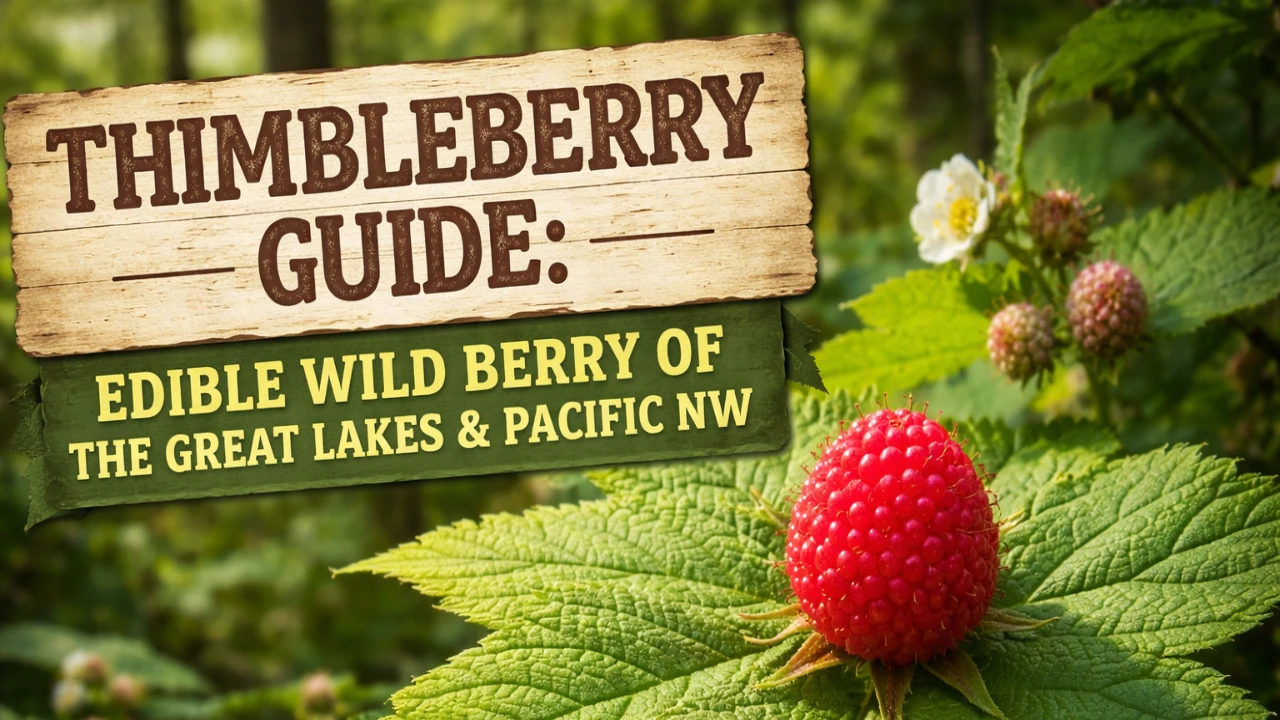
Along the forested trails of Michigan’s Upper Peninsula and the misty mountain paths of the Pacific Northwest, there grows a wild berry that experienced foragers consider one of the finest fruits on the continent — and most Americans have never heard of it. The thimbleberry is red, velvety, thornless, and so soft it nearly dissolves the moment you touch it. It cannot be shipped. It cannot be farmed commercially. The only way to taste one is to go find it yourself.
This complete guide covers everything about thimbleberries: how to identify Rubus parviflorus with confidence, what they taste like and why that texture is unique, where they grow across America, full nutrition facts, health benefits, a regional foraging guide, how they compare to raspberries, how to grow them in a garden setting, and what to make with them when you are lucky enough to find a productive patch.
Botanical Profile: What Is a Thimbleberry?
The thimbleberry (Rubus parviflorus) is a deciduous shrub in the rose family (Rosaceae), belonging to the same genus as raspberries, blackberries, and salmonberries. The Latin species name parviflorus means “small-flowered” — a somewhat ironic name, as thimbleberry flowers are among the larger and more conspicuous in the Rubus genus.
What distinguishes thimbleberry most immediately from every other Rubus species in North America is a combination of three features found together in no other plant: no thorns, very large maple-shaped leaves, and large white flowers. Once you have seen these three features together, thimbleberry identification becomes one of the most reliable in all of wild plant foraging.
The berry itself is a hollow aggregate fruit — like a raspberry, it separates cleanly from its receptacle when picked, leaving a hollow center. But the thimbleberry takes the raspberry’s structure to a velvety extreme: the individual drupelets are so loosely arranged and the overall berry so delicate that it flattens and often disintegrates at the slightest pressure. This extraordinary fragility is both the thimbleberry’s greatest charm and the reason it has never been commercially cultivated — a berry that crushes itself in your hand cannot survive modern supply chains.
Scientific name: Rubus parviflorus | Family: Rosaceae | Common names: Thimbleberry, white-flowering raspberry
Height: 3–6 feet | Fruit color: Bright red when ripe | Season: July–August | USDA Zones: 3–9
Thorns: None | Key habitat: Moist forest edges, roadsides, Pacific NW, Great Lakes
How to Identify Thimbleberries
Thimbleberry is one of the most distinctive and easiest-to-identify wild berry plants in North America. The combination of features is unique enough that experienced foragers often say it is impossible to confuse with anything else once you know what to look for.
The leaves — the most distinctive feature
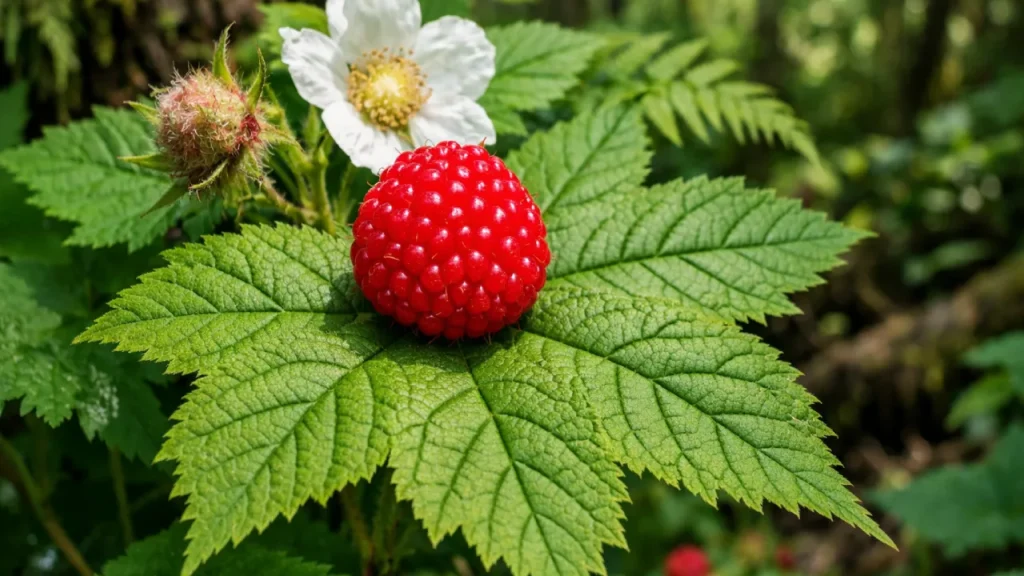
Thimbleberry leaves are enormous — often 4 to 10 inches across — and distinctly maple-shaped with 5–7 pointed lobes and coarsely toothed edges. They are soft and velvety on both surfaces due to fine hairs, giving them a fuzzy texture when touched. This leaf is unlike anything else in the Rubus genus: while raspberries and blackberries have small compound leaves made of separate leaflets, thimbleberry has a single large, simple, maple-like leaf. In dense forest understory, the large soft leaves catch filtered light and make the plant immediately recognizable to anyone who has learned to look for it.
The stems — no thorns
Thimbleberry canes are completely thornless and smooth — a critical identification feature when combined with the maple-shaped leaves. No other common berry-producing plant in thimbleberry’s range combines large maple-like leaves with entirely thornless canes. The stems are green to reddish-brown, upright, and moderately stout, typically reaching 3–6 feet in height.
The flowers
Large, white, five-petaled flowers 1.5–2 inches across — significantly larger than raspberry flowers. They appear May through July depending on elevation, growing in loose clusters of 3–7 at the tips of branches. The flowers have a sweet, light fragrance and are one of the most beautiful of any native Rubus species.
The fruit
- Bright red when fully ripe — a vivid, saturated red rather than the deep purple-red of a ripe raspberry
- Flat and slightly domed rather than the domed conical shape of a raspberry — often described as thimble-shaped (hence the name)
- Hollow when picked, like a raspberry — separates cleanly from the receptacle
- Extremely soft and delicate — pressing gently will flatten the berry immediately
- Loosely arranged drupelets with small gaps between them — less tightly packed than a raspberry
- Diameter typically 1.5–2.5 cm — similar to or slightly larger than a wild red raspberry
Seasonal progression
Thimbleberry is identifiable year-round through its distinctive leaves in summer, dried fruit husks in fall, and the previous year’s cane skeletons visible in winter. The large maple-shaped leaves emerging in spring are one of the first reliable identifiers of the season — look for them in April–May in the understory at forest edges.
The Thornless Advantage — Identification Shortcut
For anyone new to foraging who finds the idea of confidently identifying wild berries intimidating, thimbleberry offers an unusually reassuring entry point. The rule is simple:
The thimbleberry identification rule
A thornless stem + large maple-shaped leaf + red hollow aggregate fruit in the Great Lakes or Pacific Northwest = thimbleberry. This combination does not occur in any toxic plant in North America. If the stem has thorns of any kind, it is not a thimbleberry — stop and re-identify.
The thornless quality does more than simplify identification — it makes thimbleberry foraging a genuinely pleasant physical experience. While blackberry picking demands long sleeves and inevitably draws blood, and raspberry canes leave fine prickles in your skin, a thimbleberry patch can be harvested in a t-shirt with no discomfort whatsoever. Reaching into the bush to pick a berry is the same experience as picking fruit from any garden plant.
This thornlessness also makes thimbleberry an exceptional choice for native woodland garden plantings where children will be present — all the wild berry experience with none of the scratches.
What Do Thimbleberries Taste Like?
The thimbleberry has one of the most intensely flavored berries of any wild plant in North America. Most people who try their first fresh thimbleberry are surprised — the small, soft, fragile appearance gives no hint of the flavor intensity inside.
The flavor is: intensely fruity, sweet-tart, almost tropical in its brightness, with a clean berry richness and a finish that is more complex than a raspberry. The sweetness and tartness are beautifully balanced — the berry is not as assertively tart as a wild raspberry, but has more character than a cultivated raspberry. Many experienced foragers rank thimbleberry as their favorite wild berry, citing the combination of flavor intensity and textural uniqueness.
The texture deserves its own description: thimbleberries are velvety soft in a way that has no parallel in the cultivated fruit world. The berry does not so much get chewed as it dissolves — a small burst of intensely flavored juice followed by a sensation of soft fruit that disappears almost immediately. This is why people reach for a second, and a third, and suddenly find the container empty. There is something almost addictive about the combination of intense flavor and immediate softness.
Flavor varies by ripeness:
- Fully ripe: Uniform bright red, extremely soft, instantly releases from the plant — sweet, complex, intensely fruity
- Slightly underripe: Still pink or pale red, firm, tart with less sweetness — edible but disappointing compared to peak ripeness
- Overripe: Darkening toward orange-red, very soft, almost mushy — still sweet but less structured in flavor
A note on jam: Despite the fragility that makes fresh thimbleberries impossible to transport, they make extraordinary jam. The cooking process that would destroy their delicate fresh texture actually concentrates and deepens their flavor dramatically. Thimbleberry jam is considered by many in the Great Lakes region to be the finest wild berry jam available — intensely fruity, jewel-bright red, and with a flavor complexity that purchased jam cannot approach.
Thimbleberry vs Raspberry: Full Comparison
Because thimbleberry is in the same genus as raspberry and produces a similar hollow red aggregate fruit, the comparison is inevitable. Here is how they differ across every meaningful dimension:
| Feature | Thimbleberry | Red raspberry |
|---|---|---|
| Scientific name | Rubus parviflorus | Rubus idaeus |
| Thorns | None — completely thornless | Dense prickles on canes |
| Leaf type | Large, simple, maple-shaped (4–10 inches) | Compound — 3–7 separate leaflets |
| Texture | Velvety soft — dissolves when touched | Firm enough to hold shape |
| Berry shape | Flat, wide, thimble-shaped | Domed, conical |
| Flavor | Intense, sweet-tart, tropical brightness | Tart, bright, classic berry |
| Flower | Large white (1.5–2 inches) | Small white (0.5 inch) |
| Commercial availability | None — too fragile to ship | Widely available fresh and frozen |
| Range | Pacific NW, Great Lakes, Rockies | Across North America |
| Season | July–August | June–August (varies) |
| Best culinary use | Fresh eating, jam (fragile — use quickly) | Fresh, frozen, baking, jam |
The verdict: thimbleberry wins on flavor intensity and texture experience for fresh eating; raspberry wins on versatility, accessibility, and culinary range. They are not true substitutes — thimbleberry’s softness means it cannot be used in any recipe requiring a berry that holds its shape. But for fresh eating and jam, thimbleberry is the superior experience in the opinion of most who have tried both.
Where Thimbleberries Grow in the USA
Thimbleberry has a distinctive two-part distribution in the continental United States — a broad western presence and a notable eastern outpost in the Great Lakes region. Understanding where to look is the first step to finding a productive patch.
Western range
In the West, thimbleberry grows from Alaska south through British Columbia, Washington, Oregon, and California, and east through the Cascade and Sierra Nevada mountains into the Rocky Mountain states. It is found from sea level up to about 9,000 feet elevation, though it is most productive at mid-elevations (2,000–6,000 feet) in moist, partially shaded environments. It thrives in the cool, moist coastal forests of the Pacific Northwest and in mountain meadow edges and forest clearings.
Eastern Great Lakes range
In the East, thimbleberry has a geographically isolated population centered on the Great Lakes, particularly:
- Michigan’s Upper Peninsula — the most celebrated thimbleberry region east of the Rockies. The UP’s cool, moist climate and abundant forest edges support exceptional thimbleberry populations. Thimbleberry jam from the UP is sold in specialty stores across Michigan and is considered a regional treasure
- Northern Wisconsin — particularly along the Lake Superior shoreline and in the Northern Highland region
- Northern Minnesota — especially in Cook, Lake, and St. Louis counties along the North Shore of Lake Superior
- Ontario shoreline — along Lake Superior and in the Canadian Shield region
The Great Lakes population is genetically isolated from the western populations and has been separated for thousands of years — a relict from a time when the species had a continuous range across the northern continent before climate shifts fragmented its habitat.
| Region | Peak ripening | Best locations |
|---|---|---|
| Pacific Northwest coast (OR, WA) | July | Forest edges, logged areas, roadsides in Cascades foothills |
| Pacific Northwest mountains | Late July–August | Subalpine meadow edges, trail margins, clearings after disturbance |
| Northern California | June–July | Coast ranges, Shasta-Trinity area, redwood understory margins |
| Alaska | Late July–August | Forest edges, roadsides, coastal thickets |
| Michigan Upper Peninsula | Mid-July–August | Trail edges, roadsides, forest margins throughout the UP |
| North Shore Minnesota / Wisconsin | Late July–August | Lake Superior shoreline trails, forest road edges |
| Rocky Mountains (CO, ID, MT) | July–September (elevation-dependent) | Moist mountain slopes, aspen groves, stream corridors |
What habitat to look for
Thimbleberry is a plant of edges and disturbances in moist forest environments. It thrives where the forest has been opened up — by logging, fire, windthrow, or road-cutting — and partial sunlight reaches the ground. Look for it along:
- Trail margins and forest path edges
- Roadsides through forested areas
- The edges of forest clearings and open areas
- Logged areas where sunlight has reached the forest floor
- Stream banks and moist ravine edges
- Subalpine meadow margins where forest meets open terrain
In the Great Lakes region, the Pictured Rocks National Lakeshore trail in Michigan’s Upper Peninsula is one of the most celebrated thimbleberry picking destinations in the eastern United States — the trail passes through miles of thimbleberry habitat, and peak-season hikers in July and August often pick as they walk.
Thimbleberry Nutrition Facts
Detailed laboratory nutritional analysis of thimbleberries is limited compared to commercially important berries like blueberries and strawberries — a direct consequence of the berry’s inability to be commercially farmed. Available data draws primarily from Canadian ethnobotanical research and nutritional analyses of related Rubus species. The following represents the best available data for Rubus parviflorus:
| Nutrient | Per 100g thimbleberries (estimated) | Comparison to raspberry |
|---|---|---|
| Calories | ~50–60 kcal | Raspberry: 52 kcal — very similar |
| Dietary fiber | ~5–6g (estimated) | Raspberry: 6.5g — comparable |
| Vitamin C | High — similar to raspberry | Raspberry: 26mg/100g |
| Anthocyanins | High — deep red pigment | Similar range to raspberry |
| Ellagic acid | Present — Rubus genus characteristic | Raspberry is richest source |
| Potassium | Good source | Raspberry: 151mg/100g |
| Manganese | High — Rubus characteristic | Raspberry is excellent source |
| Water content | Very high (~88%) | Explains soft texture and juiciness |
The overall nutritional picture for thimbleberry is closely comparable to raspberry — which is expected given their close botanical relationship. Both are low-calorie, high-fiber, vitamin-C-rich berries with meaningful anthocyanin and ellagic acid content. The thimbleberry’s extremely high water content (~88%) explains both its velvety texture and its exceptional juiciness — the berry is more juice than structure, which is why it cannot hold its shape under any pressure.
Health Benefits of Thimbleberries
Antioxidant-rich red pigmentation
The bright red color of thimbleberries reflects a concentration of anthocyanins and other red-pigmented polyphenols — the same family of antioxidants responsible for the health benefits of raspberries, strawberries, and other red-colored Rubus berries. These compounds neutralize free radicals, reduce systemic inflammation, and protect blood vessels from oxidative damage. Research on anthocyanin-rich diets consistently shows associations with reduced rates of cardiovascular disease and cognitive decline.
Ellagic acid — a distinctive cancer-relevant compound
Thimbleberries, like all Rubus species, contain ellagic acid — a polyphenol compound that has been studied extensively for its potential role in cancer prevention. Research published in the Journal of Nutrition found that ellagic acid inhibits cancer cell proliferation and promotes apoptosis in multiple cancer cell lines. While clinical trials in humans are ongoing, the concentration of ellagic acid in Rubus berries including thimbleberry is among the highest of any food source. See our raspberry guide for more detail on ellagic acid research in this genus.
Excellent fiber for digestive health
Thimbleberries provide approximately 5–6g of dietary fiber per 100g — among the higher values of any berry, comparable to their close relative the raspberry. This fiber content supports a healthy gut microbiome, promotes regularity, slows glucose absorption, and contributes to satiety. For a berry eaten primarily in season as a fresh snack or trail food, this fiber contribution to a summer diet is meaningful.
Vitamin C and immune support
Like all red berries, thimbleberries are a good source of vitamin C, contributing meaningfully to the immune-supporting, collagen-synthesizing, and antioxidant functions that vitamin C provides. The berry’s traditional use among Indigenous peoples as a first-foods-of-summer berry likely reflects an intuitive understanding of its vitamin C contribution after winter months when fresh produce was unavailable.
Hydration from high water content
At approximately 88% water content, thimbleberries are one of the most hydrating foods available by weight. This characteristic makes them particularly valuable as trail food during summer foraging and hiking — eating thimbleberries along a sun-exposed trail provides not just calories and nutrients but meaningful hydration. This is not a trivial benefit in the warm, often dry summer conditions of the western mountains and Great Lakes region where the berry grows.
Traditional medicinal uses
Indigenous peoples across thimbleberry’s range used the leaves medicinally. Dried thimbleberry leaves were used as a poultice for minor wounds and burns — the soft, absorbent, velvety texture of the large leaves made them practical as natural bandages in the field. Leaf tea was used for various digestive complaints. These traditional uses are documented in ethnobotanical records across multiple Pacific Northwest and Great Lakes nations and are referenced in botanical research from the Native Plant Network.
Indigenous and Traditional Uses
Thimbleberry has one of the broadest documented histories of Indigenous use of any wild plant in North America, largely because the plant grows across such a vast geographic range and because multiple parts of the plant — berry, leaves, young shoots, and bark — all have documented uses.
Food uses
The berries were eaten fresh throughout their range wherever they grew. In the Pacific Northwest, nations including the Nlaka’pamux, Secwépemc, Okanagan, Haida, and many others consumed thimbleberries as a summer food and dried them for winter storage, though the berry’s softness made drying more challenging than drying firmer berries. The berries were also mixed with other more structurally stable berries — including salmonberries — in traditional preparations.
The young shoots of thimbleberry — emerging in spring before the leaves fully develop — were eaten as a cooked vegetable by multiple nations, peeled and prepared similarly to asparagus. This spring shoot use is documented across Pacific Northwest and Great Lakes nations and represents one of the few cases where the entire plant above ground (shoots, leaves, and berries) was incorporated into traditional food systems.
Medicinal and practical uses
The large, soft, velvety leaves had a well-documented practical application: they were used as natural “wrapping paper” for food — particularly berries being transported or stored — and as natural poultices applied to burns, wounds, and skin irritations. The softness and absorbency of the large leaves made them the most practical natural dressing available in the forest environments where the plant grows. This use was documented among nations across the Pacific Northwest and Great Lakes, suggesting independent discovery of the same practical application across geographically separated communities.
Foraging Guide: When, Where, and How
Foraging thimbleberries requires understanding one fundamental constraint that governs everything about this berry: its fragility. Every decision about when to go, what to bring, and how to pick needs to account for a berry that crushes under the weight of another berry placed on top of it.
Timing
The thimbleberry season is relatively brief — typically 3–5 weeks across most of its range. Within that window, individual berries ripen at different rates, meaning you can return to the same patch multiple times for successive harvests. General timing:
- Michigan Upper Peninsula: Mid-July through mid-August, peaking around late July
- North Shore Minnesota/Wisconsin: Late July through August
- Pacific Northwest low elevations: Early to mid-July
- Pacific Northwest mid-elevation (2,000–5,000 ft): Late July through August
- Subalpine and high Rocky Mountain: August through early September
Ripeness
A ripe thimbleberry is uniformly bright red and detaches from the plant at the merest touch — in fact, the lightest brush of your hand against a ripe berry will knock it off the plant. This sensitivity is the key ripeness indicator. If a berry requires any pressure whatsoever to detach, leave it for another day. Ripe thimbleberries have a satiny sheen and the slightly transparent quality of fruit at peak juice content.
Container strategy — the most important foraging decision
Because thimbleberries crush under pressure, the standard approach of filling a container deep and carrying it over your shoulder is disastrous with this berry. Experienced thimbleberry pickers use:
- Wide, shallow containers — a pie tin, wide salad bowl, or gallon ice cream tub with the berries no more than 2–3 deep. The wider the container, the less weight each berry bears
- Multiple small containers rather than one large one — transfer frequently to keep layers thin
- No sealed plastic bags — the berries will be juice within minutes
- Pick and eat as you go — the most honest approach acknowledges that the best thimbleberry experience is eating them directly from the plant, where no container pressure applies
Processing immediately
Thimbleberries must be processed the same day they are picked. Unlike blueberries or blackberries, they will not wait in the refrigerator — they are at their best within hours of picking and will be unfit for jam by the following morning. If you are making jam, bring your equipment to the site or return home immediately and begin processing. This immediacy is part of what makes thimbleberries special — they demand your full attention and presence in a way that more commercially convenient berries do not.
Growing Thimbleberries at Home
Thimbleberry can be grown as a garden plant in appropriate climates, though it is most valuable as a native plant habitat addition rather than as a high-yield food crop. Here is what to expect:
| Requirement | Ideal conditions | Notes |
|---|---|---|
| USDA Zones | 3–9 | Best in Pacific NW and Great Lakes climates |
| Soil | Moist, well-drained, slightly acidic | pH 5.5–7.0; organic-rich preferred |
| Sunlight | Partial shade preferred | Tolerates full shade; more sun = more fruit |
| Water | Consistent moisture | Not drought-tolerant; mulch to retain moisture |
| Spread | Vigorous via underground runners | Can be invasive in ideal conditions; plan for spread |
| Wildlife value | Very high | Important food for bears, birds, deer; great understory plant |
| Ornamental value | High | Large leaves, beautiful white flowers, attractive berries |
Best use case for home growing: Thimbleberry is best planted where you want a native understory shrub with high wildlife value and ornamental appeal, with the bonus of fresh berries to eat directly from the plant in summer. It is not suitable as a primary food-production berry for preserving and baking — the fragility makes harvest-in-quantity impossible. Think of it as a garden plant that happens to produce edible fruit, rather than a fruit plant that happens to be garden-worthy.
Thimbleberry plants are available from native plant nurseries in the Pacific Northwest and Great Lakes regions. Because the plant spreads readily by underground runners, a single plant can colonize a significant area within a few years — ideal for naturalizing a shaded slope or woodland garden margin.
5 Thimbleberry Recipes
1. Thimbleberry jam — Michigan Upper Peninsula style
This is the recipe that has made UP thimbleberry jam legendary across Michigan. The key is working quickly — have your equipment ready before you start so you can move from berry to finished jam in under an hour. Combine 4 cups of thimbleberries (gently measured — do not pack) with 3 cups of sugar and the juice of one lemon in a wide, heavy saucepan. The berries will immediately release juice — stir gently to combine. Bring to a boil over medium heat, stirring constantly and crushing the berries as they soften. Cook at a rolling boil for 15–18 minutes until the mixture reaches 220°F. Because thimbleberries are naturally low in pectin, some batches set firmly and some are softer — both are delicious. Pour into sterilized jars and seal. The resulting jam is the brightest, most intensely red jam imaginable, with a flavor so fruity and clean that most people who taste it immediately ask to buy a jar.
2. Fresh thimbleberries with cream
The simplest and arguably best way to eat thimbleberries is to not cook them at all. Pour freshly picked berries into a bowl and add a small amount of heavy cream or crème fraîche and a light dusting of sugar. The cream softens the berry’s already-silky texture and rounds the tartness. Eat immediately — do not wait, do not chill, do not save for later. This is a recipe for the trail or the kitchen table minutes after you return from picking, and it needs to be nothing more than it is.
3. Thimbleberry sauce for pancakes
Gently warm 1½ cups of thimbleberries in a small saucepan over low heat with 2 tablespoons of maple syrup and a squeeze of lemon juice. Stir very gently — do not crush — until the berries just begin to release their juice and warm through, about 3–4 minutes. Do not boil. Pour over pancakes, waffles, or French toast immediately. The result is a warm berry sauce that is more intense and complex than anything you can buy in a store, with the thimbleberry’s distinctive flavor amplified by the maple syrup.
4. Thimbleberry vinaigrette
Muddle 6–8 ripe thimbleberries in a small bowl with ¼ teaspoon of salt until completely crushed and liquid. Add 2 tablespoons of white wine vinegar, 1 teaspoon of honey, ½ teaspoon of Dijon mustard, and whisk in 3 tablespoons of olive oil until emulsified. Strain through a fine sieve if you prefer a smooth dressing. The result is a vivid pink-red dressing with remarkable berry flavor — perfect over arugula with goat cheese and walnuts, or over a grain salad. The berry’s intensity makes a few crushed fruits go further than you would expect.
5. Thimbleberry and yogurt parfait
Layer Greek yogurt, granola, and fresh thimbleberries in a glass — simple, fast, and one of the finest summer breakfasts available to anyone who has foraged a fresh batch. The yogurt’s tang complements the berry’s sweetness, the granola provides textural contrast to the velvety berry, and the whole assembly takes two minutes. Drizzle with local honey if available. This recipe exists to honor the freshness and fragility of the berry — not to transform it, but to let it be what it is.
Frequently Asked Questions About Thimbleberries
Are thimbleberries edible?
Yes — completely. Thimbleberries (Rubus parviflorus) are safe to eat and are considered one of North America’s finest wild berries by experienced foragers. The berries, leaves, and young shoots are all edible. There are no toxic look-alikes: no other plant in North America combines thornless stems, large maple-shaped leaves, and hollow red aggregate fruit.
What do thimbleberries taste like?
Intensely fruity, sweet-tart, and almost tropical in brightness — with a velvety texture that essentially dissolves on the tongue. Many experienced foragers consider the thimbleberry the best-tasting wild berry in North America. The flavor is more complex and intense than a raspberry, with a clean sweetness-tartness balance and a juiciness that delivers flavor as a burst rather than a bite.
What is the difference between thimbleberry and raspberry?
The three biggest differences: (1) Thimbleberry canes have no thorns at all; raspberry canes have dense prickles. (2) Thimbleberry leaves are large (4–10 inches), simple, and maple-shaped; raspberry leaves are compound with separate leaflets. (3) Thimbleberry berries are velvety soft and flat — they dissolve at a touch; raspberry berries are firm enough to hold their shape. Both produce hollow red aggregate fruits and both are delicious, but thimbleberry is more intense in flavor and far too fragile to be commercially available.
Where do thimbleberries grow in the USA?
Thimbleberries grow in two main regions: (1) the Pacific Coast and mountains from Alaska through California, east through the Cascades, Sierra Nevada, and Rocky Mountains; and (2) a Great Lakes population centered on Michigan’s Upper Peninsula, northern Wisconsin, and Minnesota’s North Shore. They grow in moist forest edges, roadsides, trail margins, and disturbed openings in forested environments.
When are thimbleberries in season?
Thimbleberry season is July through August across most of the US range, with variation by elevation and latitude. Michigan’s Upper Peninsula peaks late July through mid-August. Pacific Northwest low elevations ripen in July; higher elevations into August and September. The season at any given location lasts 3–5 weeks, with individual berries ripening at different rates, allowing multiple visits to the same patch.
Why are thimbleberries not sold in stores?
Thimbleberries are so soft and fragile that they cannot survive any commercial handling. A ripe thimbleberry crushes under the weight of another berry placed on top of it and disintegrates within hours of picking. There is no way to harvest them mechanically, pack them in containers, transport them, and have anything recognizable arrive at a store. They can only be eaten fresh immediately after picking or made into jam or sauce the same day. This fragility is precisely why they remain a wild berry secret — only foragers and those who know foragers ever taste one.
Can you grow thimbleberries at home?
Yes — thimbleberry grows well in home gardens in suitable climates (Zones 3–9, particularly in the Pacific Northwest and Great Lakes). It thrives in partial shade with consistent moisture and spreads readily by underground runners. It is best planted as a native understory shrub for wildlife habitat and ornamental value, with the bonus of fresh berries to eat directly from the plant. Because the berries are too fragile to pick in quantity, it is not suitable as a primary jam-making or baking berry in a home garden setting.
Conclusion: Go Find a Thimbleberry
The thimbleberry is one of those rare things in American food culture — a genuinely excellent ingredient that remains beyond the reach of commercial production. You cannot buy it. You cannot have it shipped. The only way to taste a thimbleberry is to walk into the woods in July or August in the right part of the country and pick one yourself.
That limitation is not a problem — it is the point. The thimbleberry rewards people who pay attention to where they walk, who notice thornless plants with maple-shaped leaves along trail edges, who check back on a patch they noticed last year to see if the berries are ripe. It is a berry that exists entirely outside the food system, available only to those willing to look.
If you live in Michigan’s Upper Peninsula, the North Shore of Lake Superior, the Pacific Northwest, or the Rocky Mountains — the thimbleberry is waiting for you. If you are passing through any of those places in July or August, keep your eyes on the forest edges. The large maple-shaped leaves and vivid white flowers are unmistakable once you know them, and the berry you find will be better than you expect.
More from Berry Nation USA
- Raspberry Complete Guide: Native American Berry & Benefits
- Salmonberry: America’s Pacific Jewel — Complete Guide
- Wild Blackberries of America: Complete ID & Foraging Guide
- Huckleberry vs Blueberry: What’s the Real Difference?
- Serviceberry (Juneberry): America’s Forgotten Native Berry
- Blueberry Complete Guide: America’s Native Superfruit
- How Many Berries Should I Eat a Day?
Written by Kirna — Berry Nation USA
Berry Nation USA is America’s dedicated resource for wild, native, and cultivated berries across all 50 states. Learn more about us.
1 thought on “Thimbleberry: America’s Velvety Wild Berry Guide”