
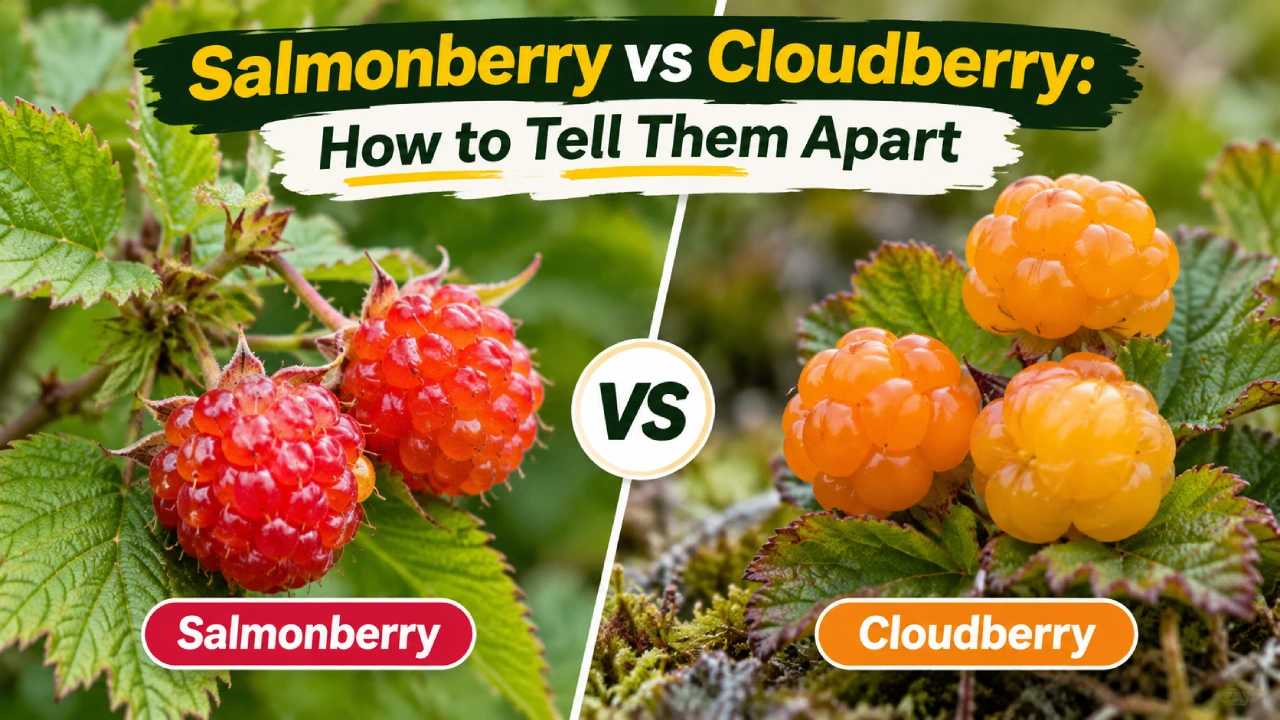
Salmonberries and cloudberries are both wild raspberry relatives with golden-orange fruit, so it is easy to mix them up. They are different plants, though, and they grow in different places, taste different and look different on the bush. Here is how to tell salmonberry and cloudberry apart, with thimbleberry thrown in because it often gets confused with both.
Salmonberry vs Cloudberry at a Glance
| Salmonberry | Cloudberry | |
|---|---|---|
| Scientific name | Rubus spectabilis | Rubus chamaemorus |
| Plant type | Tall, woody shrub with arching canes | Low, creeping plant, usually under a foot tall |
| Fruits per plant | Many berries on a branching shrub | Usually one berry per stem |
| Berry color | Orange to salmon-pink, sometimes red | Hard and red when unripe, soft and amber-gold when ripe |
| Habitat | Moist forests and stream banks of the Pacific coast | Cool, wet bogs and tundra in northern regions |
| Taste | Mild, watery and gently sweet | Tart and rich, often described as honeyed |
How to Tell Them Apart by the Plant
The plant is the easiest clue. Salmonberry grows as a large shrub that can reach well over head height, with thin, thorny canes and leaves split into three leaflets. It forms thickets along streams and in damp woods, and it flowers early in spring with bright pink blooms.
Cloudberry looks nothing like a shrub. It is a low, spreading plant with soft, rounded, crinkled leaves, and it carries a single white flower and later a single berry on each stem. It has no thorns. You will find it in open, boggy ground rather than in forest.
Where Each One Grows
Salmonberry is native to the Pacific side of North America, from Alaska down the coast into California. Cloudberry is a northern species of cold wetlands. In North America it is mostly associated with Alaska and northern Canada, and it also grows across northern Europe. If you are standing in a coastal rainforest, you are almost certainly looking at salmonberry. If you are in an arctic or subarctic bog, it is more likely cloudberry. For more about the range, see our full cloudberry guide and our salmonberry guide.
Taste and Texture
Salmonberries are soft and juicy with a mild flavor. Many people find them fairly plain, and the seeds are noticeable. Cloudberries have a stronger flavor that is both tart and sweet, with a slightly floral, honey-like note, and they are prized in northern cooking for jams, desserts and liqueurs. Our post on what salmonberries taste like goes deeper on flavor and ripeness.
What About Thimbleberry?
Thimbleberry (Rubus parviflorus) is another wild Rubus that causes confusion. It grows as a thornless shrub with large, soft leaves shaped like maple leaves, and its berries are red and so soft that they are shaped like a thimble and fall apart easily. Its color is red rather than orange, which helps separate it from salmonberry. Read the thimbleberry guide for a closer comparison with raspberry.
Quick Identification Tips
- Tall thorny shrub in damp forest: likely salmonberry.
- Low plant with one berry per stem in a bog: likely cloudberry.
- Thornless shrub with big maple-like leaves and red berries: likely thimbleberry.
- Always be certain before eating a wild berry. Use a regional field guide or ask a local expert, and never eat anything you cannot identify with confidence.
Frequently Asked Questions
Are salmonberries and cloudberries the same thing?
No. They are two different species in the same genus as raspberries and blackberries. They differ in plant size, habitat, berry color and flavor.
Which one tastes better?
It is a matter of taste, but cloudberries are generally considered the more flavorful and valuable of the two, while salmonberries are milder and often eaten fresh on the trail.
Can I grow either in a home garden?
Salmonberry is easier to grow in cool, moist climates with partial shade. Cloudberry needs cold, acidic, wet conditions that are hard to recreate, so it is rarely grown outside its native range.
Want to explore more? Browse our guide to the types of wild berries in North America.
2 thoughts on “Salmonberry vs Cloudberry: How to Tell Them Apart”