
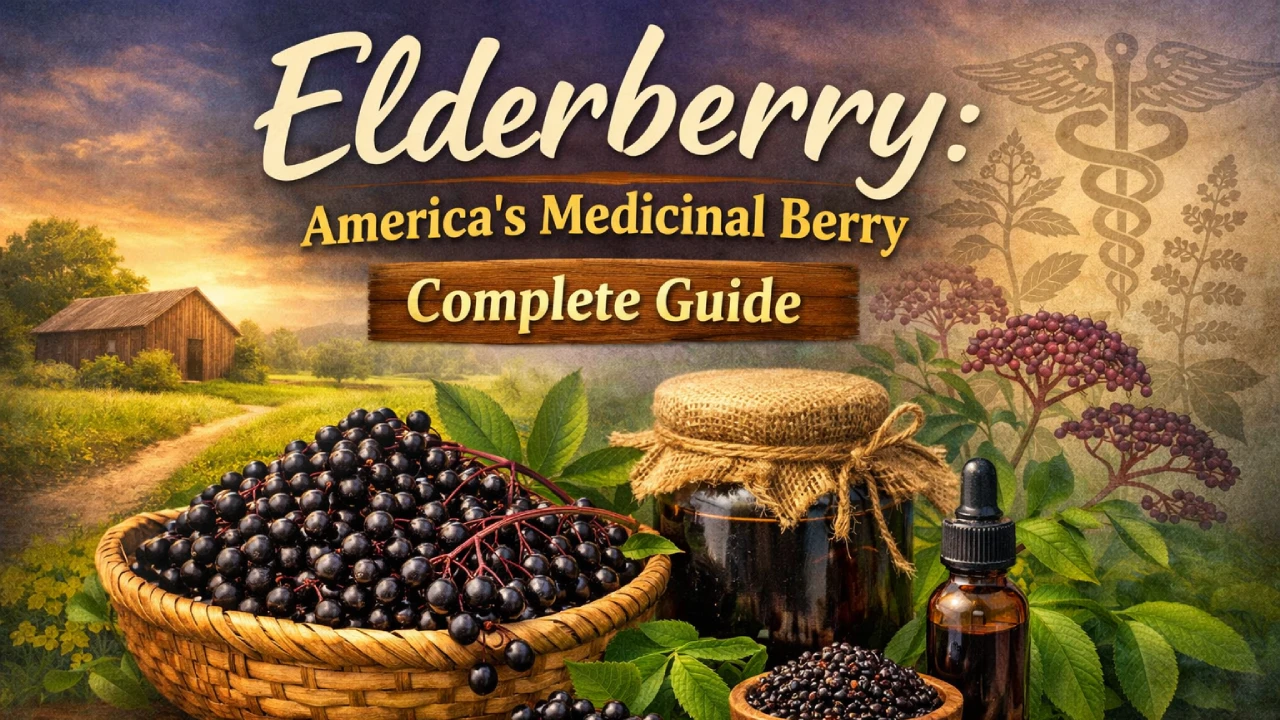
No wild berry in America has a longer or more documented history of medicinal use than the elderberry. Indigenous peoples across the continent used it for centuries. European settlers adopted it immediately upon arrival. Modern clinical trials have confirmed what traditional healers always knew: elderberry genuinely works for colds and flu — and the evidence behind it is stronger than for most herbal supplements on the market today.
This complete guide covers everything about elderberries: the native American species and how to identify them, the critical safety warning about raw berries, full nutritional breakdown, the science behind elderberry’s immune benefits, a detailed homemade syrup recipe, comparison with echinacea, growing and foraging guides, and a comprehensive FAQ. Whether you are making your first batch of elderberry syrup or want to understand the research behind the berry’s health claims — this is your definitive resource.
Important safety notice — read before foraging or preparing elderberries
Raw elderberries, and all other parts of the elderberry plant (seeds, bark, leaves, roots), contain cyanogenic glycosides — compounds that produce cyanide-like toxic effects when eaten raw. Symptoms of elderberry poisoning include nausea, vomiting, and diarrhea. Always cook elderberries before eating or making syrup. Cooking completely neutralizes these compounds. Commercially prepared elderberry products use heat-treated berries and are safe when used as directed.
Botanical Profile: What Is an Elderberry?
Elderberries are the fruit of plants in the genus Sambucus, members of the moschatel family (Adoxaceae). They are deciduous shrubs or small trees producing large, flat-topped flower clusters (called corymbs or cymes) in early summer, which develop into drooping clusters of small, dark-pigmented berries by late summer. The berries are tiny — typically 4–6mm in diameter — but grow in such dense, heavy clusters that a single mature plant can produce several pounds of fruit in a season.
The elder has one of the longest documented histories of human use of any plant in the world. Archaeological evidence of elderberry use dates back to Neolithic Europe. In North America, Indigenous peoples from dozens of nations incorporated elderberries into food, medicine, and ceremonial practices long before European contact. The plant’s utility extends beyond its berries — the flowers are edible and aromatic (used in elderflower cordials and fritters), the leaves have traditional topical medicinal uses, and the pithy stems were historically used to make flutes, blowguns, and fire-making tools.
Genus: Sambucus | Family: Adoxaceae | Native North American species: S. canadensis, S. nigra ssp. cerulea, S. racemosa
Berry size: 4–6mm | Berry color: Deep purple-black (or red in some species) | Season: August–September | USDA Zones: 3–9
Native American Elderberry Species
Three elderberry species are native to North America and commonly encountered by foragers and gardeners. Understanding the differences matters both for safe identification and for understanding which species is most appropriate for medicinal and culinary use.
| Species | Common name | Range | Berry color | Edible? |
|---|---|---|---|---|
| Sambucus canadensis | American elderberry | Eastern North America | Deep purple-black | Yes — when cooked |
| Sambucus nigra ssp. cerulea | Blue elderberry | Western North America | Blue-black with waxy bloom | Yes — when cooked |
| Sambucus racemosa | Red elderberry | Across North America | Bright red | Avoid — much more toxic |
| Sambucus nigra | European elderberry | Naturalized in Northeast US | Deep purple-black | Yes — when cooked; most research |
American elderberry (Sambucus canadensis)
The most widespread native elderberry in the United States, found from Nova Scotia to Florida and west to the Great Plains. American elderberry grows as a multi-stemmed shrub typically reaching 6–12 feet, spreading by suckers to form colonies. It tolerates a wide range of conditions and is one of the most adaptable native shrubs in eastern North America. The berries ripen August through September in large, flat-topped clusters that droop under their own weight when fully ripe. This is the species most commonly foraged and grown for medicinal use in the eastern US.
Blue elderberry (Sambucus nigra ssp. cerulea)
The western North American counterpart to the American elderberry. Blue elderberry grows from British Columbia to California and east to the Rocky Mountains, typically in moist areas along streams and in mountain canyons. Its berries have a distinctive waxy blue-gray bloom similar to a blueberry. Indigenous peoples of the Pacific Northwest and Great Basin used blue elderberry extensively for both food and medicine. It is equally suited for making elderberry syrup and wine as the eastern species.
Red elderberry (Sambucus racemosa) — caution
Red elderberry grows across northern North America, preferring cool, moist mountain environments. Its bright red berries grow in cone-shaped (pyramidal) clusters rather than the flat-topped clusters of American and blue elderberry — a key identification difference. Red elderberries contain higher concentrations of cyanogenic glycosides than the dark-fruited species and have caused poisoning even after cooking in some reports. Avoid red elderberries entirely — the dark-fruited species provide all the same benefits without the risk.
How to Identify Elderberries Safely
Elderberry identification is straightforward once you know the key features, but the plant has one serious look-alike that makes accurate identification critical. Here are the identification features you need to know:
Key identification features of American and blue elderberry
- Berries: Tiny (4–6mm), deep purple-black, growing in large flat-topped umbrella-shaped clusters (corymbs). Each individual berry is round and smooth with a small star-shaped scar at the tip. Clusters can be 6–12 inches across and contain hundreds of berries
- Leaves: Compound pinnate leaves with 5–9 opposite leaflets per leaf. Each leaflet is lance-shaped to oval with finely toothed edges. Leaves have a distinctive unpleasant odor when crushed — one of the most reliable non-visual identification clues
- Stems: Smooth, gray-brown bark with prominent lenticels (small bumps). Pith (inner stem tissue) is soft and white — cut a stem and the pithy center is immediately visible. No thorns or prickles
- Flowers: Flat-topped clusters of tiny, creamy white, five-petaled flowers with a sweet, musty fragrance. Flowers appear June–July, several weeks before berries ripen
- Cluster shape: Always flat-topped or slightly domed — this distinguishes edible dark elderberries from red elderberry, which has cone-shaped clusters
- Plant size and habit: Large, arching shrub 6–12 feet tall, often forming multi-stemmed colonies in moist, open areas near water
The dangerous look-alike: water hemlock
Water hemlock (Cicuta species) is considered the most violently toxic plant in North America. It grows in similar habitats to elderberry — moist areas, stream banks, wetland margins — and can produce white flower clusters that superficially resemble elderflowers to inexperienced observers. Critical differences: water hemlock has simple (not compound) leaves or finely divided leaves very different from elderberry’s pinnate compound leaves; water hemlock flowers are in rounded umbrella-shaped clusters (umbels) rather than elderberry’s flat-topped corymbs; water hemlock stems are hollow with distinctive purple mottling, while elderberry stems are pithy and white inside. If you are ever uncertain between elderberry and any white-flowered plant near water — do not harvest. The risk is not worth taking.
| Feature | Elderberry (safe) | Water hemlock (deadly) |
|---|---|---|
| Leaves | Pinnate compound — distinct separate leaflets | Simple or finely divided, very different texture |
| Stem interior | White pithy center (cut and check) | Hollow chambers with purple mottling |
| Flower cluster shape | Flat-topped corymb | Rounded umbrella (umbel) |
| Leaf smell when crushed | Unpleasant, slightly musky | Carrot-like or parsley-like |
| Berry color at ripeness | Deep purple-black clusters | Does not produce dark berry clusters |
Raw Elderberry Safety: The Full Story
The safety question around elderberries is one of the most important and most misunderstood aspects of this plant. Here is a complete, accurate explanation of the risk and how to eliminate it.
What makes raw elderberries potentially harmful
Raw elderberries — particularly the seeds — contain sambunigrin and other cyanogenic glycosides. These compounds are metabolized in the body to produce hydrogen cyanide. In the quantities present in raw elderberries, the effect is not life-threatening in most cases for adults, but can cause significant gastrointestinal distress: nausea, vomiting, abdominal cramping, and diarrhea. Children are more vulnerable to these effects due to their smaller body weight.
The CDC has documented cases of elderberry poisoning from improperly prepared juice. A notable 1984 case in California involved 25 people sickened after drinking fresh-pressed elderberry juice from wild berries. All recovered, but the incident illustrates that raw elderberry juice is not safe to drink.
How cooking solves the problem completely
Heat breaks down cyanogenic glycosides rapidly and completely. Simmering elderberries for 15 minutes is sufficient to neutralize the toxic compounds — the 45-minute simmer used in traditional syrup recipes provides a very generous safety margin. Commercially prepared elderberry products are always heat-processed. The bottom line: properly cooked elderberries and commercially prepared elderberry products are safe for most people.
What to avoid entirely
- Raw elderberries eaten directly from the plant
- Fresh-pressed raw elderberry juice
- All parts of the plant other than flowers and ripe berries: leaves, bark, roots, and stems contain higher concentrations of toxic compounds
- Red elderberry (Sambucus racemosa) in any preparation — higher toxicity, not worth the risk
- Elderberry supplements for pregnant or breastfeeding women — insufficient safety data
- Elderberry supplements for people taking immunosuppressant medications — potential interaction (see below)
The autoimmune consideration
Elderberry’s primary mechanism of action is stimulating immune system activity. For people with autoimmune conditions — including lupus, rheumatoid arthritis, multiple sclerosis, and others — and for people taking immunosuppressant medications after organ transplants, stimulating the immune system could theoretically worsen symptoms or interfere with treatment. People in these categories should consult their physician before using elderberry supplements. This is not a commonly reported problem in the research literature, but it is a theoretically sound caution worth discussing with a healthcare provider.
Elderberry Nutrition Facts
Elderberries are nutritionally dense, particularly for such small fruits. The following data is sourced from the USDA FoodData Central database for raw elderberries (noting that cooked elderberries have similar nutritional profiles with slightly reduced vitamin C):
| Nutrient | Per 1 cup (145g) | % Daily Value |
|---|---|---|
| Calories | 106 kcal | — |
| Carbohydrates | 26.7g | 10% |
| Dietary fiber | 10.2g | 36% |
| Sugars | 11.5g | — |
| Protein | 1.0g | 2% |
| Vitamin C | 52.2mg | 58% |
| Vitamin B6 | 0.33mg | 20% |
| Iron | 2.32mg | 13% |
| Potassium | 406mg | 9% |
| Folate | 8.7mcg | 2% |
| Calcium | 55.1mg | 4% |
| Phosphorus | 57.1mg | 5% |
Two nutritional highlights stand out. First, 10.2g of dietary fiber per cup — higher than any other berry in this guide, placing elderberries among the highest-fiber fruits available. Second, elderberries are one of the richest food sources of anthocyanins — the pigments responsible for their deep purple-black color. Research has measured elderberry anthocyanin concentrations among the highest of any commonly consumed berry, with cyanidin-3-glucoside and cyanidin-3-sambubioside as the primary active compounds driving both color and health effects.
6 Proven Health Benefits of Elderberries
1. Clinically proven reduction in cold and flu duration
This is the benefit that has made elderberry one of the most popular herbal supplements in the United States, and the clinical evidence is genuinely impressive. A 2016 randomized, double-blind, placebo-controlled trial published in Nutrients found that air travelers taking elderberry extract experienced colds that were on average 2 days shorter and significantly less severe than those in the placebo group. A landmark 2004 study in the Journal of International Medical Research found that elderberry extract reduced influenza duration by 4 days compared to placebo in a randomized controlled trial. A 2019 meta-analysis published in Complementary Therapies in Medicine pooled results from multiple elderberry studies and concluded that elderberry supplementation substantially reduces upper respiratory symptoms. This level of evidence — multiple randomized controlled trials and a confirming meta-analysis — places elderberry among the best-evidenced herbal supplements available.
2. Antiviral activity — how elderberry fights viruses
Elderberry’s antiviral mechanism has been studied at the molecular level. Research published in the Phytochemistry journal found that elderberry flavonoids bind directly to human influenza virions, preventing them from attaching to and entering host cells. This is a fundamentally different mechanism from vaccines (which prepare the immune system in advance) or antivirals like Tamiflu (which inhibit viral replication after infection). Elderberry’s flavonoids appear to physically block the first step of infection. Laboratory research has shown activity against multiple influenza strains, herpes simplex virus, and HIV, though human clinical trials on non-influenza viruses are limited.
3. Exceptional antioxidant content
Elderberries contain some of the highest anthocyanin concentrations of any commonly consumed fruit — comparable to blackcurrants and significantly higher than blueberries on a per-gram basis. These anthocyanins are among the most potent naturally occurring antioxidants known, with the ability to neutralize free radicals, reduce systemic inflammation, and protect cells from oxidative damage. The ORAC value of elderberry extract consistently ranks among the highest of any tested food or supplement. Beyond anthocyanins, elderberries contain quercetin, rutin, kaempferol, and chlorogenic acid — a diverse antioxidant matrix that provides broad-spectrum oxidative protection.
4. Cardiovascular protection
The anthocyanins and quercetin in elderberries have demonstrated cardiovascular benefits through multiple mechanisms. Quercetin — present in particularly high concentrations in elderberries — inhibits LDL oxidation, reduces platelet aggregation (lowering clotting risk), and relaxes blood vessel walls to improve blood flow. Research published in the American Journal of Clinical Nutrition found that higher dietary flavonoid intake (including from elderberry-type sources) was associated with significantly reduced rates of cardiovascular mortality. The elderberry’s high potassium content (406mg per cup) further supports healthy blood pressure.
5. Anti-inflammatory effects
Chronic inflammation underlies virtually all major chronic diseases — cardiovascular disease, type 2 diabetes, Alzheimer’s disease, and many cancers. Elderberry polyphenols have demonstrated significant anti-inflammatory activity in research, including inhibition of cyclooxygenase enzymes (the same mechanism targeted by anti-inflammatory drugs like aspirin and ibuprofen) and suppression of pro-inflammatory cytokines. This anti-inflammatory effect complements elderberry’s immune-stimulating properties — it helps calibrate and balance immune responses rather than simply stimulating them indiscriminately.
6. Gut health — outstanding fiber content
At 10.2g of dietary fiber per cup, elderberries have the highest fiber content of any berry in this guide — surpassing even raspberries and blackberries. This remarkable fiber content supports a healthy gut microbiome, promotes regular bowel movements, slows glucose absorption, and contributes to sustained satiety. The elderberry’s anthocyanins also have demonstrated prebiotic effects in research, selectively promoting the growth of beneficial gut bacteria including Lactobacillus and Bifidobacterium species, according to research published in the International Journal of Molecular Sciences.
Elderberry vs Echinacea: Which Is Better for Immune Support?
Elderberry and echinacea are the two most popular herbal immune supplements in the United States, and they are frequently compared. Here is an honest assessment of the evidence for each:
| Factor | Elderberry | Echinacea |
|---|---|---|
| Clinical evidence | Multiple RCTs, confirming meta-analysis — strong | Mixed results across trials — inconsistent |
| Mechanism of action | Direct antiviral (blocks viral entry) + immune stimulation | Immune stimulation only |
| Effect on flu duration | Reduced by ~4 days in RCT | Modest reduction in some studies; not confirmed in others |
| Safety for autoimmune patients | Caution advised — consult physician | Contraindicated for autoimmune conditions |
| Additional nutrition benefits | High — fiber, vitamin C, anthocyanins | Minimal — not a food source |
| Safe for children over 1? | Yes (cooked/commercial products) | Generally yes, though less studied |
| Best use case | Active cold or flu — reduces duration | Prevention — general immune stimulation |
Verdict: Elderberry has stronger and more consistent clinical evidence for reducing the duration and severity of active colds and flu. Echinacea has a longer tradition of use for prevention but more mixed clinical evidence. Many practitioners recommend elderberry when sick and echinacea for general immune maintenance — using them for different purposes rather than treating them as interchangeable alternatives. Neither replaces vaccination for influenza prevention.
Homemade Elderberry Syrup Recipe
Making elderberry syrup at home is straightforward, produces a superior product compared to most commercial syrups, and costs significantly less per serving. This is the classic recipe — time-tested, safe, and effective.
Ingredients
- 1 cup dried elderberries or 2 cups fresh/frozen elderberries
- 3 cups filtered water
- 1 cinnamon stick
- 5 whole cloves
- 1 tablespoon fresh grated ginger (or 1 teaspoon dried)
- 1 cup raw honey (added after cooling — never boil honey)
Method
- Combine elderberries, water, cinnamon stick, cloves, and ginger in a medium saucepan.
- Bring to a boil over medium-high heat, stirring occasionally.
- Reduce heat to low and simmer uncovered for 45 minutes, until liquid has reduced by approximately half. This cook time is important — it fully neutralizes cyanogenic glycosides.
- Remove from heat. Allow to cool to room temperature — below 104°F (40°C). This is critical: adding honey to hot liquid destroys its beneficial enzymes and antimicrobial compounds.
- Mash the softened berries with the back of a spoon, then pour through a fine mesh sieve into a clean bowl. Press firmly on the solids to extract all juice. Discard the solids.
- Add the raw honey to the cooled elderberry liquid. Stir until completely dissolved.
- Pour into a clean glass jar with a tight-fitting lid. Label with the date.
- Refrigerate immediately. Keeps for 2–3 months refrigerated.
Yield: Approximately 2 cups (32 tablespoon-sized servings) | Typical dosage: 1 tablespoon daily for maintenance; 1 tablespoon every 3–4 hours during illness (adults) | Children (over 1 year): 1 teaspoon daily
Why raw honey matters
Raw honey is not merely a sweetener in this recipe — it is an active ingredient. Raw honey contains hydrogen peroxide-producing enzymes, bee defensin-1 antimicrobial peptides, and a broad spectrum of polyphenols that have independently demonstrated antiviral and antibacterial activity. Pasteurized commercial honey has had these heat-sensitive compounds destroyed. For medicinal purposes, use raw honey specifically. Adding it only after cooling preserves its full biological activity.
Where to buy elderberries
Dried elderberries are widely available from health food stores and online retailers. Look specifically for Sambucus nigra (European elderberry) or Sambucus canadensis (American elderberry) dried berries — these are the species with clinical research backing. Avoid elderberries sold without species identification. Organic dried elderberries from reputable suppliers are preferable for a product you will be taking medicinally.
Elderberry Products: Syrup, Gummies, Capsules, and Tea
For those who prefer not to make their own syrup, the commercial elderberry market offers a wide range of options. Here is how they compare:
| Product type | Pros | Cons | Best for |
|---|---|---|---|
| Homemade syrup | Highest quality; raw honey included; cost-effective | Requires preparation time; 2–3 month shelf life | Best overall for adults and children over 1 |
| Commercial syrup | Convenient; longer shelf life; standardized dosage | More expensive per serving; often contains added sugar | Convenience and travel; gifts |
| Gummies | Easy to take; popular with children | Higher sugar; lower elderberry content per serving | Children; people who dislike liquids |
| Capsules / extract | Standardized potency; no sugar; travel-friendly | No honey benefit; more clinical feel | Adults seeking standardized dosage |
| Tea | Soothing; combines well with other herbs | Lowest elderberry concentration; weakest evidence base | Comfort drink during illness; general wellness |
Foraging Guide for Wild Elderberries
Wild elderberries are abundant across most of the United States and are among the most generous foraging plants once you learn to find them. Here is a complete field guide for harvesting wild elderberries safely and efficiently.
When to forage
American elderberry (Sambucus canadensis) ripens August through September across most of its range, with timing varying by latitude and elevation. Look for the dramatic transformation from green to deep purple-black clusters. A useful early indicator: the plant begins to droop under the weight of the ripening fruit clusters several days before full ripeness, making mature plants visible from a distance.
How to tell ripe from unripe: Fully ripe clusters are entirely deep purple-black with no red or green berries remaining. Individual berries should be slightly soft and juicy when gently pressed. Clusters with a mix of colors are not yet fully ripe — wait until the entire cluster is uniform dark purple. Taste a single berry before harvesting in bulk — ripe elderberries have a rich, tart, slightly earthy flavor. Unripe ones are sharply astringent.
Where to find wild elderberries
- Stream banks and river corridors — elderberries love moisture
- Edges of wetlands, marshes, and ponds
- Forest edges and clearings where some sun reaches the understory
- Roadsides and disturbed areas in rural regions
- Old fence lines in agricultural areas of the Midwest and Mid-Atlantic
Harvesting technique
Harvest entire clusters using scissors or pruning shears — cutting the cluster stem rather than picking individual berries is far more efficient. Place whole clusters in a wide container. At home, strip individual berries from clusters using a fork — run the tines through the cluster and the berries fall free quickly while stems are retained. Never eat the stems. Rinse berries in cold water and cook immediately, or freeze raw for later use (raw frozen berries are fine to store; they must be cooked before eating).
How to Grow Elderberries at Home
American elderberry is one of the easiest native shrubs to establish, and a single mature plant can produce an extraordinary amount of fruit — easily enough for several batches of syrup annually, with plenty left for wildlife.
| Requirement | Ideal conditions | Notes |
|---|---|---|
| USDA Zones | 3–9 | Extremely adaptable; tolerates Zone 3 winters |
| Soil | Moist, rich, slightly acidic to neutral | pH 5.5–6.5; tolerates clay and wet conditions |
| Sunlight | Full sun to partial shade | More sun = more fruit; tolerates half-day shade |
| Water | Regular moisture | Tolerates periodic flooding; not drought-tolerant |
| Pollination | Plant 2+ varieties | Cross-pollination dramatically increases yield |
| Mature size | 6–12 feet tall; spreads by suckers | Control spread by removing suckers annually |
| Years to first harvest | 2–3 years from planting | Yields increase dramatically in years 3–5 |
| Wildlife value | Exceptional | Supports 50+ bird species; important pollinator plant |
Recommended cultivated varieties for home gardens: Bob Gordon and Nova are top-rated American elderberry cultivars for syrup production, selected for exceptionally high anthocyanin content and large clusters. Adams and Bob Gordon are a recommended pair for cross-pollination. All are available from specialty native plant nurseries and increasingly from mainstream garden centers. The University of Minnesota Extension provides an excellent regional growing guide for elderberries in cold climates.
More Elderberry Recipes
Elderberry gummies (homemade)
A great way to make elderberry syrup accessible for children and anyone who prefers a solid form. Warm 1 cup of prepared elderberry syrup gently (do not boil). Whisk in 2 tablespoons of unflavored gelatin powder until completely dissolved. Pour into silicone molds and refrigerate for 2 hours until set. Pop out and store in the refrigerator in an airtight container for up to 2 weeks. Each gummy delivers the same benefits as a small serving of syrup in a fun, portable form.
Elderberry tea
Simmer 1 tablespoon of dried elderberries with 1 cup of water for 15 minutes. Strain and add raw honey and a squeeze of lemon. This is a comfort-drink version of elderberry that pairs naturally with ginger, cinnamon, and chamomile for a warming cold-season tea. The 15-minute simmer is the minimum cook time to ensure the cyanogenic glycosides are fully neutralized.
Elderberry vinaigrette
Blend 2 tablespoons of elderberry syrup with 2 tablespoons of apple cider vinegar, 3 tablespoons of olive oil, 1 teaspoon of Dijon mustard, and salt and pepper to taste. This deep purple dressing is extraordinary over bitter greens — arugula, radicchio, or endive — with goat cheese and walnuts. It transforms a simple salad into something with the depth of a restaurant dish.
Elderflower cordial (spring recipe)
In late spring before the berries form, the white flower clusters can be used to make elderflower cordial — one of the most fragrant and elegant non-alcoholic drinks in the world. Bring 4 cups of water and 4 cups of sugar to a boil. Add 20 elderflower heads (inspected and shaken gently to remove insects), the zest of 2 lemons, and the juice of 1 lemon. Steep off heat for 24 hours. Strain and bottle. Dilute 1:5 with sparkling water and serve over ice. This uses the flowers rather than berries, so the toxicity concern does not apply — elder flowers are safe without cooking.
Frequently Asked Questions About Elderberries
Are elderberries poisonous raw?
Yes — raw elderberries contain cyanogenic glycosides that can cause nausea, vomiting, and diarrhea. Cooking for at least 15 minutes (the syrup recipe uses 45 minutes for extra safety) completely neutralizes these compounds. All parts of the plant other than ripe cooked berries and flowers should be avoided entirely. Red elderberry (Sambucus racemosa) should also be avoided even when cooked.
Does elderberry actually work for colds and flu?
Yes — multiple randomized controlled trials and a 2019 meta-analysis support elderberry’s effectiveness for reducing the duration and severity of colds and flu. A 2004 study found elderberry reduced flu duration by 4 days; a 2016 study found it reduced cold duration by 2 days in travelers. The evidence is stronger than for most herbal supplements. It does not replace vaccination for flu prevention.
Is elderberry safe for children?
Cooked elderberry products are generally safe for children over 1 year. Children under 1 should not consume honey-based elderberry syrup due to infant botulism risk from honey. Never give raw elderberries to children. Consult your pediatrician before giving elderberry supplements to young children, particularly those with autoimmune conditions or taking medication.
What is the difference between American elderberry and European elderberry?
American elderberry (Sambucus canadensis) is native to eastern North America and grows as a large shrub up to 12 feet. European elderberry (Sambucus nigra) is native to Europe and grows as a small tree up to 30 feet. Both produce medicinal and culinary berries with similar properties. Most clinical research uses European elderberry extract, but American elderberry has very similar anthocyanin content and health properties.
How do you make elderberry syrup at home?
Simmer 1 cup of dried elderberries with 3 cups of water, a cinnamon stick, 5 cloves, and 1 tablespoon of ginger for 45 minutes until reduced by half. Cool to room temperature, strain, then add 1 cup of raw honey (never boil honey — add only after cooling). Refrigerate in a glass jar for up to 3 months. See the full recipe with detailed instructions in the recipe section above.
Can you take elderberry every day?
Yes — daily use of elderberry syrup or commercially prepared elderberry products is considered safe for most healthy adults and children over 1 year. The typical maintenance dose is 1 tablespoon of syrup daily. During illness, most practitioners recommend increasing to 1 tablespoon every 3–4 hours for adults. People with autoimmune conditions or taking immunosuppressant medications should consult their physician before daily elderberry use.
When are wild elderberries ripe?
American elderberries ripen August through September across most of the eastern US. Blue elderberries in the West ripen August through October. The entire cluster must be uniformly deep purple-black before harvesting — clusters with any remaining red or green berries are not ready. The plant droops visibly under the weight of ripe clusters, which is a useful distance indicator when searching patches.
Is elderberry better than vitamin C for immune support?
They work differently and are best used together rather than as alternatives. Vitamin C supports the baseline function of the immune system year-round. Elderberry has specific antiviral activity — particularly blocking virus entry into cells — that is most useful when actively fighting a cold or flu. Elderberry syrup also contains significant vitamin C alongside its other active compounds, meaning it delivers both benefits simultaneously. See our guide on how many berries to eat daily for vitamin C targets across berry types.
Conclusion: The Most Evidence-Backed Medicinal Berry in America
Of all the berries covered on Berry Nation USA, the elderberry stands alone in having clinical trial evidence — not just traditional use or laboratory research — for a specific, measurable health benefit. The randomized controlled trials showing 2–4 day reductions in cold and flu duration are not anecdote or folk medicine. They are the same standard of evidence used to evaluate pharmaceutical drugs.
The elderberry’s story spans from Indigenous American medicine to 18th-century European herbalism to 21st-century randomized trials, and the conclusion at every stop on that journey has been the same: this small, dark berry has genuine medicinal power. Learn to identify it in the wild, grow it in your yard, or make the syrup from dried berries — the investment is small and the benefits are well-supported by the science.
The one non-negotiable: always cook the berries first. Everything else is straightforward.
More from Berry Nation USA
- Blueberry Complete Guide: America’s Native Superfruit
- Wild Blackberries of America: Complete ID & Foraging Guide
- Raspberry Complete Guide: Native American Berry & Benefits
- Cranberry: More Than a Holiday Staple
- Buffaloberry: America’s Most Underrated Native Superfruit
- Strawberry in America: History, Varieties & Health Benefits
- How Many Berries Should I Eat a Day?
Written by Kirna — Berry Nation USA
Berry Nation USA is America’s dedicated resource for wild, native, and cultivated berries across all 50 states. Learn more about us.