
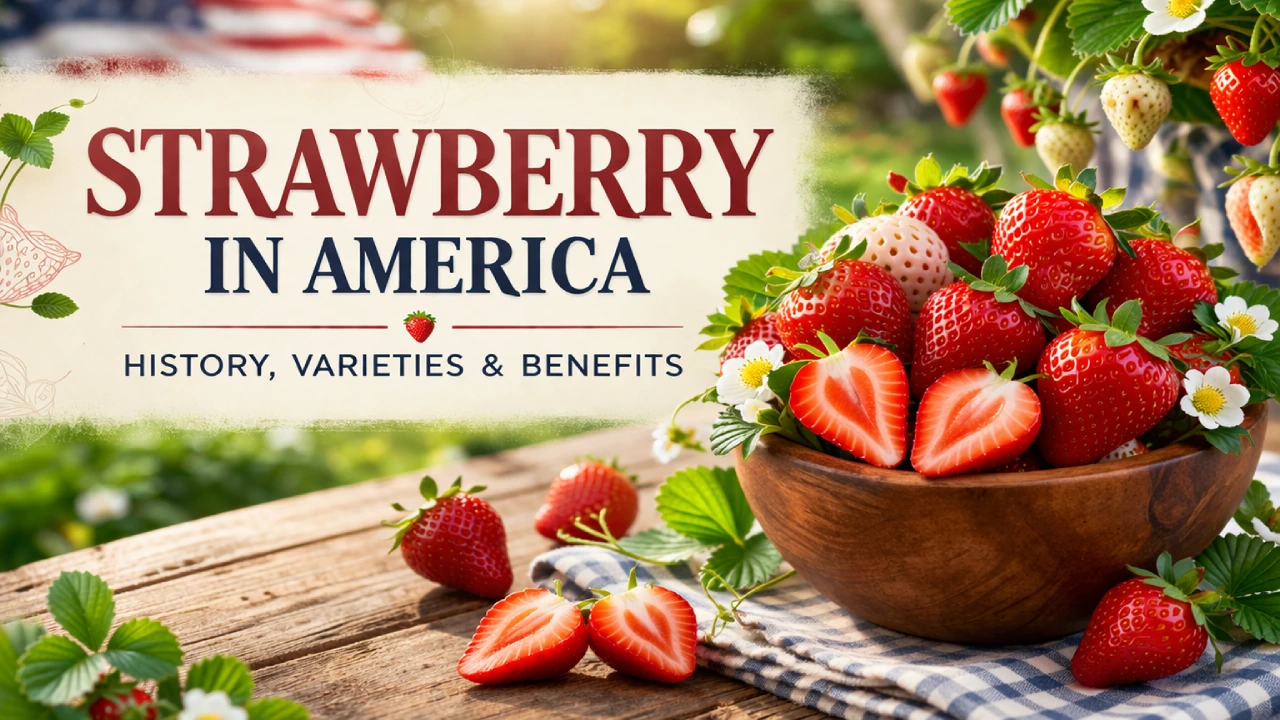
America loves the strawberry more than any other berry — and with good reason. It is the most consumed fresh fruit in the United States, the subject of centuries of cultivation, and one of only a handful of fruits with deep roots in both Indigenous North American food traditions and modern agricultural science. But the story of the strawberry in America is far richer than most people realize.
This complete guide covers the full history of the strawberry in America — from the native wild species that Indigenous peoples harvested for thousands of years to the modern cultivated varieties grown across California, Florida, and Oregon. You will find a full nutritional breakdown, six science-backed health benefits, a guide to wild strawberry identification, growing tips for home gardeners, seasonal information by state, and five recipes. Whether you are a grower, a forager, a health enthusiast, or simply someone who eats strawberries by the carton — this is your definitive resource.
Botanical Profile: Is a Strawberry Actually a Berry?
Here is a fact that surprises almost everyone: botanically speaking, strawberries are not true berries. A botanical berry is defined as a fleshy fruit that develops from a single flower with one ovary — which is why blueberries, cranberries, and even bananas qualify as true berries. Strawberries do not.
A strawberry is technically an accessory fruit or aggregate fruit. The red, fleshy part we eat is the enlarged receptacle — the base of the flower. The tiny yellow seed-like dots covering the outside surface are the actual fruits of the plant, each technically called an achene. Each achene contains one true seed.
This makes the strawberry botanically unique — one of the few fruits where what we consider the “fruit” is actually a swollen flower base, and the true fruits are the dots on the outside. Despite this botanical technicality, strawberries are universally grouped with berries in culinary and nutritional contexts — and for the purposes of this guide, they absolutely belong in the Berry Nation USA family.
Native species: Fragaria virginiana (wild), Fragaria chiloensis (beach) | Cultivated: Fragaria × ananassa
Family: Rosaceae | Type: Accessory fruit (not a true botanical berry)
Season: Year-round commercially; peak May–July | Top producing state: California (88% of US crop)
The History of Strawberries in America
The strawberry’s story in America is one of the most fascinating in food history — a native American fruit that traveled to Europe, was hybridized, and then returned to North America in its transformed cultivated form to become the country’s most popular berry.
Indigenous origins
Long before European contact, Indigenous peoples across North America gathered and ate wild strawberries (Fragaria virginiana) in spring and early summer. From the Haudenosaunee (Iroquois) in the Northeast to the Cherokee in the Southeast and the Plains tribes of the Midwest, wild strawberries were celebrated as one of the first fruits of the season after winter. The Haudenosaunee held a formal Strawberry Thanksgiving ceremony each year to celebrate the first strawberries, a tradition that continues in some communities today.
Indigenous peoples also used strawberries medicinally — for digestive ailments, as a breath freshener, and the leaves for making teas. Wild strawberry leaves contain tannins and have astringent properties that traditional healers used for various purposes.
The transatlantic exchange that created the modern strawberry
In the early 1700s, a French military engineer named Amédée-François Frézier brought back plants of the Pacific coast strawberry (Fragaria chiloensis) from Chile to France. This large-fruited Pacific species, planted near the smaller Virginia wild strawberry (Fragaria virginiana) that had already been brought to Europe, accidentally cross-pollinated. The result was the modern cultivated strawberry, Fragaria × ananassa — larger, sweeter, and more productive than either parent.
This hybrid — created in France from two American species — was then brought back to North America by European settlers and has since become the basis for all modern commercial strawberry production. The modern cultivated strawberry is, in a very real sense, an American invention that took a European detour before coming home.
California’s strawberry revolution
Commercial strawberry cultivation in California began in earnest in the late 1800s and accelerated dramatically through the 20th century. The development of new disease-resistant, high-yielding varieties and the extension of the growing season through careful variety selection and plastic mulching transformed California into the strawberry capital of the world. Today California produces more strawberries than most countries.
Wild Strawberry vs Cultivated Strawberry
The gap between wild and cultivated strawberries is larger than with almost any other berry. Wild strawberries are tiny — often no bigger than a fingernail — but their flavor is extraordinary: intensely sweet, complex, and fragrant in a way that large cultivated berries rarely match. Here is a full comparison:
| Feature | Wild strawberry (F. virginiana) | Cultivated strawberry (F. × ananassa) |
|---|---|---|
| Size | Very small (1–2cm) | Large (4–7cm) |
| Flavor | Intensely sweet, aromatic, complex | Milder, sweet, less fragrant |
| Antioxidants | Higher concentration (smaller berry) | Lower concentration per gram |
| Where found | Meadows, forest edges, roadsides | Grocery stores, farms, gardens |
| Season | May–June (brief and weather-dependent) | Year-round commercially |
| Shelf life | 1–2 days (very delicate) | 5–7 days refrigerated |
| Best used for | Fresh eating, immediate use | All purposes — fresh, baking, jam |
| Native to | All of North America | Hybrid (bred in Europe from American parents) |
If you ever encounter wild strawberries while hiking — identifiable by their tiny size, trifoliate leaves, and white flowers with five petals — eat them immediately. The flavor is one of the most rewarding surprises in North American foraging, and the berries are too delicate to carry home.
Types of Strawberries Grown in the USA
Commercial strawberry production in the United States relies on a relatively small number of high-performing varieties selected for yield, disease resistance, shelf life, and appearance. Home gardeners have more flexibility and can choose varieties optimized for flavor. Here are the most important types:
| Variety | Type | Best regions | Known for |
|---|---|---|---|
| Camarosa | June-bearing | California | High yield, firm, commercial standard |
| Chandler | June-bearing | California, Southeast | Excellent flavor, large size |
| Sweet Charlie | June-bearing | Florida, Southeast | Outstanding sweetness, early season |
| Albion | Day-neutral | California, Pacific NW | Excellent flavor, long season |
| Seascape | Day-neutral | California coast, Pacific NW | Good flavor, tolerates cool summers |
| Earliglow | June-bearing | Northeast, Midwest | Best flavor of any home garden variety |
| Honeoye | June-bearing | Northeast, Great Lakes | Very productive, cold-hardy |
| Ozark Beauty | Everbearing | Nationwide | Two crops per year, good flavor |
| Alpine / Fraises des Bois | Everbearing | Nationwide (garden) | Wild-like intense flavor, no runners |
Which type should you grow? For the best flavor in a home garden in the Northeast or Midwest, Earliglow is consistently rated the top choice by horticulturalists at University of Minnesota Extension. For a long season with two harvests, an everbearing variety like Ozark Beauty gives maximum yield for minimum space. For the closest experience to a wild strawberry, Alpine varieties (also called Fraises des Bois) produce tiny, intensely flavored berries all season long with no runners to manage.
Where Are Strawberries Grown in America?
The United States is the world’s second largest strawberry producer, behind China, and the largest producer of premium fresh-market strawberries. Production is heavily concentrated in two states, with meaningful growing happening across many others:
- California (88% of US production): The undisputed strawberry capital of the country. The Watsonville-Salinas coastal area in central California and the Oxnard Plain in Ventura County are the two main production regions. California’s mild, fog-cooled coastal climate allows for an exceptionally long growing season — sometimes year-round production in the warmest years. According to the USDA NASS, California produces over 2 billion pounds of strawberries annually.
- Florida (second largest): Florida’s Plant City area near Tampa is the winter strawberry capital of the US, producing the majority of fresh strawberries consumed November through April when California supplies are lower. The annual Florida Strawberry Festival in Plant City is one of the largest in the country.
- Oregon and Washington: The Pacific Northwest produces high-quality strawberries, particularly valued for processing into jams, juices, and frozen products. The Hood strawberry, an Oregon heirloom variety, is renowned for its exceptional flavor and is a favorite at farm stands despite being too delicate for commercial shipping.
- Northeast and Midwest: New York, Michigan, Pennsylvania, and Ohio all have significant strawberry production, primarily serving local fresh markets and u-pick farms. The season is short — typically 3–4 weeks in June — but intensely popular.
Strawberry Nutrition Facts
Strawberries punch well above their weight nutritionally. One cup of sliced strawberries (152g) is one of the most vitamin-C-dense foods you can eat — surpassing an orange — while remaining very low in calories and sugar. The following data comes from the USDA FoodData Central database:
| Nutrient | Per 1 cup sliced (152g) | % Daily Value |
|---|---|---|
| Calories | 49 kcal | — |
| Carbohydrates | 11.7g | 4% |
| Dietary fiber | 3.0g | 11% |
| Sugars | 7.4g | — |
| Protein | 1.0g | 2% |
| Vitamin C | 97.6mg | 108% |
| Folate (B9) | 35.9mcg | 9% |
| Manganese | 0.56mg | 24% |
| Potassium | 220mg | 5% |
| Vitamin K | 3.7mcg | 3% |
| Magnesium | 19.8mg | 5% |
| Phosphorus | 35.5mg | 3% |
The headline number is 108% of daily vitamin C in a single cup at just 49 calories — making strawberries one of the most vitamin-C-efficient foods on Earth, surpassing oranges (which deliver roughly 88% of daily vitamin C per cup at 85 calories). Strawberries also contain a broad spectrum of polyphenol antioxidants including anthocyanins, ellagic acid, quercetin, kaempferol, and fisetin — each contributing to the berry’s impressive health profile in distinct ways.
6 Health Benefits of Strawberries
1. Exceptional vitamin C and immune support
One cup of strawberries provides over 100% of your daily vitamin C requirement — making them one of the most convenient immune-supporting foods available. Vitamin C is essential for the production and function of white blood cells, the maintenance of the skin’s barrier against pathogens, collagen synthesis for wound healing, and the absorption of non-heme iron from plant foods. Unlike vitamin C supplements, the vitamin C in whole strawberries comes packaged with co-factors — flavonoids and other polyphenols — that enhance its bioavailability and antioxidant effect. Research published in the Nutrients journal confirms that whole-food sources of vitamin C have superior biological effects compared to isolated ascorbic acid supplements.
2. Heart health — cholesterol, blood pressure, and arterial function
Strawberries are among the most extensively studied fruits for cardiovascular health. The anthocyanins in strawberries — particularly pelargonidin, the pigment responsible for their red color — have been shown to reduce LDL cholesterol oxidation, improve arterial elasticity, and lower blood pressure. Landmark research from the Harvard School of Public Health tracking over 93,000 women found that those eating three or more servings of strawberries and blueberries per week had a 32% lower risk of heart attack compared to those eating berries once a month or less. This effect was attributed specifically to anthocyanin intake and was independent of other dietary and lifestyle factors.
3. Blood sugar regulation — low glycemic, high fiber
Despite their sweet taste, strawberries have a low glycemic index of approximately 41 — meaning they cause a slow, gradual rise in blood sugar rather than a spike. The 3g of fiber per cup helps slow glucose absorption further. Research published in the British Journal of Nutrition found that consuming strawberries with a high-carbohydrate meal reduced the postprandial (after-meal) glucose and insulin response compared to the meal alone. This makes strawberries an excellent choice for people managing blood sugar, pre-diabetes, or type 2 diabetes — one of the sweetest fruits they can eat with the least glycemic impact.
4. Cancer-preventive compounds — ellagic acid and fisetin
Strawberries are one of the richest dietary sources of ellagic acid and fisetin — two polyphenol compounds that have attracted significant interest in cancer prevention research. Ellagic acid has demonstrated the ability to inhibit cancer cell proliferation and induce apoptosis (programmed cell death) in laboratory studies across multiple cancer types. Fisetin, a flavonol found in particularly high concentrations in strawberries compared to any other common food, has shown promise in research on brain health and as a senolytic (a compound that clears damaged “zombie” cells linked to aging and cancer). A review in the Journal of Agricultural and Food Chemistry summarized the evidence for strawberry polyphenols in cancer prevention as promising, though clinical trials in humans are ongoing.
5. Brain health and cognitive protection
Emerging research suggests strawberries may be among the most brain-protective foods available, largely due to their fisetin content. A study published in Aging Cell found that fisetin reduced markers of aging-related inflammation in the brain and improved memory in animal models. Broader research on berry anthocyanins — including those in strawberries — has consistently shown associations with slower cognitive decline in older adults. The Nurses’ Health Study, tracking over 16,000 women, found that those with the highest strawberry and blueberry intake showed cognitive aging rates equivalent to being 2.5 years younger than those with the lowest intake.
6. Skin health — vitamin C and collagen synthesis
Vitamin C is the essential cofactor for collagen synthesis — the process by which the body builds and maintains the structural protein that gives skin its firmness, elasticity, and youthful appearance. Strawberries provide over 100% of daily vitamin C per cup, making them one of the most effective dietary supports for skin health. Ellagic acid in strawberries has also shown UV-protective properties in research, potentially helping prevent collagen breakdown caused by sun exposure. The combination of high vitamin C, ellagic acid, and anthocyanins makes strawberries a genuinely evidence-based skin health food.
Identifying Wild Strawberries
Wild strawberries (Fragaria virginiana) grow across virtually all of North America east of the Rockies, and the Pacific strawberry (Fragaria chiloensis) grows along the West Coast. They are one of the safest and most beginner-friendly plants to forage, with no dangerous look-alikes that share all identification features. Here is how to identify them with confidence:
Key identification features
- Leaves: Three leaflets (trifoliate) with sharply toothed edges, held on a long petiole. The terminal tooth on each leaflet is typically shorter than the two adjacent teeth — a useful detail that distinguishes wild strawberry from some look-alikes.
- Flowers: Five white petals arranged symmetrically around a yellow center. Flowers appear before or with the early leaves in April–May. The five-petal white flower on a low-growing plant with trifoliate leaves is the most reliable identification signal.
- Fruit: Small (1–2cm), red, and unmistakably strawberry-shaped with tiny seeds on the surface. Fully ripe berries will be uniformly red and release a strong, sweet strawberry fragrance — the fragrance alone is a reliable confirmation.
- Growth habit: Low-growing plants (6–12 inches) that spread via runners (stolons) — long horizontal stems that root at nodes and create new plants. Often found growing in patches covering significant areas.
- Habitat: Open meadows, forest edges, roadsides, old fields, grasslands — anywhere that gets reasonable sunlight. Not typically found in dense shade.
Is there a dangerous look-alike?
Mock strawberry (Potentilla indica, also called Indian strawberry) is sometimes confused with wild strawberry. The key difference: mock strawberry flowers are yellow, while true wild strawberry flowers are white. Mock strawberry fruit is also tasteless and mealy rather than sweet. Mock strawberries are not poisonous — just disappointing. If the flower is white and the fruit smells like strawberry, it is the real thing.
How to Grow Strawberries at Home
Strawberries are one of the most rewarding and accessible fruits for the home garden. A 4-foot raised bed can produce enough strawberries for a family through peak season, and the plants require minimal space and investment once established.
June-bearing vs everbearing vs day-neutral
- June-bearing varieties produce one large, concentrated crop over 2–3 weeks in late spring or early summer. They give the biggest berries and the most total yield per plant over the season, but the harvest window is brief. Best for making jam or preserves in bulk.
- Everbearing varieties produce two crops — one in spring and one in fall — with some fruit throughout summer. Total yield is less than June-bearing, but the season is much longer.
- Day-neutral varieties produce continuously from spring through fall, fruiting regardless of day length. They give the longest fresh-eating season and are increasingly popular for home gardens. Albion and Seascape are top-rated day-neutral varieties.
Planting and soil
Plant strawberries in full sun — 6–8 hours of direct sunlight daily is the minimum for good fruit production. They prefer slightly acidic soil (pH 5.5–6.5) with excellent drainage. Raised beds are ideal — they warm earlier in spring and prevent the waterlogged roots that cause crown rot. Plant with the crown (the central growing point where leaves emerge) level with the soil surface — too deep and the crown rots; too shallow and the roots dry out.
Runners and renovation
Strawberry plants spread via runners — long stems that produce daughter plants. Managing runners is one of the most important tasks in strawberry growing. For the highest yield, allow each plant to produce 2–3 runners per season and remove the rest. After the third year, most June-bearing plantings benefit from renovation — mowing the foliage immediately after harvest, thinning to the most vigorous plants, and fertilizing to stimulate fresh growth for the following year.
Container growing
Strawberries are among the best fruits for container growing. A hanging basket, window box, or strawberry tower can produce a meaningful harvest from a balcony or patio. Use a well-draining potting mix, water regularly (containers dry out quickly), and fertilize monthly with a balanced fertilizer. Day-neutral varieties are best for containers since they produce fruit continuously rather than all at once.
Storing and Freezing Strawberries
Selecting and storing fresh strawberries
- Choose berries that are fully red with no white or green around the shoulder — unlike some fruits, strawberries do not ripen further after picking
- Look for a bright green, fresh-looking cap (hull) — a brown or wilted cap indicates age
- Smell matters: a ripe, good-quality strawberry has a strong, sweet fragrance detectable before you bite into it
- Do not wash strawberries until immediately before eating — moisture accelerates mold growth dramatically
- Store unwashed in the refrigerator in a single layer on a paper-towel-lined container, loosely covered
- Fresh strawberries last 3–7 days refrigerated; they are best within 1–2 days of purchase
Freezing strawberries
- Rinse gently in cold water and hull (remove the green cap)
- Pat completely dry with paper towels — surface moisture creates frost and causes berries to clump
- Slice large berries or leave small ones whole
- Spread in a single layer on a parchment-lined baking sheet
- Freeze for 2–3 hours until solid
- Transfer to airtight freezer bags or containers, removing as much air as possible
- Label with the date — frozen strawberries keep well for 8–12 months
Frozen strawberries are ideal for smoothies, baked goods, jam, sauces, and overnight oats. They retain their vitamin C and anthocyanin content well after freezing. The texture softens after thawing, making them less ideal for fresh eating but perfect for any cooked or blended application.
5 Strawberry Recipes
1. Classic strawberry jam (no commercial pectin)
Strawberries are low in natural pectin, so the traditional method uses a long cook time and lemon juice to achieve a set. Combine 4 cups of hulled, crushed strawberries with 3 cups of sugar and the juice of one large lemon in a wide, heavy saucepan. Bring to a boil over medium-high heat, stirring frequently. Continue boiling, stirring often to prevent sticking, until the mixture reaches 220°F (the gel point) — approximately 20–30 minutes. Skim off any foam. Pour into sterilized jars and seal. The result is a deeply flavored, glossy jam that tastes nothing like the store-bought equivalent.
2. Strawberry vinaigrette
Blend 6 ripe strawberries with 3 tablespoons of white balsamic vinegar, 3 tablespoons of extra virgin olive oil, 1 teaspoon of honey, a pinch of salt, and a grind of black pepper. This vibrant pink dressing works over any green salad and keeps refrigerated for up to five days. Pair it with arugula, sliced almonds, shaved parmesan, and thinly sliced red onion for a restaurant-quality salad in five minutes.
3. Strawberry overnight oats
Combine ½ cup of rolled oats with ¾ cup of milk (any kind), 1 tablespoon of chia seeds, 1 tablespoon of honey, and ½ teaspoon of vanilla extract. Stir well, then top with ½ cup of sliced fresh or frozen strawberries. Refrigerate overnight. In the morning, add a splash more milk if needed and top with additional fresh strawberries. This no-cook breakfast delivers fiber, protein, and over 50% of your daily vitamin C before 9am.
4. Roasted strawberry compote
Roasting concentrates the flavor of strawberries dramatically — especially helpful with out-of-season berries that are not at their peak. Toss 2 cups of hulled strawberries with 2 tablespoons of sugar and 1 teaspoon of balsamic vinegar on a parchment-lined baking sheet. Roast at 400°F for 20–25 minutes until the berries have collapsed and released their juices into a thick, jammy sauce. Use over vanilla ice cream, Greek yogurt, pancakes, or toast with ricotta. Keeps refrigerated for one week.
5. Fresh strawberry lemonade
Blend 1 cup of hulled strawberries until smooth and strain through a fine sieve to remove seeds. Combine the strawberry juice with the juice of 4 lemons, 3 cups of cold water, and 3 tablespoons of simple syrup (adjust to taste). Stir and serve over ice with fresh strawberry slices. This two-minute recipe transforms an ordinary lemonade into something genuinely special, with the strawberry adding sweetness, color, and antioxidants to the vitamin C already in the lemon.
Frequently Asked Questions About Strawberries
Are strawberries native to America?
Yes. Two species are native to North America: the Virginia wild strawberry (Fragaria virginiana), found across the continent, and the beach strawberry (Fragaria chiloensis), native to the Pacific Coast. The modern cultivated strawberry (Fragaria × ananassa) is a hybrid of these two American species, developed in 18th-century France and then brought back to North America — making it, in a sense, an American invention that took a European detour.
Are strawberries actually berries?
Botanically, no. A true botanical berry develops from a single flower with one ovary, which is why blueberries and cranberries (and even bananas) qualify. A strawberry is technically an accessory fruit — the red flesh is the enlarged flower base, and the tiny yellow “seeds” on the outside are the true fruits. In culinary terms, however, strawberries are universally and correctly treated as berries.
What state grows the most strawberries in the USA?
California produces approximately 88% of all strawberries grown in the United States. The Watsonville-Salinas coastal area and the Oxnard Plain are the primary production regions. Florida is the second largest producer, with a winter season supplying fresh strawberries from November through April when California production slows.
Are strawberries good for weight loss?
Yes — strawberries are one of the best fruits for weight management. At only 49 calories per cup, with 3 grams of fiber for satiety and a low glycemic index of approximately 41, they satisfy a sweet craving with minimal caloric impact. Their natural sweetness also makes them an effective substitute for higher-calorie desserts.
When are strawberries in season in the USA?
Florida produces fresh strawberries November through April. California’s peak season runs April through June with some year-round production. The Pacific Northwest peaks in June and July. The Northeast and Midwest typically have a 3–4 week season in June. With everbearing home garden varieties, you can harvest May through October across most of the country.
How many strawberries should I eat per day?
One cup (about 8 medium strawberries, 152g) delivers over 100% of your daily vitamin C, 3g of fiber, and a full range of antioxidants at only 49 calories. This is the serving size used in most berry health research. See our post on how many berries you should eat per day for guidance across all berry types.
Should you wash strawberries before storing?
No — wash strawberries only immediately before eating. Moisture on the surface dramatically accelerates mold growth and softening. Store unwashed in the refrigerator in a single layer on a paper-towel-lined container, loosely covered, for 3–7 days. Once washed, eat within an hour for best texture and flavor.
Are organic strawberries worth buying?
Strawberries consistently appear on the Environmental Working Group’s “Dirty Dozen” list — the twelve fruits and vegetables with the highest pesticide residue levels in conventional production. If budget allows, organic strawberries are worth prioritizing over other produce categories. Alternatively, buying from local farms that use reduced-spray or integrated pest management practices is often a good middle ground between full organic and conventional supermarket strawberries.
Conclusion: America’s Berry, Through and Through
The strawberry’s story — from the wild Fragaria virginiana cherished by Indigenous nations across the continent, to the transatlantic hybridization that created the modern cultivated berry, to the fields of California that feed the world — is one of the most fascinating journeys of any food in American history. And the nutritional science only adds to the story: over 100% of daily vitamin C per cup, powerful heart and brain-protective anthocyanins, cancer-preventive ellagic acid, and the extraordinary fisetin compound that no other common food provides in comparable amounts.
Whether you are picking wild ones in a June meadow, growing Earliglow in a raised bed, or pulling frozen California berries from your freezer for a January smoothie — the strawberry earns every bit of its status as America’s most beloved berry.
More from Berry Nation USA
- Blueberry Complete Guide: America’s Native Superfruit
- Raspberry Complete Guide: Native American Berry, Benefits & Recipes
- Cranberry: More Than a Holiday Staple
- Buffaloberry: America’s Most Underrated Native Superfruit
- How Many Berries Should I Eat a Day?
- All Berry Types Found in America — Berry Nation USA
Written by Kirna — Berry Nation USA
Berry Nation USA is America’s dedicated resource for wild, native, and cultivated berries across all 50 states. Learn more about us.