
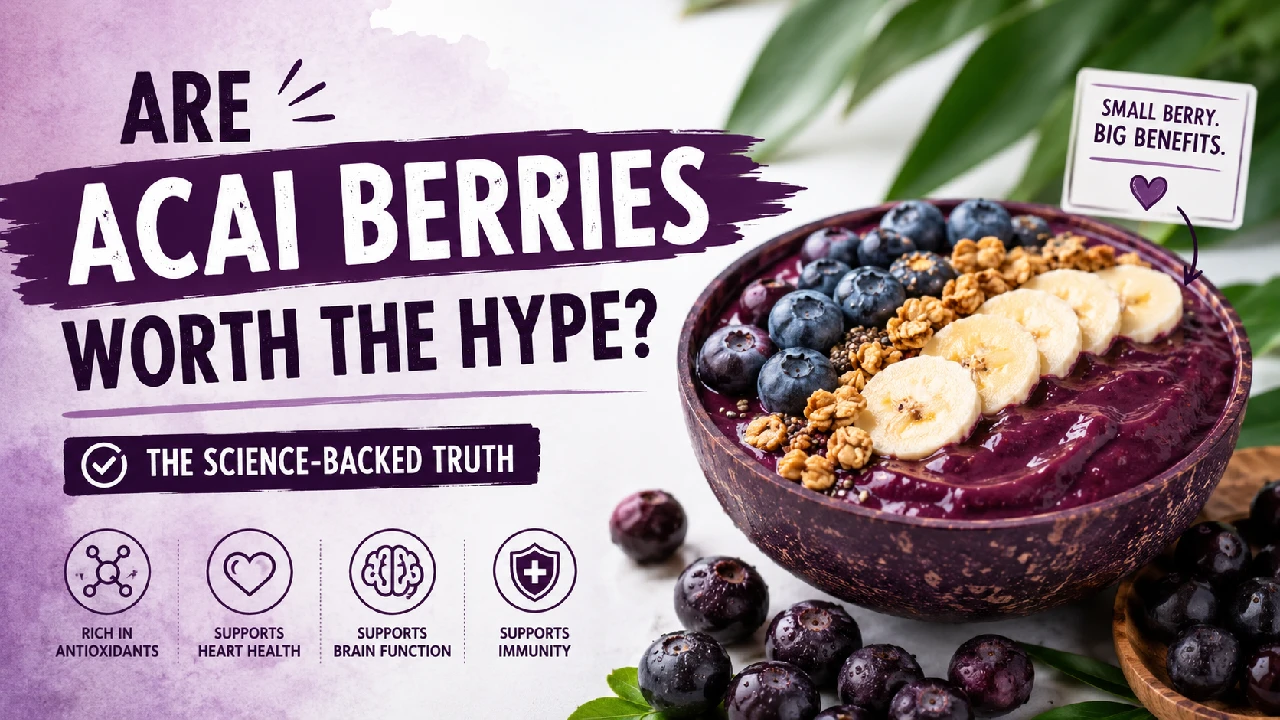
Acai (pronounced ah-sigh-EE) is one of the most successfully marketed foods in modern history. In the early 2000s it was essentially unknown outside the Amazon; by 2010 it was in every smoothie shop in America with a “superfood” label attached; by 2025 it was a global industry worth billions. Whether that success reflects genuine nutritional merit or brilliant marketing — or both — is exactly the question this guide answers. Honestly, with the actual research in hand.
This post takes an evidence-first approach: we look at what the clinical research actually says about acai, what the science does not support despite marketing claims, how acai compares to cheaper alternatives, what the most recent meta-analyses conclude, and whether the premium price is justified. By the end, you will have a clear, honest answer to whether acai berries are worth the hype — not a marketing pitch in either direction.
What Is Acai? Background and Origin
Acai (Euterpe oleracea) is a small, dark purple berry that grows on acai palm trees in the floodplain rainforests of Central and South America — primarily Brazil, where the Amazonian state of Pará produces the vast majority of the world’s supply. The berry is approximately 1 inch (2.5 cm) in diameter with a thin purple skin, minimal pale yellow flesh, and a very large seed that makes up about 80% of the berry’s weight.
In the Amazon, acai has been a dietary staple for Indigenous peoples for thousands of years. The açaizeiro palm was — and remains — a crucial food source in the Amazon delta, where acai pulp mixed with water or manioc flour constitutes a calorie-dense base food. Brazilian researchers estimate that acai provides up to 42% of the total food intake by volume for some riverside communities in the Amazon delta.
The North American and European acai market took off following a series of marketing campaigns in the early 2000s that positioned acai as an exotic “superfood” with miraculous health properties. The timing coincided with growing consumer interest in antioxidants after the ORAC (Oxygen Radical Absorbance Capacity) scoring system became publicly known — and acai’s very high ORAC score became the cornerstone of an extraordinarily successful marketing strategy.
Scientific name: Euterpe oleracea | Family: Arecaceae (palm family)
Origin: Amazon rainforest, particularly Brazil | Pronunciation: ah-sigh-EE
Available as: Frozen puree, powder, juice, supplements, acai bowls
Fresh acai is essentially unavailable outside Brazil — it ferments within 24 hours of harvest
Acai Berry Nutrition Facts
Because acai is 80% seed by weight, nutritional data refers to the pulp and skin (what you actually eat). Most commercial acai products use frozen pulp. Data from the USDA FoodData Central database for 100g of acai pulp and skin:
| Nutrient | Per 100g acai pulp | Standout quality |
|---|---|---|
| Calories | 70 kcal | Moderate — higher than most berries |
| Total fat | 5g | Unusually high for a berry — primarily oleic acid (like olive oil) |
| Carbohydrates | 4g | Low — most carbs are fiber |
| Dietary fiber | 2g | Moderate |
| Vitamin C | ~9mg | Low — similar to blueberry, far less than strawberry |
| Anthocyanins | Very high | Primary active compounds; cyanidin-3-glucoside dominant |
| Calcium | 35mg (4% DV) | Higher than most berries |
| Iron | 0.8mg (5% DV) | Meaningful for a fruit |
| Vitamin A | 1002 IU (20% DV) | High — eye health and immune function |
| ORAC antioxidant score | ~15,000–102,700 per 100g | Among highest measured in any food |
The unusual fat content
What makes acai nutritionally distinctive among berries is its fat content — approximately 5g per 100g of pulp, making it far higher in fat than any other commonly eaten berry. The fats are primarily oleic acid (the monounsaturated fatty acid dominant in olive oil) and palmitoleic acid, with smaller amounts of omega-3 and omega-6 polyunsaturated fats. This fat content contributes to acai’s higher calorie density and also improves the absorption of its fat-soluble antioxidants — a genuine nutritional advantage over lower-fat berries.
The vitamin C surprise
One nutrient notably absent from acai’s impressive profile is vitamin C — the berry contains only about 9mg per 100g, similar to a blueberry and far below a strawberry (58mg), elderberry (36mg), or black currant (181mg). This matters because vitamin C is one of the most well-evidenced nutritional contributors to immune health — and acai’s high-antioxidant profile does not automatically translate to high vitamin C.
What the Clinical Research Actually Confirms
This is where an honest acai guide separates from most marketing material. Here is what peer-reviewed clinical research in humans actually shows — not what test-tube or animal studies suggest, not what supplement companies claim, but what randomized controlled trials and systematic reviews have confirmed in people.
Confirmed: Outstanding antioxidant activity
Clinical trials confirm that açaí favorably modulates biomarkers of oxidative stress and inflammation. A meta-analysis covering 15 randomized clinical studies found that regular consumption of acai significantly improves oxidative stress markers in humans. A 2020 study in 69 participants with overweight and dyslipidemia found that adding 200 grams of acai daily for 60 days to a calorie-restricted diet reduced oxidative stress and improved inflammation. This is robust evidence that acai genuinely reduces markers of oxidative damage in the body — which is meaningful given oxidative stress’s role in aging and chronic disease.
Confirmed: Modest cardiovascular benefits
A 2025 review of human studies suggests that acai could help improve cholesterol levels by decreasing total lipid levels. However, the picture is more nuanced than supplement marketing suggests. A 2025 meta-analysis confirmed that while açaí intake may modestly reduce total lipid concentrations, it has no significant effect on LDL-C, HDL-C, total cholesterol, or triglycerides. In other words: some cholesterol-related benefit exists, but it is modest and does not extend to the specific lipid markers most associated with heart disease risk. The research on cardiovascular benefits is real but significantly more limited than marketing claims typically imply.
Confirmed: Anti-inflammatory effects
Multiple human studies have found that regular acai consumption reduces markers of systemic inflammation including C-reactive protein and interleukin-6. A 2023 study published in the Journal of Agricultural and Food Chemistry found acai’s anthocyanins and flavonoids significantly reduce oxidative stress, helping protect cells from damage linked to aging and chronic diseases. These anti-inflammatory effects are genuine and consistent with the berry’s high anthocyanin content.
Confirmed: High antioxidant bioavailability
Unlike some foods with high laboratory antioxidant scores that do not translate to blood absorption, acai’s antioxidants are well-absorbed. The fat content of acai appears to help with antioxidant bioavailability — fat-soluble carotenoids and fat-accompanied polyphenols are absorbed more efficiently. This means acai’s impressive ORAC score translates more reliably to actual biological activity than it would for a zero-fat berry with the same ORAC value.
Promising but unconfirmed: Brain health
The most urgent priority for future research is to address discrepancies between compelling preclinical neuroprotective data and the lack of human cognitive trials. Animal studies show exciting neuroprotective effects from acai. Human cognitive trials are essentially absent. This is an area to watch but not to claim benefits from yet.
What Is Overhyped: Marketing vs Evidence
Acai marketing has made claims across the years that range from exaggerated to outright false. Here is the honest breakdown of the most common ones:
| The claim | The evidence reality | Verdict |
|---|---|---|
| “Acai promotes weight loss” | No clinical evidence. FTC has taken action against companies making this claim. Any weight loss in studies was from calorie restriction, not acai. | False |
| “Acai reverses aging” | No human evidence. Some cell and animal studies on oxidative stress. “Reverses aging” is not a scientifically meaningful claim for any food. | False / misleading |
| “Acai detoxifies your body” | No evidence. “Detox” is not a physiologically coherent claim for food. The liver and kidneys handle detoxification — no berry assists this process meaningfully. | False |
| “Acai is the world’s most powerful antioxidant” | Acai has a very high ORAC score in some measurements, but so do many common foods. Comparison depends heavily on test method and form of acai tested. Wild blueberries, black currants, aronia berries, and elderberries are comparable or higher in relevant antioxidant compounds per dollar. | Exaggerated |
| “Acai fights cancer” | Animal studies only. No human cancer trials. All dark-pigmented berries with high anthocyanins have similar laboratory-level anti-cancer activity. This claim applies to dozens of berries, not specifically to acai. | Misleading |
| “Acai improves heart health significantly” | Modest cardiovascular benefits confirmed — reduced oxidative stress and modest lipid effects. But no significant effects on LDL, HDL, or triglycerides in the most rigorous 2025 meta-analysis. | Partly true but exaggerated |
| “Acai is high in vitamin C” | False. Acai contains approximately 9mg per 100g — lower than blueberry and far below elderberry, strawberry, or black currant. This misconception is very common. | False |
| “Acai is a high-fiber superfood” | Moderate fiber (2g per 100g) — significantly less than raspberries (6.5g), blackberries (5.3g), or elderberries (7g). Not a standout for fiber. | Exaggerated |
Acai vs Cheaper Alternatives: The Honest Comparison
This is the question that most acai articles avoid but that most consumers actually need answered: is acai nutritionally superior enough to justify its significant price premium over other berries?
| Berry | Anthocyanins | Vitamin C | Fiber | Clinical research depth | Approx. cost per 100g |
|---|---|---|---|---|---|
| Acai | Very high | Low (9mg) | Moderate (2g) | Growing but limited | $2–5 |
| Wild blueberry (frozen) | Very high | Moderate (9mg) | Good (3.6g) | Extensive — hundreds of trials | $0.50–1 |
| Black currant | Very high | Very high (181mg) | Good (4.3g) | Good and growing | $1–2 |
| Elderberry | Very high | High (36mg) | Very high (10g) | Strong RCTs for immune | $1–3 |
| Aronia (chokeberry) | Highest of any common berry | Moderate | Good | Growing body of research | $1–2 |
| Blackberry (frozen) | High | Good (21mg) | Very high (5.3g) | Good research base | $0.50–1 |
The honest conclusion from this comparison: acai is genuinely nutritious but is not nutritionally superior enough to justify a 3–8× price premium over alternatives like frozen wild blueberries, blackberries, or elderberries. The anthocyanin content is comparable. The vitamin C is lower. The fiber is lower. The clinical research depth is far shallower than blueberries. The unique selling points of acai — its oleic acid fat content and its distinctive flavor — are real but do not constitute a case for spending dramatically more money to achieve similar or inferior antioxidant outcomes.
If you enjoy acai and can afford the premium, it is a fine addition to your diet. If you are buying acai primarily for health benefits on a budget, frozen wild blueberries from Maine deliver comparable or superior outcomes for a fraction of the cost.
Best Forms to Buy (and What to Avoid)
Not all acai products are created equal, and some deliver far less actual acai than their marketing implies.
Best choices
- Frozen acai puree packets (unsweetened): The gold standard. These single-serving packets of frozen acai pulp retain the most nutrients closest to the fresh berry. Look for brands that list acai as the only ingredient — no added sugar, no fillers. Blend directly from frozen into smoothies or bowls. This is what Brazilians eat, and it is what the research studies most commonly use
- Freeze-dried acai powder: Highly concentrated, shelf-stable, and nutrient-dense. 1 tablespoon of quality freeze-dried powder delivers meaningful anthocyanins and can be added to smoothies, yogurt, or oatmeal. Look for brands without fillers — pure freeze-dried acai powder only
Use with caution
- Acai juice blends: Most commercial acai juices are heavily diluted with apple, grape, or other juice — and may contain as little as 5–10% actual acai. Read the ingredient list carefully. If acai is not the first ingredient and the sugar content is high, you are paying a premium for colored apple juice
- Acai supplements and capsules: Unregulated, inconsistent quality, and provide far less acai per dose than food forms. The FDA does not verify supplement claims. If you want acai, eat acai — the food form is more reliable than pills
What to avoid
- Sweetened acai puree packets: Some brands add sugar, guaraná syrup, or other sweeteners — adding calories without adding nutritional value. Check the ingredient list and choose unsweetened
- Acai-flavored products: Many products — yogurts, protein bars, cereals — are marketed with acai in the name but contain negligible actual acai. The flavor is typically artificial or derived from a tiny amount of acai concentrate
The Acai Bowl Problem: When “Healthy” Isn’t
The acai bowl — a blended frozen acai base topped with granola, banana, honey, coconut, and fresh fruit — is one of the most successfully marketed “healthy” foods of the 2010s and 2020s. It deserves honest scrutiny, because the nutritional reality of most commercial acai bowls is very different from the health-food image they project.
A typical restaurant acai bowl contains:
- Frozen acai puree base (the genuinely nutritious part): approximately 100–200 calories
- Granola topping: 200–300 calories, often high in added sugar
- Banana: 100 calories
- Honey drizzle: 60–100 calories
- Additional fruits, coconut, nut butter: 100–200 calories additional
Total: 560–900 calories, with 60–100g of sugar in many commercial versions.
This calorie range exceeds many fast food meals and the sugar content rivals desserts. The acai itself is genuinely nutritious, but the surrounding preparation undoes most of the nutritional benefit for anyone seeking a weight-conscious or blood-sugar-conscious meal. A large commercial acai bowl from popular chains can contain more sugar than a can of soda.
This does not mean acai bowls are bad — it means that a homemade acai bowl with a measured amount of granola, no added honey, and fruit toppings is a very different nutritional proposition from a restaurant version. The marketing of commercial acai bowls as health food is one of the most successful nutritional misdirections in modern food culture.
To make an acai bowl that is actually nutritious: Use one unsweetened acai puree packet (about 100g). Blend with ½ cup of frozen blueberries and ½ frozen banana — no added liquid or sweetener. Top with 2 tablespoons of granola (not a full cup), fresh fruit, and chia seeds. Skip the honey and coconut. The result is approximately 350 calories with controlled sugar and genuine nutritional density from the acai and berries.
Environmental and Ethical Considerations
Any honest assessment of acai must address its environmental context — because the story here is both complex and important.
The positive case
Sustainable acai harvesting in the Amazon is one of the strongest arguments in favor of buying the product. Euterpe oleracea palms grow in floodplain forests and are harvested without destroying the tree — climbers ascend the palms and harvest the berry clusters, leaving the tree intact for future harvests. The economics of sustainable acai harvesting give Amazonian forest communities a financial incentive to maintain forest rather than clear it for cattle or soy. Multiple studies have documented that managed açaizeiro forest is economically competitive with cattle ranching while preserving biodiversity. In this sense, buying sustainably sourced acai directly supports Amazon conservation.
The concerns
The explosion of global acai demand has created significant environmental pressures alongside these benefits. Some Amazonian floodplains have been converted to monoculture açaizeiro plantations that displace native forest diversity. The demand for acai has also increased pressure on fishing communities as land use shifts from subsistence fishing to acai cultivation. Carbon footprint from refrigerated shipping acai from the Amazon to North American markets is also significant compared to domestically grown alternatives.
What to do
If buying acai, look for products certified by organizations that verify sustainable wild harvesting practices. Several Brazilian producer cooperatives work to ensure environmental and social standards in the supply chain. When possible, choose brands that clearly identify their Brazilian sourcing and sustainability commitments rather than anonymous bulk processed products.
The Verdict: Is Acai Worth the Hype?
After reviewing the research, here is an honest, evidence-based verdict broken down by what kind of consumer you are:
| If you are… | Acai verdict |
|---|---|
| Someone who enjoys the flavor and can afford the cost | Yes — worth it. It is genuinely nutritious and you get real benefits alongside a food you enjoy. |
| Someone buying acai specifically for health benefits on a budget | Not worth the premium. Frozen wild blueberries deliver comparable antioxidants with vastly more clinical research at 1/5 the cost. |
| Someone eating acai bowls regularly as a “healthy” meal | Check your calories. Commercial acai bowls are often 600–900 calories with very high sugar. Make them at home to control the nutritional profile. |
| Someone taking acai supplements for health | Not recommended. Supplement quality is unverified, doses are inconsistent, and food-form acai is nutritionally superior. Save the money. |
| Someone who cares about Amazon conservation | Consider supporting it. Certified sustainable acai purchasing directly supports Amazon forest conservation economics. |
| Someone who believed acai cures disease or reverses aging | Those claims are false. No food cures disease or reverses aging. Acai is nutritious food — not medicine. |
The bottom line: Acai is a real food with genuine nutritional value — particularly for its anthocyanin antioxidants, healthy fats, and moderate anti-inflammatory evidence. It is not a miracle food, not a weight loss aid, not uniquely superior to other dark-pigmented berries, and not worth the price premium for budget-conscious consumers seeking health benefits specifically. The marketing has dramatically overstated its benefits and priced it far above what its nutritional profile justifies relative to alternatives.
Eat it if you enjoy it. Do not expect it to do what it cannot do. And consider that frozen wild blueberries, blackberries, or elderberries — available at a fraction of the cost — deliver comparable or superior outcomes for most health goals that brought you to acai in the first place.
Frequently Asked Questions About Acai Berries
Are acai berries actually healthy?
Yes — acai berries are genuinely nutritious. Clinical research has confirmed benefits for oxidative stress reduction, anti-inflammatory effects, and modest cardiovascular markers. The debate is not whether acai is healthy but whether it is worth a significant premium over similarly nutritious berries like frozen wild blueberries, which deliver comparable antioxidants at a fraction of the cost.
Do acai berries help with weight loss?
No. Despite early and aggressive marketing, there is no credible clinical evidence that acai promotes weight loss. The FTC has taken action against companies making this claim. Any weight reduction seen in acai studies was attributable to overall calorie restriction in the diet, not to acai specifically. Additionally, commercial acai bowls often contain 600–900 calories — working directly against weight management goals for most people.
Is acai better than blueberries?
Not meaningfully — and certainly not per dollar. Acai has higher ORAC values but blueberries have far deeper clinical evidence for specific health benefits in humans. Frozen wild Maine blueberries match or exceed acai’s antioxidant profile at roughly 1/5 the cost. Acai’s unique advantages are its healthy fat content and distinctive flavor — not a superior overall nutritional profile that justifies its price premium.
What is the best form of acai to buy?
Unsweetened frozen acai puree packets are the best value — they retain the most nutrients and are closest to what clinical studies use. Freeze-dried acai powder is a good shelf-stable alternative. Avoid acai juice blends (usually mostly apple juice), acai supplements (unregulated, inconsistent quality), and sweetened acai packets (unnecessary added sugar). Always check ingredient lists — the best products have acai as the only ingredient.
Are acai berries high in vitamin C?
No — this is a common misconception. Acai contains approximately 9mg of vitamin C per 100g, which is similar to a blueberry and far below a strawberry (58mg), elderberry (36mg), or black currant (181mg). Acai’s antioxidant profile is driven by anthocyanins and fat-soluble compounds, not vitamin C. If you need vitamin C specifically, acai is not the right choice.
How does acai compare to other superfoods?
Acai has a genuine nutritional case — high antioxidants, healthy fats, real (if limited) clinical evidence. It compares favorably to many “superfood” products with even less evidence. However, for comparable or lower cost, frozen wild blueberries, elderberries, black currants, or aronia berries deliver similar or superior antioxidant profiles with more extensive clinical research. Acai’s premium reflects its exotic origin and strong marketing more than proportional nutritional superiority.
Are acai bowls actually healthy?
The acai base itself is nutritious. Most commercial acai bowls are not a healthy meal — they commonly contain 600–900 calories and 60–100g of sugar from granola, honey, and fruit toppings. A homemade acai bowl with controlled toppings (2 tablespoons of granola, no added honey, fresh fruit) is a different nutritional proposition. Check calorie counts before assuming a restaurant acai bowl fits your nutritional goals.
Conclusion: Real Food, Overstated Claims, Better Alternatives for Less
Acai is a genuine food with genuine nutritional value — particularly its anthocyanin antioxidants, healthy fat profile, and confirmed anti-inflammatory effects. It is not a miracle food, not a weight loss tool, not a unique superfood that nothing else can replace, and not worth a significant premium over alternatives when health benefits are the primary goal.
The most honest summary: buy unsweetened frozen acai if you enjoy the flavor and can afford it. Do not buy it because you think it will uniquely transform your health. Do not eat commercial acai bowls and assume you are eating a low-calorie health meal. And consider that the same money spent on frozen wild blueberries, blackberries, or elderberries delivers comparable antioxidant outcomes with better-established clinical evidence and a much lower ecological footprint.
Acai is worth knowing. The hype around it is not worth believing.
More from Berry Nation USA
- Blueberry Complete Guide: America’s Native Superfruit
- Elderberry Complete Guide: Benefits, Syrup Recipe & Safety
- Wild Blackberries of America: Complete ID & Foraging Guide
- Cranberry: More Than a Holiday Staple
- How Many Berries Should I Eat a Day?
- Raspberry Complete Guide: Native American Berry & Benefits
Written by Kirna — Berry Nation USA
Berry Nation USA is America’s dedicated resource for wild, native, and cultivated berries across all 50 states. Learn more about us.