
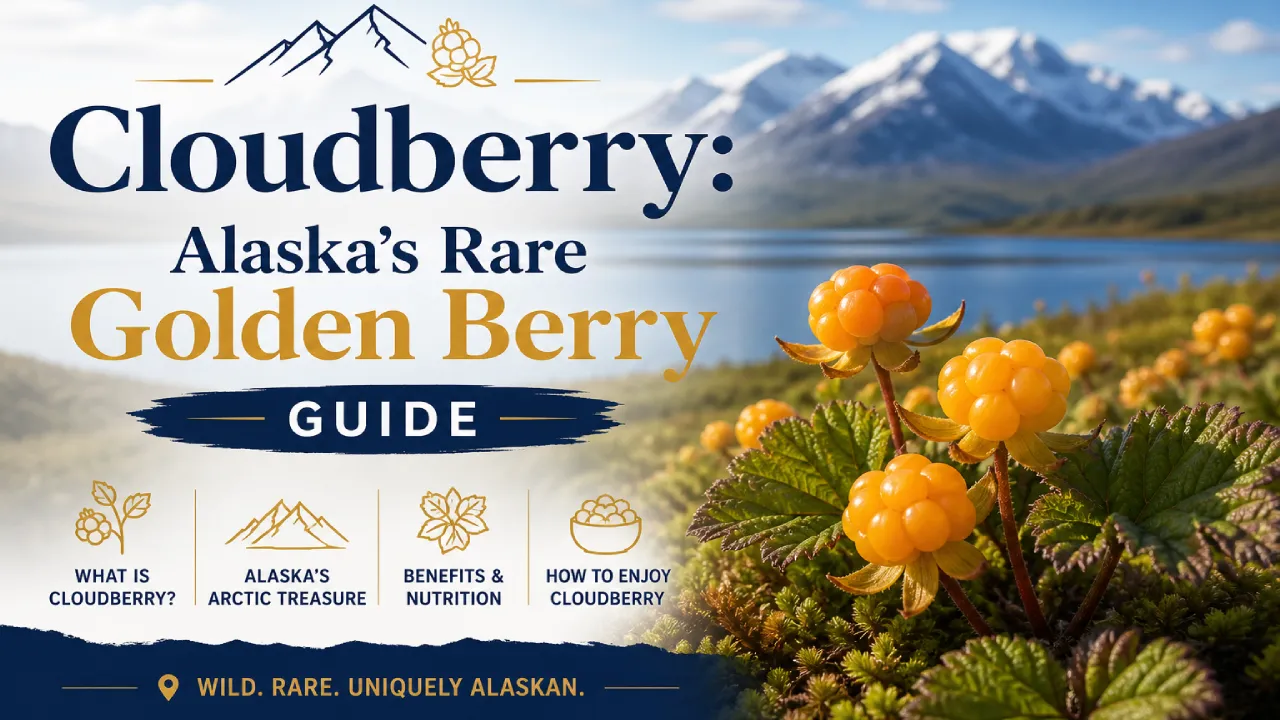
Somewhere in a remote Alaskan bog, a plant no taller than your ankle is producing one of the most prized wild berries on Earth. The cloudberry ripens for a few weeks each summer across the arctic and sub-arctic world, then disappears — too soft to ship, too demanding to farm, and too rare to find without knowing exactly where to look. In Norway it is served at royal banquets. In Alaska it is harvested by Indigenous families for winter provisions. In Finland it costs more per pound than most meats. This guide tells you everything about it.
This complete cloudberry guide covers the botanical profile of Rubus chamaemorus, its remarkable nutritional profile including the extraordinary vitamin C content that made it a survival food for Arctic peoples, what it tastes like and how that flavor compares to related berries, exactly where it grows in the USA (primarily Alaska), its deep cultural significance across both Indigenous American and Scandinavian traditions, foraging guidance for those in Alaska, where to buy cloudberry products in America, and what to make with them.
Botanical Profile: What Is a Cloudberry?
The cloudberry (Rubus chamaemorus) is a low-growing perennial herb in the rose family (Rosaceae) — a member of the same Rubus genus as raspberries, blackberries, and salmonberries, yet different from all of them in nearly every practical characteristic. While its Rubus relatives grow as tall shrubs with thorny canes, the cloudberry is an almost impossibly delicate creeping plant that never exceeds about 10 inches in height and grows one berry per plant per season.
The Latin species name chamaemorus means “ground mulberry” — a reference to the plant’s low-growing habit and the resemblance of its golden fruit to a miniature white mulberry. The common name “cloudberry” is believed to derive from the Old Norse word klóðber or from the plant’s association with high, cloud-level terrain in Scandinavian mountains, though etymology is debated.
Rubus chamaemorus is one of the few Rubus species to be dioecious — male and female flowers grow on separate plants, meaning not every cloudberry plant produces fruit. Only female plants bear the single golden berry that makes this species so prized. In any given cloudberry population, roughly half the plants are male and will never produce fruit — an important consideration for both foragers and the plant’s conservation.
Scientific name: Rubus chamaemorus | Family: Rosaceae | Common names: Cloudberry, bakeapple (Newfoundland), knotberry, averin, Nordic gold
Height: 4–10 inches | Fruit color: Red (unripe) to golden-amber (ripe) | Season: July–August
Thorns: None | Berries per plant: One | USDA range: Alaska, far northern Minnesota | Cannot be commercially cultivated
How to Identify Cloudberries
Cloudberry is one of the most distinctive and unmistakable wild plants in the arctic and sub-arctic landscape. Once you have seen it, you will never mistake it for anything else.
The plant
- Height: Extremely low — typically 4 to 10 inches tall, emerging from the bog or tundra surface almost like a ground cover plant rather than a shrub
- Stems: Slender, unbranched, slightly reddish, completely thornless
- Root system: Spreads via underground rhizomes, forming loose colonies of male and female plants across bog surfaces
The leaves
- Simple, round to kidney-shaped with 5–7 shallow, rounded lobes — resembling a small geranium or mallow leaf more than any typical Rubus species
- Typically 1–3 inches across, with a distinctly wrinkled or crinkled texture on the upper surface
- Pale to medium green, slightly leathery
- 1–3 leaves per stem, arranged alternately
- The rounded lobed leaf shape is completely unlike the compound leaves of raspberries and blackberries — one of the most reliable identification features
The flowers
- Single white flower at the tip of each stem — one flower per plant
- Five petals, 1–2 cm across, with a central cluster of yellow stamens
- Flowers appear June through early July depending on latitude and elevation
- Male and female flowers look identical to casual observers but can be distinguished by the presence of well-developed stamens (male) or a prominent pistil cluster (female)
The fruit
- Structure: An aggregate fruit like a raspberry — made of individual drupelets — but typically larger and more loosely structured than a wild raspberry. Usually 1.5 to 3 cm in diameter
- Color progression: Fruit begins hard and bright red (unripe), then turns orange-red (ripening), then softens to a golden-amber or pale yellow when fully ripe. The color change from red to gold is one of the most dramatic ripening transformations of any wild berry
- Texture at ripeness: Extremely soft and juicy — similar to an overripe raspberry in texture, immediately yielding when touched
- Position: Each berry sits alone at the top of a single stem above the leaves — impossible to miss in a productive bog
- One berry per plant: The dioecious nature of the plant combined with one fruit per stem means each individual cloudberry is the full seasonal output of that entire plant
Habitat identification
Cloudberry habitat is itself a reliable identification clue. The plant grows almost exclusively in:
- Sphagnum bogs and mires with high water tables
- Arctic and sub-arctic tundra, particularly low-lying wet areas
- Alpine bog habitats above treeline in northern mountains
- Coastal sedge meadows and wetlands in Alaska
If you are standing in a Sphagnum moss bog in Alaska in July and you see small round golden-amber fruits sitting atop plants no taller than your ankle — those are cloudberries. No other berry grows in this habitat and looks like this.
What Do Cloudberries Taste Like?
The cloudberry’s flavor is one of the great sensory discoveries available to anyone lucky enough to taste a ripe one fresh in the field. It is genuinely unlike any other berry — not just in intensity or tartness, but in the nature of the flavor itself.
The best description: a complex, tart-sweet flavor with floral and tropical notes — somewhere between a raspberry, an apricot, and a passion fruit, with a honey-like sweetness that emerges fully only at peak ripeness. The flavor has a depth and elegance that is difficult to convey to someone who has only eaten commercial berries. There is a floral quality — not perfume-like, but genuinely flower-derived — that reflects the plant’s arctic bog environment where certain organic compounds accumulate differently than in temperate soils.
The texture at full ripeness is extremely soft and almost custardy — the berry releases its juice immediately upon contact and melts rather than being bitten into. This is part of why cloudberries are so prized for jam: the cooking that would destroy a more fragile fresh berry experience actually concentrates the extraordinary flavor into something that survives preservation.
Ripeness stages and flavor:
- Hard and red (unripe): Very tart, astringent, minimal sweetness — edible but not representative of the berry’s potential. Similar to an unripe raspberry but with that distinctive cloudberry floral note already present
- Orange-red (approaching ripeness): Tartness moderating, sweetness beginning to develop, flavor complexity emerging
- Golden-amber and soft (fully ripe): The complete flavor — tart-sweet, floral, honey-like, tropical undertones, extraordinary complexity
- Very soft and slightly translucent (overripe): Sweetness dominant, some fermented quality beginning — still excellent for jam but past peak for fresh eating
People from Scandinavia — where cloudberry is a high-status food featured in fine dining and sold at premium prices in supermarkets — often describe the flavor as evoking the far north: clean, pure, and wild in a way that cultivated berries never achieve. This is not mere romanticism — the cloudberry’s unique flavor compounds are a direct product of the specific cold, acidic, oxygen-poor bog environment where it grows, and cannot be replicated in any other growing condition.
Cloudberry vs Salmonberry Comparison
The most common confusion about cloudberries among Americans is conflating them with salmonberries (Rubus spectabilis) — another Pacific Northwest and Alaska berry that ripens in orange and yellow colors. They are different in almost every way:
| Feature | Cloudberry (R. chamaemorus) | Salmonberry (R. spectabilis) |
|---|---|---|
| Plant height | 4–10 inches (ground-hugging) | 6–12 feet (tall shrub) |
| Thorns | None | Soft sparse prickles |
| Leaf shape | Round, lobed, geranium-like | Compound, trifoliate |
| Ripe color | Golden-amber to pale yellow | Orange, salmon, or red |
| Berries per plant | One per stem | Many clusters |
| Habitat | Arctic/sub-arctic bogs and tundra | Pacific coastal moist forests |
| Flavor | Complex, floral, apricot-tropical | Mild, light, watery-tart |
| Vitamin C | Exceptional — among highest of any berry | Good but lower |
| Commercial availability | None fresh; jam/frozen online | None — too soft for commercial |
| Cultural status | Nordic luxury; Arctic cultural staple | Pacific NW Indigenous tradition |
Where Cloudberries Grow in the USA
In the continental United States, cloudberry habitat is almost entirely confined to Alaska — one of the most important reasons this berry remains unknown to most Americans despite its extraordinary qualities.
Alaska — the heart of American cloudberry country
Alaska hosts the largest and most productive cloudberry populations in the United States. The berry grows across a wide range of Alaskan habitats, from sea level coastal bogs to alpine tundra, but is most abundant and accessible in:
- Yukon-Kuskokwim Delta: The vast lowland delta of western Alaska is perhaps the most productive cloudberry region in the entire state. The Y-K Delta’s extensive Sphagnum bogs and sedge meadows support exceptional cloudberry populations, and the berry is a critically important traditional food for Yup’ik communities throughout the region
- Seward Peninsula: Around Nome and throughout the Seward Peninsula, cloudberries grow abundantly on tundra slopes and in coastal bog communities
- Arctic Slope and Brooks Range foothills: Cloudberries grow in wet tundra habitats across northern Alaska, though the shorter growing season at these latitudes means smaller berries and more variable crops
- Interior Alaska: Cloudberries are found in bog habitats throughout interior Alaska, including areas around Fairbanks and in the Tanana Flats region
- Southeast Alaska and the Panhandle: Less abundant here than in western Alaska, but present in suitable bog habitats
- Kodiak Island and Alaska Peninsula: Coastal bog habitats support good cloudberry populations
Lower 48 states
Outside Alaska, cloudberry populations in the contiguous United States are minimal and geographically isolated. A small, relict population exists in northern Minnesota — particularly in the peat bogs of Lake of the Woods County and a few other far northern bog systems along the Canadian border. These populations are considered botanically significant as the southernmost naturally occurring cloudberry in North America but are too small to support any meaningful foraging.
There are also very occasional historical records from extreme northern Maine, though the species’ current status in Maine is unclear. The cloudberry does not grow in the Rocky Mountains, the Pacific Northwest, the eastern forests, or anywhere else in the lower 48 states — its requirements are simply too specialized.
| Location | Abundance | Peak season | Best habitat |
|---|---|---|---|
| Yukon-Kuskokwim Delta, AK | Very abundant | Late July–August | Lowland Sphagnum bogs, sedge meadows |
| Seward Peninsula, AK | Abundant | Late July–August | Tundra slopes, coastal bogs |
| Interior Alaska | Common in bogs | Late July–early August | Sphagnum bogs, muskeg |
| Arctic Slope / Brooks Range, AK | Present, variable | August | Wet tundra, low-lying areas |
| Northern Minnesota (Lake of the Woods) | Rare — do not forage | Late July | Protected peat bogs — do not disturb |
A note on the Minnesota population: The cloudberry populations in northern Minnesota are botanically significant as rare and isolated populations at the southern edge of the species’ range. They should not be foraged — they are protected in their natural habitat, the population is small, and disturbing these plants would risk destroying a rare botanical resource. Cloudberry foraging in the USA should be limited to Alaska where populations are robust.
Cloudberry Nutrition Facts
Cloudberries are among the most nutritious berries in the world — a fact that has been recognized and relied upon by Arctic peoples for thousands of years. The berry’s extraordinary vitamin C content is its most remarkable nutritional characteristic, but the full profile is impressive across multiple dimensions. Data sourced from Scandinavian food research institutions and the USDA FoodData Central database:
| Nutrient | Per 100g cloudberries | Comparison |
|---|---|---|
| Calories | ~51 kcal | Very low calorie |
| Vitamin C | 158mg — exceptional | 3× more than an orange; 4× more than blueberry |
| Vitamin E | Very high for a berry | Unusual in berries; supports skin and immune function |
| Dietary fiber | ~4–5g | Higher than blueberry; good gut health support |
| Ellagic acid | High | Rubus genus characteristic; cancer prevention research |
| Citric acid | High | Explains tartness; natural preservative |
| Benzoic acid | Notable | Natural antimicrobial; helps berry self-preserve |
| Potassium | ~170mg | Good source for blood pressure support |
| Phosphorus | ~32mg | Notable for a berry |
| Anthocyanins (golden form) | Moderate — primarily ellagitannins | Color from carotenoids not anthocyanins at full ripeness |
The vitamin C story — why it matters so much
The cloudberry’s vitamin C content of approximately 158mg per 100g is not just nutritionally impressive — it is historically significant. Arctic and sub-arctic communities living through long winters with limited access to fresh produce depended on stored cloudberries as their primary source of vitamin C during months when scurvy was an existential threat. The cloudberry’s natural benzoic acid content acts as a preservative, allowing the berries to be stored in their own juice without fermentation or spoilage — a natural preservation mechanism that no other common berry possesses to the same degree. This combination of very high vitamin C and natural self-preservation made cloudberry, in effect, a life-saving berry for Arctic peoples across millennia.
To put the vitamin C number in context: 100g of cloudberries provides approximately 175% of the daily recommended intake for vitamin C. That is roughly three times the vitamin C in an orange (50mg/100g), four times that in a blueberry (10mg/100g), and nearly double that in a strawberry (58mg/100g). For a berry eaten primarily fresh in limited quantities, this is a remarkable nutritional contribution.
6 Health Benefits of Cloudberries
1. Extraordinary vitamin C — the defining nutritional benefit
At 158mg of vitamin C per 100g, cloudberries are one of the richest food sources of vitamin C available from any berry globally. Vitamin C is essential for immune function, collagen synthesis, iron absorption, wound healing, and antioxidant defense. The research base for vitamin C benefits is among the most robust in nutritional science — published in thousands of studies across the NIH PubMed Central database confirming roles in immune support, cardiovascular protection, and reduced risk of chronic disease. Cloudberries deliver this vitamin in a whole-food matrix that enhances bioavailability beyond what isolated ascorbic acid supplements provide.
2. Ellagic acid — cancer prevention research
As a Rubus species, cloudberries contain ellagic acid — the polyphenol compound that has been the subject of significant cancer prevention research across the genus. Research published in the Journal of Nutrition found that ellagic acid inhibits cancer cell proliferation and promotes apoptosis in laboratory models. The concentration of ellagitannins in cloudberries is among the highest measured in the Rubus genus, making cloudberry one of the richest known sources of these compounds per gram of fruit.
3. Vitamin E content — unusual in berries
Cloudberries contain notably higher vitamin E levels than most other berries — a fat-soluble antioxidant that protects cell membranes from oxidative damage, supports immune function, and plays a role in skin health. Most berries are poor sources of vitamin E (which is typically found in nuts, seeds, and vegetable oils), making cloudberry’s vitamin E content a genuinely unusual nutritional characteristic. The combination of both vitamin C and vitamin E in meaningful quantities creates a synergistic antioxidant effect, as vitamin C regenerates oxidized vitamin E, extending the activity of both.
4. Natural preservation through benzoic acid
Cloudberries contain benzoic acid — a natural organic acid that functions as an antimicrobial compound, inhibiting the growth of bacteria, molds, and yeasts in the berry. This is the same compound used as a food preservative (sodium benzoate) in commercial food production. In cloudberries, it allows the fresh berries to be stored for months without cooking or sugar, simply packed whole in clean containers and kept cool — a property unique among major berry species and one that was critical for Arctic peoples who needed to preserve summer harvests for winter consumption.
5. Anti-inflammatory and cardiovascular protection
Cloudberries contain quercetin, ellagitannins, and other polyphenols with demonstrated anti-inflammatory activity. Research on ellagitannin-rich foods consistently shows reductions in markers of systemic inflammation including C-reactive protein and interleukin-6. The berry’s potassium content (approximately 170mg per 100g) contributes to blood pressure regulation. The combination of these anti-inflammatory compounds with the antioxidant vitamins C and E creates a comprehensive cardiovascular protection profile.
6. Gut health through fiber and ellagitannins
With approximately 4–5g of dietary fiber per 100g, cloudberries contribute meaningfully to gut health through prebiotic fiber that feeds beneficial bacteria. Additionally, ellagitannins from cloudberries are converted by gut bacteria to urolithins — a class of compounds with anti-inflammatory effects on gut tissue that has attracted significant research interest in recent years. Research published in Cell Metabolism found that urolithin A (derived from ellagitannin metabolism) activates mitophagy — cellular cleanup of damaged mitochondria — suggesting health benefits beyond simple anti-inflammatory effects. Cloudberries are among the richest sources of ellagitannins available from any food.
Cultural Significance: Alaska, Scandinavia, and Indigenous Traditions
No berry in the northern world carries more cultural weight than the cloudberry. Across the Arctic and sub-arctic world — from Alaska to Norway to Finland to Russia — the cloudberry occupies a special status that goes beyond nutrition into the realm of identity, ceremony, and seasonal ritual.
Alaska — Yup’ik and Iñupiat traditions
For the Yup’ik people of western Alaska, cloudberries (called aqviqaq in Central Yup’ik) are one of the most important wild foods of the year. The berry harvest in late July and August is a community event — entire families move to berry-picking camps on the tundra, and the harvest represents both a food security activity and a deeply important cultural practice. Cloudberries are traditionally preserved in one of two ways: fermented with fish oil or seal oil to make akutaq (Eskimo ice cream), or packed fresh in seal pokes or birch bark containers where they self-preserve in their own benzoic acid-rich juice through winter.
Akutaq — the traditional Alaskan Native frozen dessert made by whipping animal fat (historically caribou or seal fat, now often Crisco), sugar, and various wild berries including cloudberries — is one of the most culturally significant foods in Alaska Native cuisine. Cloudberries contribute both nutrition and a distinct flavor profile to akutaq that no other berry replicates.
Scandinavia — from royal tables to IKEA
In Norway, Sweden, and Finland, cloudberry (molte in Norwegian, hjortron in Swedish, lakka in Finnish) is a symbol of the wild north and one of the most prized wild foods in the national culinary tradition. Norwegian law protects the right of individuals to pick cloudberries in the wild for personal consumption, but commercial picking on private land is restricted — reflecting both the berry’s value and the fragility of its populations. Norwegian cloudberry jam is served at royal banquets and is a standard feature of Christmas celebrations. Finnish cloudberry liqueur (Lakkaliköri) is one of Finland’s most recognized culinary exports.
IKEA’s cloudberry jam — available at IKEA stores worldwide — has introduced millions of people globally to cloudberry flavor and is the most widely distributed cloudberry product available in the United States today. While the IKEA jam is made from Scandinavian cloudberries rather than Alaskan ones, it gives Americans an accessible first taste of this extraordinary berry’s flavor.
Canada — bakeapple culture in Newfoundland
In Newfoundland, cloudberries are called “bakeapples” — a name whose origin is debated but possibly derived from baie qu’appelle (French: “what kind of berry is that?”). Bakeapple picking in late summer is a Newfoundland cultural institution as beloved as lobster fishing, and bakeapple jam is considered one of the province’s most iconic food products. The term “bakeapple” has no connection to apples — the name simply stuck through generations of Newfoundland usage.
Why Cloudberries Cannot Be Farmed
The cloudberry’s resistance to cultivation is even more absolute than the huckleberry’s. Despite decades of research in Norway, Finland, and Sweden — countries with both strong economic incentive and sophisticated agricultural science — commercial cloudberry cultivation has never succeeded at any meaningful scale.
The reasons are multiple and compounding:
- Dioecious reproduction: Male and female plants must be present in the right ratio for pollination. Controlled planting of known-sex plants is required but does not solve the deeper problems
- Mycorrhizal dependence: Like mountain huckleberries, cloudberries depend on specific mycorrhizal fungi associated with Sphagnum moss bog ecosystems. Without these fungi, plants survive but produce minimal fruit. Replicating bog soil ecology in a farm setting is effectively impossible
- Sphagnum bog requirements: The plant requires waterlogged, highly acidic (pH 3.5–5.0), nutrient-poor Sphagnum moss substrate — a soil type that is the antithesis of productive agricultural soil and that cannot be replicated in a farm environment
- Climate specificity: Cloudberry requires long, cold winters (consistent snow cover), a specific pattern of spring thaw and frost timing, and cool, humid summers. Even within the plant’s natural range, warm or dry years produce dramatically reduced crops
- Pollination complexity: The dioecious reproductive system combined with dependence on specific pollinators in the bog ecosystem creates a pollination requirement that is difficult to ensure in cultivation
- One berry per plant per season: Even if all other problems were solved, the fundamental yield limitation of one fruit per plant makes cloudberry economically challenging as a crop
Scandinavian agricultural researchers have made partial progress — establishing cloudberry plants in constructed bog gardens that produce some fruit — but yields per acre remain tiny compared to any cultivated berry, and the cost per berry produced vastly exceeds market viability. For the foreseeable future, every cloudberry will be hand-picked from wild plants. This is why they cost what they do.
Foraging Cloudberries in Alaska
For Alaskans, cloudberry foraging is one of the great summer traditions of the state. For visitors, a cloudberry picking day in western or central Alaska in late July is an experience worth planning a trip around. Here is practical guidance for doing it well.
Timing
The cloudberry season in Alaska is brief — typically 2–4 weeks at any given location — and varies by year and location:
- Western Alaska (Y-K Delta, Seward Peninsula): Late July through mid-August in most years. The warmest years push the season earlier; cold springs delay it
- Interior Alaska (Fairbanks area): Mid-July through early August
- Northern Alaska (Kotzebue, Arctic Slope): Late July through August
- Southeast Alaska: Occasional populations ripen in July
Local knowledge is invaluable for cloudberry timing — Yup’ik and Iñupiat communities in western Alaska have generations of accumulated knowledge about when and where specific patches peak. If visiting Alaska specifically to pick cloudberries, connecting with local guides or community members is the most reliable way to hit the season correctly.
Ripeness
Wait for the transition from red to golden-amber. Red cloudberries are edible but tart and not representative of the berry’s potential. Fully golden berries are at their best — any that have turned very soft and slightly translucent are overripe and best for jam rather than fresh eating.
Container strategy
Like thimbleberries, cloudberries are extremely soft and require shallow, wide containers. Traditional Alaskan berry picking uses gallon ice cream tubs or similar wide containers kept at no more than 3–4 berries deep. Cloudberries packed deep in a container will crush and begin to ferment within hours. Pick small amounts into a wide container and transfer to shallow trays for storage.
Processing
Cloudberries must be processed quickly — within a day or two of picking for fresh preparations. Their high benzoic acid content means they self-preserve remarkably well at cool temperatures if stored whole and uncrushed, but once damaged they deteriorate quickly. For jam, process the same day if possible. For fresh storage, keep cool and consume within 2–3 days.
Where to Buy Cloudberries in the USA
For most Americans, buying cloudberry products rather than foraging them fresh is the only practical option. Here is where to find them:
Scandinavian cloudberry products
- IKEA: Sells cloudberry jam at IKEA stores nationwide and online — the most accessible cloudberry product in the USA. Look for it in the food market section of any IKEA store. This is Norwegian/Swedish cloudberry, not Alaskan, but the flavor is authentic and excellent
- Scandinavian specialty stores: Cities with Scandinavian heritage communities (Minneapolis, Seattle, Chicago, New York) often have specialty food stores carrying Norwegian and Finnish cloudberry jam, cloudberry liqueur, and cloudberry chocolate
- Online importers: Multiple online retailers import Scandinavian cloudberry products — search for Norwegian cloudberry jam (multekrem, multejam), Finnish cloudberry jam (lakkahillo), or cloudberry liqueur for authentic products
Alaskan cloudberry products
- Alaskan specialty food companies: Several Alaska-based food producers sell cloudberry jam, cloudberry syrup, and frozen cloudberries online — search for “Alaska cloudberry jam” to find current producers. These products use Alaskan-harvested berries and support Indigenous and local harvesting communities
- Farmers markets in Alaska: During the August season, fresh cloudberries and cloudberry jam appear at farmers markets in Anchorage, Fairbanks, and other Alaska cities
What to buy if you have never tried cloudberry
Start with IKEA cloudberry jam — it is the most accessible, least expensive introduction to the flavor. Spread on toast or serve alongside vanilla ice cream for the classic Scandinavian preparation. If you enjoy it, consider ordering frozen Alaskan cloudberries or a higher-quality Norwegian cloudberry jam for comparison. The flavor difference between premium and standard cloudberry jam is significant.
5 Cloudberry Recipes
1. Cloudberry jam (the essential preparation)
Cloudberry jam is the primary preservation method for this berry across all cultures that eat it — the cooking concentrates the extraordinary flavor into something that survives the season. Combine 2 cups of ripe cloudberries with 1½ cups of sugar and 1 tablespoon of lemon juice in a heavy saucepan. Bring to a boil over medium heat, stirring gently and crushing the berries lightly as they cook. Simmer for 15–20 minutes until thickened to a jam consistency — cloudberries are naturally high in pectin and set without additives. Pour into sterilized jars. The resulting jam is golden-amber with an extraordinary floral-tart-sweet flavor that is unlike anything commercially available from major berry species.
2. Cloudberry cream (multekrem) — the Norwegian classic
This is the most celebrated cloudberry preparation in Scandinavia and one of the great simple desserts of world cuisine. Whip 1 cup of heavy cream to soft peaks. Fold in 2 tablespoons of sugar and ½ teaspoon of vanilla extract. Gently fold in ¾ cup of cloudberry jam, leaving some swirls of jam visible rather than fully incorporating — the contrast of cream white and golden jam is part of the visual appeal. Serve immediately in chilled glasses. In Norway this is served at Christmas celebrations, at weddings, and at fine restaurants. The combination of cloudberry’s tart complexity and the richness of fresh cream is one of the finest simple desserts imaginable.
3. Cloudberry sauce for fish
The cloudberry’s tartness and acidity make it a natural pairing for rich fatty fish — Arctic char, salmon, or halibut. Warm ½ cup of cloudberry jam with 2 tablespoons of butter and 1 tablespoon of white wine vinegar over low heat until fluid. Season lightly with salt and a pinch of white pepper. Spoon over pan-seared salmon or Arctic char fillets. The sauce cuts through the fish’s richness in a way that lemon alone cannot — the berry’s complexity adds a dimension that transforms a simple fish dish into something with genuine culinary depth.
4. Akutaq — traditional Alaskan Native dessert (modern adaptation)
Traditional akutaq uses animal fats that most Americans do not have access to. This modern adaptation honors the tradition while using accessible ingredients: whip ½ cup of vegetable shortening until light and fluffy. Gradually beat in ¼ cup of sugar. Fold in 1 cup of cloudberries (fresh or frozen-thawed), ½ cup of fresh or frozen blueberries, and a handful of dried cranberries. Freeze in a wide container until firm. Serve as a frozen dessert. This preparation is best made with Alaskan cloudberries if available — the flavor difference from Scandinavian cloudberries is noticeable in a simple preparation like this.
5. Cloudberry smoothie
Blend ½ cup of frozen cloudberries with ½ cup of frozen mango chunks (the tropical quality of both fruits amplifies the other), ¾ cup of Greek yogurt, 1 tablespoon of honey, and ½ cup of almond milk. The mango enhances the tropical notes already present in the cloudberry, and the Greek yogurt’s richness complements the berry’s natural tartness. The color is a beautiful golden-peach. This is the most vitamin-C-dense smoothie possible from wild berry ingredients — cloudberry’s extraordinary vitamin C combined with mango’s own respectable content creates a genuinely nutritionally outstanding beverage.
Frequently Asked Questions About Cloudberries
Are cloudberries edible?
Yes — cloudberries are completely safe to eat and are considered a luxury wild berry across Alaska, Canada, and Scandinavia. They have been eaten by Arctic peoples for thousands of years. Both the ripe golden-amber berries and the less-ripe red berries are edible, though the golden-ripe stage delivers the full flavor complexity. There are no toxic look-alikes in cloudberry’s arctic and sub-arctic habitat.
What do cloudberries taste like?
Complex, floral, tart-sweet with tropical and honey-like notes — somewhere between a raspberry, an apricot, and a passion fruit with a clean Arctic purity. The flavor is more sophisticated than most temperate berries. Many people consider cloudberry to have the most complex and interesting flavor of any berry in the world. Ripe golden berries deliver the full flavor; red unripe berries are primarily tart.
Where do cloudberries grow in the USA?
Almost entirely in Alaska — particularly in the Yukon-Kuskokwim Delta, Seward Peninsula, interior boreal bogs, and northern tundra. A rare, protected relict population exists in northern Minnesota peat bogs but should not be foraged. Cloudberries do not grow in the Rocky Mountains, Pacific Northwest, or anywhere else in the lower 48 states.
Why are cloudberries so expensive?
Cloudberries cannot be commercially farmed due to their dependence on specific arctic bog soil ecosystems, mycorrhizal fungi, and climate conditions. Every cloudberry is hand-picked from wild plants in remote terrain. The berry is also extremely soft and perishable, complicating transport. The combination of limited supply, hand labor, remote locations, and high demand from Scandinavian food culture creates prices of $30–50 per pound for fresh berries and premium pricing for jam and other products.
Is cloudberry the same as salmonberry?
No — cloudberry (Rubus chamaemorus) and salmonberry (Rubus spectabilis) are different species. Cloudberry is a tiny ground-hugging plant of Arctic bogs producing one golden berry per stem. Salmonberry is a large Pacific Coast shrub up to 12 feet tall producing many orange-to-red berries per plant. They share the Rubus genus but differ in every practical characteristic.
Where can I buy cloudberries in the USA?
The most accessible option is IKEA cloudberry jam, available at IKEA stores nationwide. Scandinavian specialty food stores carry Norwegian and Finnish cloudberry jam, liqueur, and other products. Alaskan specialty food producers sell frozen cloudberries and cloudberry jam online. Search for “Alaska cloudberry jam” or “Norwegian cloudberry jam” online for current producers and importers.
How much vitamin C do cloudberries have?
Cloudberries contain approximately 158mg of vitamin C per 100g — one of the highest concentrations of any berry in the world. This is roughly three times the vitamin C in an orange, four times that in a blueberry, and nearly double that in a strawberry. This extraordinary vitamin C content is why cloudberry was historically so critical as a winter food for Arctic peoples who needed to prevent scurvy during months without fresh produce.
Conclusion: The Rarest Berry Worth Knowing
The cloudberry occupies a unique position in the world of wild berries — genuinely uncultivable, geographically remote within the United States, culturally profound across two continents, and possessing a flavor complexity that most commercially available berries cannot approach. It is not a berry you will find at the grocery store. It is not something you can grow in your garden. In most of America, it is something you will taste first as a golden jam on toast from an IKEA jar.
But that jar is a door. Behind it is a flavor that has sustained Arctic peoples through winters, graced royal Norwegian tables, and made Finnish liqueur famous. Behind it is a tiny golden berry growing alone on an ankle-high plant in an Alaskan bog in July, one berry per plant, one season per year, requiring a continent of specific conditions to exist at all.
That is worth knowing about, even if you never taste one fresh. And if you ever find yourself in western Alaska in late July — go find a bog.
More from Berry Nation USA
- Salmonberry: America’s Pacific Jewel — Complete Guide
- Huckleberry vs Blueberry: What’s the Real Difference?
- Thimbleberry: America’s Velvety Wild Berry Guide
- Raspberry Complete Guide: Native American Berry & Benefits
- Wild Blackberries of America: Complete ID & Foraging Guide
- Blueberry Complete Guide: America’s Native Superfruit
- How Many Berries Should I Eat a Day?
1 thought on “Cloudberry: Alaska’s Rare Golden Berry Guide”