
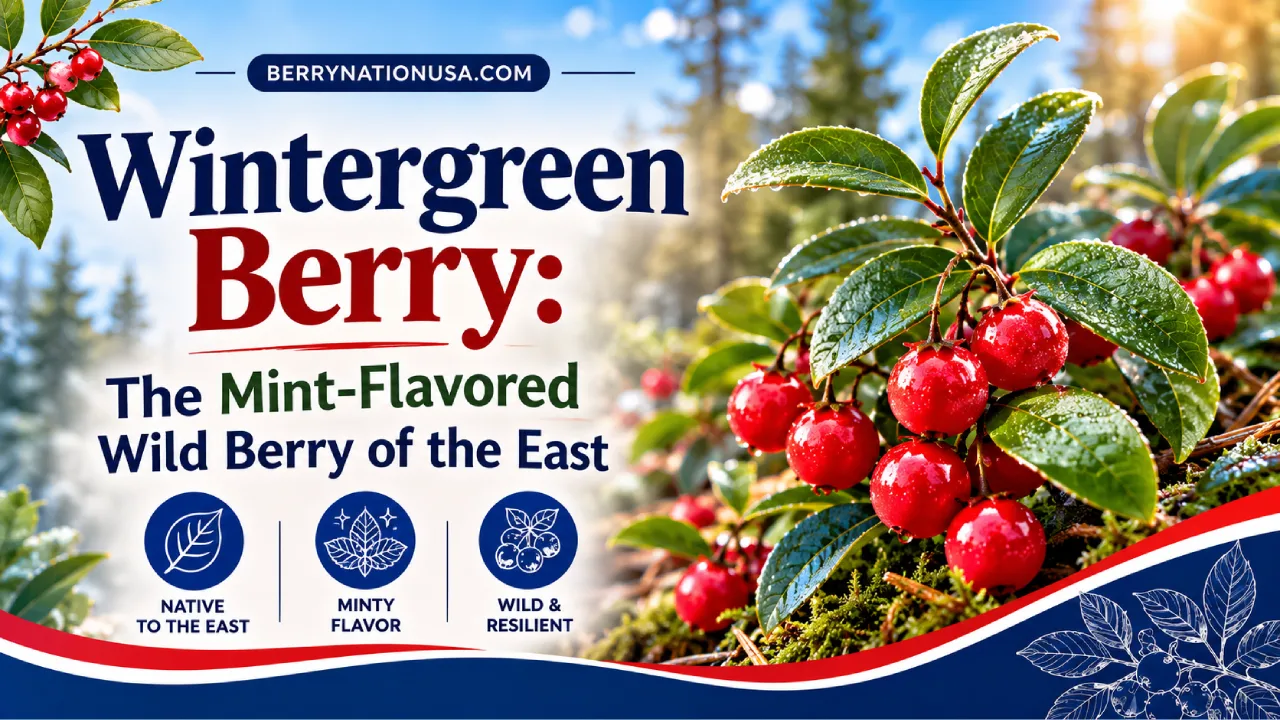
Somewhere in a northeastern forest, beneath the snow of January, a small evergreen plant with bright red berries is waiting — still edible, still fragrant, still perfectly preserved by the cold. Crush a leaf between your fingers and the scent hits immediately: that clean, sharp, deeply familiar wintergreen mint that you know from chewing gum and candy but have probably never encountered from its source. This is Gaultheria procumbens — one of the most distinctive and historically important wild plants in eastern North America.
This complete guide covers everything about wintergreen berry: the botanical profile, a clear answer on edibility and safety, what the berries and leaves taste like, where the plant grows across the eastern United States, the chemistry behind methyl salicylate and why it matters both medicinally and for safety, traditional Indigenous uses that shaped American medicine, foraging tips for finding wintergreen through all four seasons, and how to use the berries and leaves in tea, cooking, and home preparations.
Safety note — read before foraging or using
Wintergreen berries and leaves are safe in small amounts for healthy adults and older children. However, wintergreen essential oil is extremely dangerous — even small quantities can cause fatal salicylate toxicity. Never use wintergreen essential oil internally. A few fresh berries or a cup of leaf tea carries very different risk than any concentrated extract. Avoid wintergreen in any form if you are pregnant, have aspirin sensitivity, take blood thinners, or take NSAIDs. Consult a healthcare provider before medicinal use.
Botanical Profile: What Is Wintergreen?
Wintergreen (Gaultheria procumbens) is a low-growing, mat-forming evergreen shrub in the heath family (Ericaceae) — the same family as blueberries, cranberries, and bearberry. It is native to eastern North America, from Newfoundland south through the Appalachian Mountains to Georgia and Alabama, and west through the Great Lakes to Manitoba.
The plant’s most immediately striking characteristic is its scent. Crush a single leaf between your fingers and the distinctive wintergreen aroma fills the air instantly — clean, sharp, cool, intensely minty. This scent comes from methyl salicylate, a volatile organic compound produced in the leaf and berry tissue that is both the source of wintergreen’s flavor and the basis of its long medicinal history.
Gaultheria procumbens was for centuries the primary commercial source of natural wintergreen oil — before the compound could be synthesized cheaply, entire forests of the plant were harvested across the Appalachians to supply the flavoring and pharmaceutical industries. The distinctive wintergreen flavor in candies, gum, and medicines that most Americans know comes from a synthetic version of the same compound the plant produces naturally.
Scientific name: Gaultheria procumbens | Family: Ericaceae | Common names: Wintergreen, teaberry, checkerberry, eastern teaberry, mountain tea
Height: 3–6 inches (mat-forming ground cover) | Berry color: Bright red | Season: September–October ripening; persists year-round
USDA Zones: 3–8 | Key compound: Methyl salicylate | Flavor: Classic wintergreen mint
How to Identify Wintergreen
Wintergreen is one of the most reliably identifiable wild plants in the eastern forest. Its combination of features is unique, and the scent test alone makes confusion with any other plant essentially impossible.
The leaves — the primary identifier
- Shape: Oval to elliptical, 1–2 inches long, with a pointed tip and finely toothed edges
- Texture: Thick and leathery, glossy dark green on top, paler below — persisting through winter without wilting
- Arrangement: Clustered near the tips of short stems in whorled or rosette-like groups of 2–6 leaves
- The scent test: Crush any part of the plant — leaf, stem, or berry — and inhale. The immediate, unmistakable wintergreen aroma is the single most reliable identification feature of this plant. No dangerous plant in Gaultheria’s range produces this scent
The stems
- Slender, slightly woody, upright stems 3–6 inches tall arising from creeping underground rhizomes
- Reddish to brownish, smooth, without thorns or prickles
- The creeping rhizome system spreads slowly to form dense colonies
The flowers
Small, white, urn-shaped flowers (the same characteristic bell shape of all Ericaceae family members) hanging downward from the leaf axils in July and August. They are 5–6mm long, waxy-looking, and faintly fragrant. The downward-hanging urn shape is very similar to bearberry flowers — both are members of the same family.
The berries
- Color: Bright red — a vivid, saturated red that stands out dramatically against the dark glossy leaves and the brown forest floor
- Size: 6–10mm in diameter — similar to a small cranberry or bearberry
- Structure: A fleshy capsule rather than a true drupe or berry in the botanical sense — the red flesh is actually the enlarged calyx surrounding the true fruit within. Each “berry” contains several tiny seeds
- Persistence: Berries ripen in September–October and remain on the plant through winter, under snow, and well into the following spring and summer — one of the few wild berries available for foraging in January and February in the Northeast
- Texture: Slightly mealy or grainy compared to a raspberry or blueberry, with a firm outer skin
- Scent: The wintergreen aroma is immediately present when you crush or bite a berry
Habitat identification
Wintergreen is a plant of acidic, forested environments. It strongly prefers:
- The understory of oak, pine, and hemlock forests
- Acidic, humus-rich, well-drained soils
- Partial to full shade — it is one of few berry plants that thrives in deep forest shade
- Sandy or rocky acidic soils where the forest floor is covered with pine needles
Finding wintergreen is often a matter of searching the forest floor in acidic pine and oak woods in the Northeast and Appalachians. In good habitat, the plant can carpet the forest floor in dense colonies extending many square feet — the glossy leaves and red berries are distinctive even in low winter light.
Potential look-alikes
No dangerous plant shares wintergreen’s distinctive scent. However, two plants are sometimes confused with wintergreen visually:
- Partridgeberry (Mitchella repens): Another low-growing forest floor plant with red berries, but partridgeberry has distinctive paired berries (two berries fused together with two dimples visible at the tip), small rounded leaves with white veins, and no wintergreen scent. Safe to eat and a pleasant mild flavor, but clearly different once you know the scent test
- Lily of the valley (Convallaria majalis): Red berries in shady woods, but lily of the valley has broad lance-shaped leaves, no wintergreen scent, and berries that grow in clusters rather than individually. Toxic — do not eat. The scent test immediately distinguishes wintergreen from this plant
The scent test resolves all ambiguity: if crushing the leaf produces the unmistakable wintergreen aroma, it is Gaultheria procumbens.
Are Wintergreen Berries Edible? Full Safety Breakdown
Wintergreen berries are edible — this is the clear, direct answer. They have been eaten by Indigenous peoples and settlers across the Northeast and Appalachians for centuries. However, understanding the safety context around methyl salicylate is essential before eating them in quantity.
What is safe
- Fresh berries eaten directly: A handful of wintergreen berries (10–20 berries) is safe for healthy adults. The flavor is strong enough that most people naturally self-limit their consumption — eating a large quantity of intensely flavored wintergreen berries is difficult simply because of the flavor intensity
- Wintergreen leaf tea: 1–2 cups per day of tea made from fresh or dried leaves is considered safe for healthy adults without aspirin sensitivity
- Berries used as flavoring: Small amounts in cooking, baking, or beverages — safe in culinary quantities
- Fresh berries for children: A few berries (3–5) are safe for older children; smaller amounts for younger children
What is dangerous
- Wintergreen essential oil: Extremely dangerous — 1 teaspoon contains the salicylate equivalent of 21 adult aspirin tablets. Even small amounts applied to skin can cause systemic toxicity. Keep completely away from children. Never use internally
- Very large quantities of berries: Eating cups of wintergreen berries could theoretically cause salicylate toxicity, though the intensity of the flavor makes this an unlikely accident
- People with aspirin sensitivity: Methyl salicylate cross-reacts with aspirin allergy — avoid entirely
- Pregnant women: Salicylates in high doses have been associated with pregnancy complications — avoid medicinal wintergreen use during pregnancy
- Blood thinner users (warfarin, etc.): Methyl salicylate has anticoagulant properties that can interact with blood-thinning medications
- NSAID users: Combining methyl salicylate with ibuprofen, aspirin, or naproxen increases bleeding risk
The practical summary: eating a modest amount of fresh wintergreen berries or drinking a cup of wintergreen tea is a pleasant, safe experience for most healthy adults. The danger is not from casual berry tasting but from concentrated preparations, particularly the essential oil, which should be treated as a hazardous substance rather than a food.
What Do Wintergreen Berries Taste Like?
The flavor of a fresh wintergreen berry is one of the most immediately recognizable in all of wild foraging — and one of the most surprising to people who encounter it for the first time in the field.
The taste is: intensely, unambiguously wintergreen mint. Exactly the flavor of wintergreen Life Savers, winter-fresh gum, and birch beer soda. Cool, sharp, aromatic, slightly sweet, and with a clean medicinal edge that is completely distinctive. If you have ever tasted any wintergreen-flavored candy or gum, you know exactly what a fresh wintergreen berry tastes like — the artificial flavoring industry copied this plant’s chemistry precisely.
The texture is firm and slightly mealy compared to a soft berry like a raspberry or blueberry. There is a thin, somewhat tough red skin, and the flesh inside is white to cream-colored and drier than most berries. The overall eating experience is less about juiciness and more about the extraordinary aroma-flavor hit that comes from biting into the berry.
The flavor intensifies with fermentation and cold: Berries that have been through repeated freeze-thaw cycles over winter develop a deeper, slightly fermented wintergreen flavor that many foragers prefer to the fresh-picked fall berry. The winter berries — dug from under snow in January or February — are considered by experienced foragers to be at their flavor peak. The cold concentrates the methyl salicylate and the berry’s natural sugars, producing a more complex, sweeter experience than the newly ripened fall berry.
The leaves taste identical to the berries — the same wintergreen punch from the same methyl salicylate compound. Both can be chewed raw as a trail snack (a single leaf is the traditional “teaberry” experience) or used to make tea.
Wintergreen vs Peppermint: What’s the Difference?
The wintergreen-peppermint confusion is one of the most common flavor misidentifications in American food culture, and understanding it reveals something interesting about how similar smells can come from completely different chemical pathways.
| Feature | Wintergreen (G. procumbens) | Peppermint (Mentha × piperita) |
|---|---|---|
| Plant family | Ericaceae (heath family) | Lamiaceae (mint family) |
| Active flavor compound | Methyl salicylate | Menthol |
| Flavor character | Warm, deep, aromatic, slightly sweet mint | Cool, sharp, clean, refreshing |
| Chemical relation to aspirin | Yes — methyl salicylate is related to salicylic acid | No — menthol is a terpene alcohol |
| Plant size | 3–6 inch ground cover | 1–3 feet upright herb |
| Produces berries? | Yes — bright red, edible | No fruit produced |
| Safe with blood thinners? | No — interacts with anticoagulants | Yes in food amounts |
| Famous products using the flavor | Wintergreen Life Savers, birch beer, Pepto-Bismol | Peppermint patties, toothpaste, herbal teas |
The distinction matters practically because methyl salicylate has aspirin-like physiological effects while menthol does not. Someone who is told to avoid aspirin and NSAIDs (which includes menthol-containing peppermint with no concern) needs to also avoid wintergreen preparations.
Where Wintergreen Grows in the USA
Wintergreen is a native of eastern North America with a range spanning from the Canadian Maritime provinces south through the Appalachian Mountains to Georgia and Alabama, and west through the Great Lakes region. It is one of the defining plants of the northeastern acidic forest floor.
| Region | Abundance | Best habitat |
|---|---|---|
| New England (ME, NH, VT, MA, CT) | Very abundant | Acidic pine and oak forests, especially under hemlock and jack pine |
| Mid-Atlantic (NY, PA, NJ, MD) | Very common | Pitch pine barrens (NJ Pine Barrens especially), oak ridges, rocky woodland floors |
| Appalachians (VA, WV, NC, TN, GA) | Common at elevation | Mountain forest understory, heath balds, ridge-top woods |
| Great Lakes (MI, WI, MN, OH) | Common | Jack pine and mixed woods, sandy acidic forest floors |
| Southeast coastal plain (SC, GA, AL) | Occasional | Longleaf pine savanna understory, sandy acidic soils |
The New Jersey Pine Barrens deserve special mention — this unique acidic sandy ecosystem hosts exceptionally dense wintergreen populations, along with many other acid-loving plants. Hiking through the Pine Barrens in winter with eyes on the sandy forest floor reveals carpets of wintergreen with persistent red berries visible through light snow. The plant is also abundant throughout the White Mountains, the Catskills, the Adirondacks, and the entire length of the Appalachian Trail — one of the most commonly encountered plants for long-distance hikers in the eastern mountains.
Methyl Salicylate: The Active Compound Explained
Understanding methyl salicylate is the key to understanding everything about wintergreen — its flavor, its medicinal history, its safety considerations, and its commercial importance.
What methyl salicylate is
Methyl salicylate is an organic ester — a compound formed from salicylic acid and methanol. It is produced by Gaultheria procumbens and a handful of other plants as a natural defense compound against herbivores and pathogens. The intense aroma functions as a deterrent to many insects and larger herbivores, while also attracting specific pollinators and seed dispersers that have co-evolved with the plant.
The aspirin connection
Salicylic acid — the acid from which methyl salicylate is derived — is also the parent compound of aspirin (acetylsalicylic acid). This chemical relationship explains why wintergreen has historically been used for pain relief and inflammation, and why it carries the same contraindications as aspirin. When methyl salicylate is absorbed through skin or digested, it is metabolized to salicylic acid, which has the same anti-inflammatory and pain-relieving effects as aspirin. Wintergreen rubbing compounds like Ben-Gay and Icy Hot use this mechanism — the methyl salicylate penetrates skin and converts to salicylic acid, reducing local inflammation and pain.
Commercial history
Before synthetic chemistry made cheap production possible in the late 19th century, Gaultheria procumbens was the sole source of commercial wintergreen oil. Entire Appalachian communities were involved in the distillation industry — steam-distilling enormous quantities of plant material to extract the volatile oil. Pennsylvania and New York were major centers of production. The distillation of wintergreen oil was one of the first chemical industries in North America, predating the formal pharmaceutical industry by decades. The industry declined rapidly after the synthesis of methyl salicylate from salicylic acid became commercially viable around 1875, but the wild plant populations that fueled this industry remain across the Appalachians today.
Health Benefits of Wintergreen
Anti-inflammatory and pain relief — the salicylate mechanism
The primary documented health benefit of wintergreen is topical anti-inflammatory and pain-relieving activity through methyl salicylate. Applied to skin, methyl salicylate penetrates tissue and is metabolized to salicylic acid, which inhibits cyclooxygenase (COX) enzymes — the same mechanism as aspirin and ibuprofen. The FDA recognizes methyl salicylate as an approved active ingredient in over-the-counter topical analgesics. Research published in the British Journal of Clinical Pharmacology confirmed the bioavailability and anti-inflammatory efficacy of topically applied methyl salicylate. Commercial products including Ben-Gay, Icy Hot, and Tiger Balm use this mechanism. Traditional wintergreen leaf poultices applied for arthritis, muscle soreness, and headache are pharmacologically validated by this research.
Antibacterial properties
Methyl salicylate and other compounds in wintergreen have demonstrated antibacterial activity against several pathogenic bacteria in laboratory research. A study published in Phytotherapy Research found that Gaultheria procumbens essential oil exhibited significant antimicrobial activity against Staphylococcus aureus, Bacillus subtilis, and several other bacteria. The traditional use of wintergreen for mouth freshening and mild oral infections has pharmacological support from this research — though again, the essential oil used in research is far more concentrated than fresh berries or leaf tea.
Antioxidant activity
Wintergreen berries contain anthocyanins (the red pigments), flavonoids, and other polyphenol antioxidants that provide general oxidative protection. While wintergreen is not typically highlighted as an antioxidant powerhouse compared to berries like blackberries or elderberries, the antioxidant contribution of the whole berry consumed fresh is a genuine nutritional benefit alongside the more famous methyl salicylate activity.
Digestive support
Traditional herbalists have used wintergreen tea for digestive complaints including gas, bloating, and stomach cramps. The carminative (gas-reducing) and antispasmodic effects of methyl salicylate on smooth muscle tissue provide plausible pharmacological support for this use. Wintergreen tea taken after meals is a traditional New England folk remedy for indigestion that has genuine pharmacological rationale.
Oral health
The antimicrobial properties of methyl salicylate, combined with the pleasant fresh flavor, make wintergreen an effective natural mouth freshener with genuine bacteria-reducing action. The use of wintergreen in toothpastes, mouthwashes, and dental products is well-established. Chewing a fresh wintergreen leaf is one of the oldest trail-tested breath fresheners in North American foraging tradition — and it genuinely works. The leaf tea used as a mouth rinse provides mild antimicrobial benefits to the oral cavity.
Indigenous and Historical Significance
Indigenous uses — “teaberry” culture
Among the most widespread Indigenous uses of wintergreen was the preparation of a simple tea from the leaves — steeped in hot water to produce a fragrant, mildly medicinal drink. The Ojibwe, Cree, Potawatomi, Menominee, Haudenosaunee (Iroquois), and many other nations used wintergreen leaf tea for headache, fever, rheumatic pain, and as a general tonic. The Cherokee used the plant for back pain and rheumatism. The Algonquian peoples of the northeastern coast incorporated the berries and leaves into food and medicine.
The common name “teaberry” — still widely used in parts of New England — directly references this tradition of tea-making that predates European contact by thousands of years. The term “mountain tea” reflects the Appalachian practice of gathering wintergreen leaves for brewing during mountain journeys.
Revolutionary War history
Wintergreen played a documented role in the American Revolutionary War. When the British trade blockade cut off access to Chinese tea, American colonists sought local alternatives. Wintergreen leaf tea — already known from Indigenous traditions — became one of the most widely used “liberty teas” of the period, drunk by colonists who refused to import British-taxed tea. The historical record documents wintergreen as one of the primary tea substitutes during the war years, a detail that gives the humble forest floor plant an unexpected place in American political history.
The Pennsylvania Dutch tradition
Among Pennsylvania Dutch communities, wintergreen berries — called “checkerberries” — were a traditional folk candy and trail snack gathered by children in autumn. The intensely flavored red berries were familiar to generations of rural Pennsylvania children in the same way that wild strawberries or blackberries were familiar to children in other regions. This tradition is documented in Pennsylvania Dutch foodways literature and represents a uniquely regional relationship with a nationally widespread plant.
Foraging Guide: All Four Seasons
Wintergreen is one of the few wild berry plants that rewards foraging across all four seasons — each season offering a different experience of the same plant.
Fall (September–November): fresh ripe berries
Berries ripen to bright red in September and October. This is the season for fresh berry eating and for harvesting the largest quantities. The berries are at their most aromatic — the methyl salicylate content is highest in newly ripened fruit. Look for the characteristic red berries against glossy dark green leaves in acidic forest understory. The combination of the red berry color and the scent test makes identification certain.
How to pick: The berries are individually attached to short stems from the leaf axils. Pick by rolling the berry gently between thumb and forefinger — ripe berries detach with minimal pressure. Avoid picking berries that require significant force; they may be slightly unripe and will be drier and more astringent.
Winter (December–March): the best-kept secret
This is wintergreen’s most magical foraging season and the one that most Americans have never experienced. The berries persist on the plant through winter, remaining perfectly edible under snow. Dig gently through snow in known wintergreen patches and the red berries will be there — slightly fermented from freeze-thaw cycles, often sweeter than fall-picked berries, and carrying a deeper, more complex wintergreen flavor.
The ability to find fresh wild berries in January in New England — kneeling in the snow, brushing it aside to reveal the glossy red berries and dark leaves underneath — is one of the most genuinely surprising foraging discoveries available in the eastern United States. For hikers on the Appalachian Trail or other winter trails, wintergreen berries are a reliable trail snack available when almost nothing else is.
Spring (April–May): young leaves
Young, newly emerging wintergreen leaves in spring have a particularly fresh, bright flavor and can be eaten directly as a trail nibble or steeped into tea. They are also more tender than mature leaves, though the flavor is the same methyl salicylate-driven wintergreen. Spring is a good time to harvest leaves for drying, as the new growth is particularly aromatic.
Summer (June–August): flowers and older berries
The small white urn-shaped flowers appear in July and August and can be nibbled — they have the same wintergreen flavor in a delicate floral package. Berries from the previous year’s crop may still be present through early summer, though they will be drier and less flavorful than fresh-picked berries. Look for both last year’s old berries and the developing green berries of the current year’s crop on the same plant simultaneously.
Foraging ethics
- Forage only on public land or with landowner permission
- Take no more than 20–25% of berries from any colony — leave the rest for wildlife (ruffed grouse, wild turkey, white-tailed deer, and many other species depend on wintergreen berries as winter food)
- When harvesting leaves, never remove more than one-third of a plant’s leaves — the plant needs them for photosynthesis
- Avoid picking near roadsides with heavy traffic or in areas that may have been sprayed
Growing Wintergreen at Home
Wintergreen is an excellent native ground cover for shaded, acidic garden settings — particularly under pine, oak, or hemlock trees where few other plants thrive. It is primarily valuable as an ornamental and wildlife plant, with the bonus of edible berries and aromatic leaves.
| Requirement | Ideal conditions | Notes |
|---|---|---|
| USDA Zones | 3–8 | Best in cool, humid northeastern and Great Lakes climates |
| Soil pH | 4.5–5.5 (acidic) | Will not thrive in neutral or alkaline soil; amend with sulfur or peat if needed |
| Sunlight | Partial to full shade | One of the few berry plants that tolerates deep shade; more berries in partial shade |
| Soil type | Well-drained, humus-rich | Excellent drainage essential; does not tolerate waterlogged conditions |
| Moisture | Moderate — consistent moisture | Mulch with pine needles to maintain moisture and soil acidity |
| Spread | Slow via underground rhizomes | Takes 2–3 years to form a dense mat; plant 12–18 inches apart |
| Ornamental value | Year-round interest | Glossy evergreen leaves + red berries through winter = outstanding native ground cover |
Wintergreen is one of the best native ground covers for the challenging environment under mature acid-soil trees where most plants struggle. It requires very little maintenance once established, tolerates drought better than many shade plants, and provides ecological value through winter as a berry food source for wildlife. The key to success is starting with the right soil pH — without adequate acidity, the plant will slowly decline regardless of other conditions.
Purchase container-grown plants from native plant nurseries — do not transplant from the wild, as the mycorrhizal associations the plant depends on rarely survive disturbance. Pine needle mulch applied annually maintains soil acidity and mimics the natural forest floor environment.
How to Use Wintergreen: Tea, Cooking, and More
Wintergreen leaf tea — the classic preparation
The simplest and most traditional wintergreen preparation. For fresh leaf tea: steep 8–10 fresh wintergreen leaves (or 1 teaspoon of dried, crumbled leaves) in 1 cup of just-boiled water for 10 minutes. Strain and add honey if desired. The resulting tea is a beautiful pale green with an unmistakable wintergreen aroma and a clean, slightly medicinal mintiness. Drink 1–2 cups per day — not more, and not daily for extended periods. This is exactly the “mountain tea” that Indigenous peoples, Revolutionary War colonists, and Appalachian Trail hikers have been drinking for centuries.
Cold-water infusion for stronger flavor: For a more concentrated flavor with less bitterness, cold-steep 15–20 fresh leaves in 2 cups of cold water for 8–12 hours in the refrigerator. Strain and drink cold or gently warm. This method extracts the aromatic methyl salicylate very effectively while producing a less astringent infusion than hot steeping.
Fresh berries as trail candy
The original and best wintergreen berry preparation: eat them fresh, directly from the plant. Pop a berry in your mouth on the trail, bite through the firm skin, and let the burst of wintergreen flavor arrive. This is the “teaberry” experience that New England children knew for generations. Limit yourself to 10–20 berries as a reasonable trail snack.
Wintergreen berry jelly
Collecting enough wintergreen berries for jelly requires patience — the berries are small and the plant produces them individually rather than in large clusters. But the reward is a jelly unlike anything commercially available. Simmer 3 cups of wintergreen berries with ½ cup of water for 15 minutes until soft. Mash and strain through a jelly bag (the seeds are tiny and will pass through fine mesh — use cheesecloth for a clearer jelly). Measure extracted juice and combine with equal weight of sugar and a tablespoon of lemon juice. Bring to 220°F and pour into sterilized jars. The resulting jelly is a deep ruby-red with an extraordinary wintergreen mint flavor that is genuinely stunning on biscuits, scones, or paired with sharp cheddar cheese.
Wintergreen-infused honey
Gently warm 1 cup of raw honey to just below simmering (do not boil). Add 15–20 fresh wintergreen leaves and allow to infuse off heat for 2 hours, then strain. The resulting honey takes on a beautiful wintergreen aroma and flavor that is subtler and more complex than the raw leaf. Use over pancakes, stirred into tea, on yogurt, or as a glaze for roasted root vegetables. Keeps indefinitely in a sealed jar.
Wintergreen sprigs in drinks
A sprig of 3–4 wintergreen leaves added to a cocktail, mocktail, or sparkling water provides an elegant, unusual mint garnish with a distinctly different character from peppermint or spearmint. The leaves release methyl salicylate gradually into the drink, creating a subtle wintergreen background note. Particularly good in apple cider, whiskey sours, and craft ginger ales.
Frequently Asked Questions About Wintergreen Berry
Are wintergreen berries edible?
Yes — wintergreen berries are edible and safe in modest amounts for healthy adults. A handful of fresh berries or a cup of leaf tea carries minimal risk. The danger is with large quantities or concentrated preparations — particularly wintergreen essential oil, which should never be consumed and contains enough methyl salicylate to cause serious harm even in small amounts. Avoid wintergreen if you take blood thinners, have aspirin sensitivity, or are pregnant.
What do wintergreen berries taste like?
Exactly like classic wintergreen mint — the same flavor as wintergreen Life Savers, wintergreen gum, and birch beer soda. Intensely aromatic, cool, slightly sweet, and with a distinctive medicinal mint quality. The flavor comes from methyl salicylate, the same compound used as artificial wintergreen flavoring in commercial products. Winter-picked berries that have been through freeze-thaw cycles are often considered more flavorful than freshly ripened fall berries.
Is wintergreen the same as peppermint?
No — completely different plants with different active compounds. Wintergreen’s flavor comes from methyl salicylate (chemically related to aspirin); peppermint’s comes from menthol (a terpene alcohol with no aspirin relationship). The flavors are similar to the palate but distinguishable — wintergreen is warmer and deeper; peppermint is cooler and sharper. The important practical difference is that methyl salicylate interacts with blood thinners and NSAIDs while menthol does not.
When do wintergreen berries ripen?
Wintergreen berries ripen in September and October across most of the eastern US. Crucially, they do not drop from the plant after ripening — they persist through the entire winter, remaining edible under snow and into the following spring and summer. This makes wintergreen one of the only wild berries that can be foraged in January and February in the northeastern US.
Can you make tea from wintergreen leaves?
Yes — wintergreen leaf tea has a centuries-long tradition among Indigenous peoples and colonial Americans. Steep 8–10 fresh leaves or 1 teaspoon of dried leaves in hot water for 10 minutes. Drink 1–2 cups per day in moderation. Avoid if you take blood thinners, NSAIDs, or aspirin, or if you have aspirin sensitivity. This is the same “mountain tea” and “liberty tea” brewed by Revolutionary War colonists who rejected British-taxed imports.
Is wintergreen berry safe for children?
A few fresh berries (3–5) are safe for healthy older children as a trail snack. Younger children should eat fewer. The intense flavor naturally limits overconsumption. Keep wintergreen essential oil completely away from all children — it is extremely dangerous and not comparable to eating fresh berries. Do not give wintergreen products to children who take aspirin or have any salicylate sensitivity.
Why is it called wintergreen?
Wintergreen gets its name from two of its most distinctive characteristics: it stays green through winter (unlike most forest floor plants, the leaves persist and remain green under snow) and it remains available for foraging through winter (the red berries persist on the plant through the entire cold season). The plant was one of the few green, berry-producing plants visible in the northeastern forest in the depths of winter, making its name both descriptive and memorable to the settlers and Indigenous peoples who relied on it.
Conclusion: The Forest’s Most Familiar Wild Flavor
The wintergreen berry holds a unique position among North American wild plants: it is the source of a flavor so deeply embedded in American candy and gum culture that millions of people know it intimately without knowing it comes from a small forest floor plant that grows under the snow in January. The gap between the synthetic flavor in a stick of wintergreen gum and the real berry on a New England forest floor is the gap between a photograph and the place it was taken — recognizable but not the same thing at all.
Finding wintergreen in a pine forest, crushing a leaf to release that immediate, unmistakable aroma, or kneeling in winter snow to find bright red berries waiting beneath — these are experiences that reframe a familiar flavor entirely. The artificial version you have known all your life turns out to have been a copy of something genuinely remarkable growing wild across eastern North America, available to anyone willing to look down at the forest floor.
More from Berry Nation USA
- Bearberry (Uva-Ursi): Edible Wild Berry and Natural UTI Remedy
- Cranberry: More Than a Holiday Staple
- Blueberry Complete Guide: America’s Native Superfruit
- Serviceberry (Juneberry): America’s Forgotten Native Berry
- Chokecherry: Tart Native Berry, Safety & Jelly Recipe
- Wild Blackberries of America: Complete ID & Foraging Guide
- How Many Berries Should I Eat a Day?