
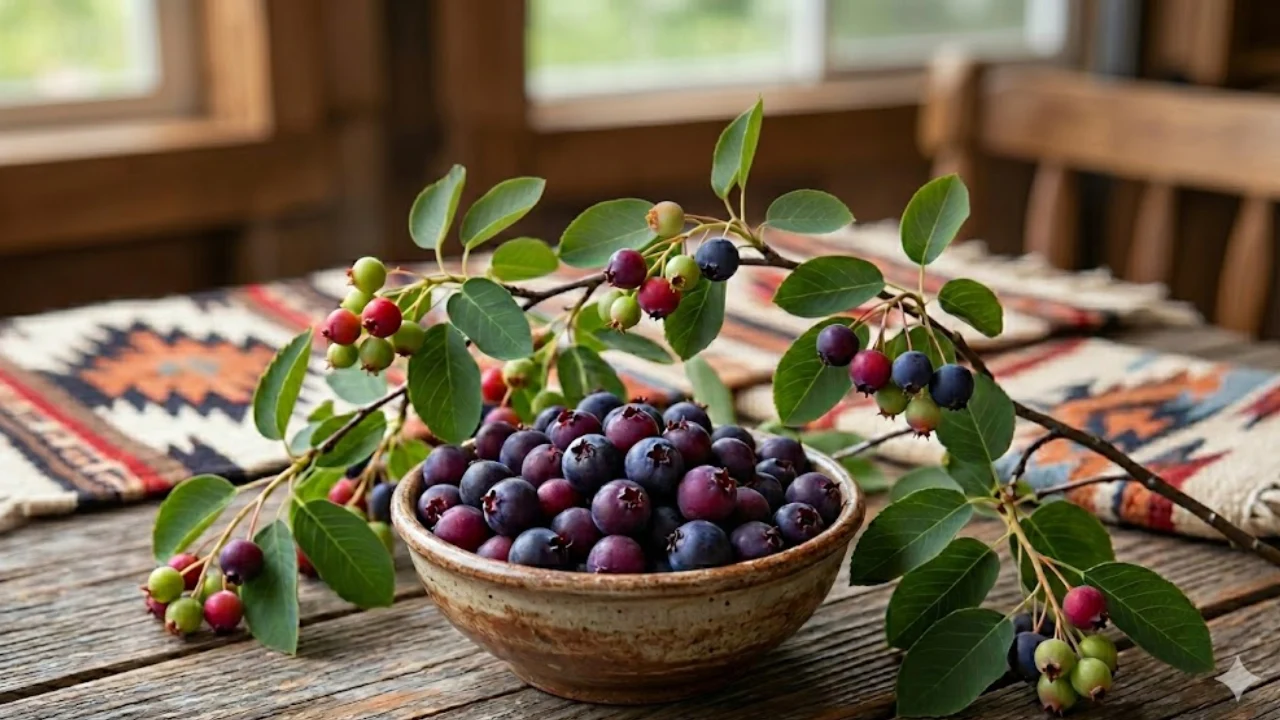
There is a native American berry that produces clouds of white spring blossoms before almost any other tree flowers, ripens into sweet purple fruit in June when fresh berries are still scarce, feeds more bird species than almost any other shrub, and tastes like a blueberry crossed with a cherry with a hint of almond. You have almost certainly walked past it without recognizing it. This is the serviceberry — America’s most overlooked native fruit.
This complete guide covers everything about serviceberries: the many names this plant goes by and why, a full botanical and species breakdown, detailed identification, taste profile, nutrition facts, six health benefits, a regional foraging guide, why birds beat you to every patch, growing it as a landscape and food plant, storage tips, and five recipes. Whether you are a forager, a home gardener, or someone who simply wants to know what that tree in the park is producing — this is your definitive serviceberry resource.
All the Names: Serviceberry, Juneberry, Saskatoon, Shadbush
One reason serviceberries are so underappreciated is that no one agrees on what to call them. Depending on where in North America you are, the same genus of plants might be called:
- Serviceberry — the most widely used name in the continental US, applied to most Amelanchier species
- Juneberry — common in the Midwest and Great Plains, referencing the June ripening window
- Saskatoon — the dominant name in Canada and the northern Great Plains, specifically for Amelanchier alnifolia. The city of Saskatoon, Saskatchewan takes its name from the Cree word mis-ask-quah-toomina for this berry
- Shadbush or shadblow — used in the Northeast, because the flowers bloom at the same time shad fish migrate upstream to spawn
- Sugarplum — a less common name used in some parts of Appalachia
- Wild plum or Indian cherry — historical names used by early European settlers who were unfamiliar with the plant
All of these names refer to plants in the genus Amelanchier. For this guide we use “serviceberry” as the primary name, but if you encounter any of the others, know they refer to the same excellent wild fruit.
As for the origin of “serviceberry” — the most widely accepted explanation is that the flowers bloomed in the Appalachian mountains at the time when frozen ground finally thawed enough to dig graves for those who died during winter, allowing burial services to be held. The flowering serviceberry marked the return of burial season. It is a grim etymology for such a beautiful and delicious plant, but it speaks to how deeply embedded these trees were in the rhythms of early American life.
Botanical Profile and Key Species
Serviceberries belong to the genus Amelanchier in the rose family (Rosaceae) — the same family as apples, cherries, pears, and roses. There are approximately 20 species of Amelanchier native to North America, ranging from large multi-stemmed shrubs to small single-trunk trees up to 40 feet tall. All species produce edible berries, though they vary in fruit size, flavor, and productivity.
Genus: Amelanchier | Family: Rosaceae | Common names: Serviceberry, juneberry, Saskatoon, shadbush
Native to: All of North America | Fruit color: Red ripening to dark purple | Season: May–July (region dependent)
USDA Zones: 2–9 depending on species | Height: 6–40 feet depending on species
The key species you are most likely to encounter as a forager or home gardener in the United States:
| Species | Common name | Range | Best features |
|---|---|---|---|
| Amelanchier alnifolia | Saskatoon serviceberry | Western North America, Great Plains | Best flavor; largest fruit; commercially grown in Canada |
| Amelanchier laevis | Allegheny serviceberry | Eastern North America | Excellent flavor; grows as small tree; ornamental spring flowers |
| Amelanchier canadensis | Canada serviceberry / shadbush | Northeast US, Atlantic coast | Tolerates wet soils; prolific bloomer; good foraging species |
| Amelanchier arborea | Downy serviceberry | Eastern and central North America | Largest tree form; common in forests and roadsides; widespread |
| Amelanchier utahensis | Utah serviceberry | Intermountain West | Drought-tolerant; important wildlife food in arid regions |
| Amelanchier stolonifera | Running serviceberry | Northeast, Great Lakes | Low-growing colony-forming; rocky barrens and pine plains |
How to Identify Serviceberries
Serviceberries are one of the most distinctive and identifiable native plants in North America once you know what to look for. The sequence of features through the seasons makes them progressively easier to confirm:
Spring: the flowers (first to bloom)
Serviceberry flowers are one of the most beautiful and earliest spectacles of the North American spring. They appear in March through May (depending on latitude and elevation) — often while the tree is still leafless or just unfurling new leaves — as dense clusters of pure white, five-petaled flowers with long, narrow petals that give them a slightly feathery appearance. This combination of timing (earliest flowering woody plant in many regions) and flower form (long narrow white petals, 5 per flower) is uniquely identifiable. In the eastern US, serviceberry flowering is a reliable phenological marker — it blooms before most other native shrubs and trees.
Summer: the fruit
- Color progression: Berries begin green, turn red, and ripen to deep purple — almost identical to the color transition of a blueberry. Fully ripe serviceberries are a uniform dark purple, sometimes with a slight blue bloom
- Size: 6–12mm in diameter depending on species — slightly smaller than a cultivated blueberry but larger than a wild lowbush blueberry
- Crown: Like a blueberry, serviceberries have a small five-pointed calyx crown at the tip — this feature is very reliable for confirmation
- Cluster arrangement: Berries hang in elongated clusters (racemes) of 4–10 fruits, which droop gracefully when ripe. This raceme arrangement distinguishes them from blueberries, which grow with berries more independently on the branch
- Seeds: Each berry contains 4–10 small, soft seeds — softer than huckleberry seeds, similar in size but fewer than blueberry seeds
Year-round: the plant itself
- Leaves: Simple, alternate, oval to round with fine teeth along the edges. Emerging leaves in spring often have a distinctive bronze or reddish tinge (especially in A. laevis) before turning green. In fall, serviceberry leaves turn brilliant orange, red, and yellow — making them a sought-after landscape plant
- Bark: Smooth gray bark with fine vertical striations, similar to a young cherry or birch. Distinctive and elegant — serviceberry bark is one of the prettiest of any native tree
- Habit: Multi-stemmed shrub or small tree with a graceful, arching form. Typically 10–25 feet tall in forest settings; shorter in open prairie or exposed conditions
Are there dangerous look-alikes?
This is reassuring news for foragers: serviceberries have no seriously dangerous look-alikes in North America. The combination of the distinctive white five-petaled spring flowers, the calyx crown on the berry tip, the elongated fruit cluster arrangement, and the smooth gray bark together create an identification profile that is not shared by any toxic species. The closest potential confusion is with chokecherry (Prunus virginiana), which also produces dark berries in clusters — but chokecherry fruit grows in longer, denser cylindrical clusters, the pits are large and hard (toxic), and the leaves have a distinctly different shape. When serviceberries are confirmed by their spring flowers before the fruit develops, the identification is essentially certain.
What Do Serviceberries Taste Like?
Serviceberries are genuinely delicious — which makes their obscurity all the more puzzling. The flavor profile is distinctive enough to be memorable and versatile enough to work in virtually any culinary application.
The best description of a ripe serviceberry: imagine a blueberry that has been crossed with a mild cherry and given a hint of almond. The sweetness is pronounced — ripe serviceberries are sweeter than blueberries with less of the tartness. There is a mild nuttiness from the seeds (which contain amygdalin, the same compound that gives almonds their flavor) and a soft, yielding texture more like a ripe grape than a blueberry. The overall impression is of a berry that is sweet, complex, and deeply satisfying.
Flavor varies meaningfully by species and ripeness:
- Amelanchier alnifolia (Saskatoon): Generally considered the best-flavored species — large, sweet, and with the most pronounced almond note. The berries used in commercial Saskatoon production in Canada are selected cultivars of this species
- Amelanchier laevis (Allegheny serviceberry): Excellent flavor, often considered the best of the eastern species — sweet and juicy with good complexity
- Amelanchier arborea (Downy serviceberry): Good but slightly more seedy and sometimes drier than other species
- Underripe serviceberries: Noticeably inferior — pale, dry, and tasteless. Wait for full dark purple color before eating
The almond-like flavor from the seeds is one of serviceberry’s most distinctive qualities and one that people either love immediately or grow to appreciate. It makes serviceberry jam taste more complex than blueberry jam, and serviceberry pie more interesting than apple pie made from the same recipe. The French have long valued this flavor in marzipan and amaretto — in serviceberries, you get it naturally in a whole fruit.
Where Serviceberries Grow in the USA
Amelanchier species grow across virtually all of North America — making serviceberry one of the most geographically widespread native fruit-bearing plants on the continent. Here is a regional breakdown of where to find them:
| Region | Key species | Peak ripening | Typical habitat |
|---|---|---|---|
| Northeast (NY, PA, NE, MA) | A. canadensis, A. laevis, A. arborea | Mid-June to early July | Forest edges, stream banks, rocky hillsides |
| Mid-Atlantic and Appalachians | A. arborea, A. laevis | Late May to mid-June | Mountain slopes, trail edges, forest margins |
| Midwest (MI, OH, IL, MN) | A. arborea, A. laevis, A. alnifolia | Mid-June to mid-July | Forest edges, prairie margins, parks, roadsides |
| Great Plains (ND, SD, NE, KS) | A. alnifolia | June to early July | Riverbanks, ravines, shelterbelts |
| Pacific Northwest (WA, OR) | A. alnifolia | June to July | Open woods, rocky slopes, Cascade foothills |
| Intermountain West (CO, UT, ID) | A. alnifolia, A. utahensis | Late June to August | Mountain shrublands, canyon sides, dry slopes |
| Southeast (excluding deep coastal plain) | A. arborea | Late May to June | Mountain woods, upland forests, ridgelines |
One of the best places to find serviceberries in urban and suburban areas is in landscaped parks, trail edges, and roadside plantings. Serviceberry has become an increasingly popular ornamental and native plant landscape choice in the past two decades, meaning well-fruiting trees are often planted in public spaces. A serviceberry along a bike path or in a city park is available to any passer-by who knows what to look for — urban foraging at its most accessible.
Serviceberry Nutrition Facts
Serviceberries are nutritionally impressive, though they have received less research attention than blueberries due to their limited commercial production in the US. The most comprehensive nutritional data on Amelanchier comes from Canadian research on Saskatoon berries (A. alnifolia), which are commercially important in Alberta and Saskatchewan. Data sourced from research published by Agriculture and Agri-Food Canada and the USDA FoodData Central database.
| Nutrient | Per 100g serviceberries | Notes |
|---|---|---|
| Calories | ~74 kcal | Low calorie, nutrient-dense |
| Water | ~77g | Good hydration |
| Dietary fiber | ~5.3g | Higher than blueberry (2.4g/100g) |
| Manganese | Very high | Among highest of any berry — important for bone health |
| Iron | ~1.2mg | Significantly higher than blueberry; notable for a fruit |
| Calcium | ~29mg | Higher than most berries |
| Vitamin C | ~7mg | Moderate — lower than strawberry but present |
| Potassium | ~162mg | Good source for blood pressure support |
| Magnesium | ~24mg | Good source |
| Anthocyanins | Very high | Deep color indicates high antioxidant pigment concentration |
The serviceberry’s mineral profile is its most distinctive nutritional quality. The iron content (~1.2mg per 100g) is unusually high for a berry — roughly comparable to cooked spinach on a per-calorie basis. The calcium content (~29mg per 100g) is higher than most berries. And the manganese levels are among the highest of any commonly eaten fruit. This mineral-dense profile reflects the serviceberry’s deep roots in the calcareous soils of the Rocky Mountains and the alkaline prairies where A. alnifolia evolved.
6 Health Benefits of Serviceberries
1. Rich in anthocyanins — deep antioxidant protection
Serviceberries’ deep purple color reflects a high concentration of anthocyanins — the same family of plant pigments responsible for the health benefits of blueberries, blackberries, and elderberries. Research published in the Journal of Agricultural and Food Chemistry found that Saskatoon serviceberries contain anthocyanin levels comparable to wild blueberries — placing them among the most antioxidant-rich fruits available. These anthocyanins neutralize free radicals, reduce systemic inflammation, protect blood vessels, and support long-term cellular health.
2. Exceptional iron content for a fruit
Serviceberries are one of the few fruits with iron content high enough to meaningfully contribute to daily requirements. At approximately 1.2mg of iron per 100g, a generous serving of serviceberries provides a meaningful fraction of the 8mg daily requirement for adult men and 18mg for pre-menopausal women. This is a nutritional value that Indigenous peoples of the Great Plains and Rocky Mountains intuitively understood — serviceberries (Saskatoon) were a key ingredient in pemmican precisely because they added both flavor and nutritional substance to the portable food that sustained long journeys. Consuming serviceberries with foods containing vitamin C (already present in the berries) enhances non-heme iron absorption further.
3. Outstanding fiber for gut health
At 5.3g of dietary fiber per 100g, serviceberries contain more fiber than cultivated blueberries (2.4g/100g) and are among the higher-fiber options in the berry family. This fiber content supports a healthy gut microbiome, promotes regular digestion, slows glucose absorption, and contributes to satiety. The fiber in serviceberries is a mix of soluble and insoluble types, providing the full spectrum of gut health benefits in a single fruit.
4. Bone health support — calcium, manganese, and magnesium
The combination of calcium, manganese, and magnesium in serviceberries creates a notable bone health profile uncommon in most fruits. Manganese is an essential cofactor for bone matrix formation and is required for the synthesis of chondroitin sulfate, a key structural component of cartilage. Serviceberries’ unusually high manganese content, combined with their calcium and magnesium, makes them a genuinely useful dietary component for long-term bone and joint health — a benefit that is well-documented in research on Saskatoon berries by Canadian agricultural scientists.
5. Heart health through multiple pathways
Serviceberry anthocyanins, potassium, and fiber all support cardiovascular health through distinct mechanisms. Anthocyanins reduce LDL oxidation and arterial inflammation. Potassium (162mg per 100g) helps regulate blood pressure by balancing sodium’s effects. Soluble fiber reduces LDL cholesterol by binding bile acids in the digestive tract. Research on Saskatoon berry polyphenols published in the Journal of Functional Foods found significant antioxidant and anti-inflammatory effects that support cardiovascular protection.
6. Blood sugar management
Serviceberries have a relatively low glycemic index for a fruit this sweet-tasting — the fiber content moderates glucose absorption significantly. Research on polyphenol-rich foods consistently shows that anthocyanins inhibit alpha-glucosidase, an enzyme that breaks down complex carbohydrates into glucose, slowing the rate at which carbohydrate-containing meals raise blood sugar. For a berry that tastes as sweet as a serviceberry, its actual blood glucose impact is modest — making it a good choice for people managing blood sugar who want fruit with genuine flavor satisfaction.
Serviceberry vs Blueberry Comparison
Since serviceberries are so often described in relation to blueberries, here is a direct side-by-side comparison across the dimensions that matter most:
| Feature | Serviceberry | Blueberry (cultivated) |
|---|---|---|
| Flavor | Sweeter, almond undertone, complex | Mild, sweet-tart, clean |
| Fiber (per 100g) | ~5.3g (higher) | 2.4g |
| Iron | ~1.2mg (much higher) | ~0.28mg |
| Calcium | ~29mg (higher) | ~6mg |
| Anthocyanins | Very high — comparable to wild blueberry | High (cultivated); very high (wild) |
| Availability | Wild, foraged, or specialty nursery grown | Year-round in all grocery stores |
| Growing difficulty | Easy — tolerates more conditions | Moderate — needs acidic soil |
| Recipe substitution | 1:1 substitute for blueberries | Standard baseline |
| Ornamental value | Exceptional — spring flowers and fall color | Moderate fall color |
| Wildlife value | Exceptionally high (50+ bird species) | High |
Nutritional conclusion: Serviceberry is nutritionally superior to cultivated blueberry in fiber, iron, calcium, and manganese, while being comparable in anthocyanins. It is a nutritionally richer berry that is harder to find — exactly the trade-off you expect with a wild fruit. If you have access to serviceberries, eat them enthusiastically and often.
Indigenous and Historical Significance
Serviceberries have the longest and most geographically broad history of human use of any berry in North America. Because the plant grows from Alaska to Florida and from the Atlantic coast to the Pacific, virtually every Indigenous nation on the continent had a traditional relationship with it.
The Plains nations and pemmican
For the Lakota, Blackfoot, Assiniboine, Cree, and other nations of the Great Plains, the Saskatoon serviceberry (Amelanchier alnifolia) was one of the most important plant foods of the year. The berries were eaten fresh during the brief summer window, but more importantly, they were dried and incorporated into pemmican — the concentrated portable food made from dried buffalo meat, rendered fat, and dried berries that sustained plains communities through winter and during long-distance travel. Serviceberries contributed natural sweetness, fiber, iron, and vitamins to a food that would otherwise lack these nutrients. The berry was so important that the Cree word for it — mis-ask-quah-toomina — became the name of an entire city (Saskatoon).
Eastern nations
In the Northeast and Appalachians, serviceberries (A. canadensis, A. laevis, A. arborea) were harvested by Haudenosaunee (Iroquois), Algonquian, Cherokee, and many other nations. They were eaten fresh, dried for winter storage, cooked into soups and porridges, and used medicinally. The flowers and young leaves were also used in various traditional preparations. Ethnobotanical records document serviceberry use among more Indigenous nations than almost any other native fruit.
European settler adoption
European settlers quickly adopted serviceberries upon encountering them, recognizing a fruit that could fill the seasonal gap when early summer berries were just beginning and cultivated fruits were not yet available. Early American cookbooks include serviceberry pie recipes, and the plant appears in numerous 18th and 19th century accounts of frontier food. The name “serviceberry” itself suggests how integrated this plant was into early American life — a berry so tied to the rhythms of the community that it marked the season when church services could resume after winter.
Foraging Guide: Timing, Identification, and the Bird Problem
Foraging serviceberries requires solving one central challenge that every serviceberry hunter eventually confronts: the birds almost always get there first.
The bird problem
Serviceberries are arguably the single most important berry plant for birds in North America. Cedar waxwings, American robins, Baltimore orioles, scarlet tanagers, catbirds, and dozens of other species know exactly when and where serviceberries ripen — and they monitor patches with impressive vigilance. A serviceberry tree that is full of nearly-ripe fruit in the morning may be stripped bare by afternoon. This is not an exaggeration: cedar waxwings in particular travel in flocks specifically to exploit serviceberry crops and can clear a tree in a matter of hours.
The solution is simple but requires attention: check your patches daily as the fruit approaches ripeness. The window between ripe enough to be excellent and stripped by birds can be as short as 24–48 hours. Early morning harvesting is strongly recommended — get there before the birds warm up for the day.
Timing by region
- Mid-Atlantic and Appalachians: Late May to mid-June — look for berries when mountain laurel is in bloom nearby
- Midwest and Great Lakes: Mid-June to early July — often coincides with the first wild strawberry harvest
- Great Plains: June — look for berries after the spring wheat is well established in fields nearby
- Pacific Northwest: June to July — varies significantly by elevation; lowland sites first, high-elevation sites through July
- Rocky Mountain states: Late June through August depending on elevation
Ripeness indicators
- Color must be uniform deep purple — berries that are red or pink are not yet ripe and will taste dry and bland
- The berry should yield slightly to gentle pressure and detach easily from the stem
- Ripe serviceberries are noticeably sweeter than unripe ones — taste-test as you approach full color
- Bird activity around the tree is the most reliable field indicator that berries are at or approaching peak ripeness
Harvesting technique
Serviceberry clusters hang conveniently at accessible heights on most wild plants. Unlike blackberries, there are no thorns — you can reach into the plant freely. Berries strip from stems easily when ripe. Use a wide container to avoid crushing; serviceberries are softer than blueberries and bruise easily. Pick clusters rather than individual berries for speed. Wash gently in cold water — the berries are delicate.
Growing Serviceberries at Home
The serviceberry may be the best native fruit tree for home gardens in the eastern half of North America — and it is dramatically underutilized. Here is why it should be in every food-producing landscape, and how to grow it successfully.
Why serviceberry is the perfect home garden fruit tree
- Four-season interest: Spectacular white spring flowers before the leaves emerge; attractive green summer foliage with developing fruit; brilliant orange, red, and yellow fall color; elegant gray-barked winter silhouette. No other fruit-producing plant offers this much visual interest year-round
- Tolerates more conditions than blueberry: Does not require the acidic soil that blueberry demands. Serviceberry grows in pH 5.5–7.5 — a far wider range than blueberry’s 4.5–5.5 requirement, making it suitable in soils where blueberry would fail
- Wildlife value: A mature serviceberry is a wildlife magnet. The spring flowers are among the first nectar sources for pollinators emerging from winter. The fruit feeds 50+ bird species. The dense branching provides nesting cover. Few garden plants offer equivalent ecological value
- Cold hardiness: Most serviceberry species are hardy to Zone 3 or even Zone 2 — among the most cold-hardy fruit plants available to northern gardeners
- Productive and low-maintenance: Once established, serviceberries require minimal care — no annual spraying, less intensive pruning than apple or peach, and good disease resistance in most conditions
Recommended cultivated varieties
| Variety | Species | Zones | Known for |
|---|---|---|---|
| Regent | A. alnifolia | 2–6 | Best fruit quality; compact (4–6 ft); top choice for home gardens |
| Autumn Brilliance | A. × grandiflora | 4–9 | Outstanding fall color; good fruit; widely available at nurseries |
| Thiessen | A. alnifolia | 2–6 | Largest fruit of any Saskatoon cultivar; excellent flavor |
| Martin | A. alnifolia | 2–6 | Disease-resistant; reliable producer; good for colder climates |
| JB-30 (Smoky) | A. alnifolia | 2–7 | One of the original Saskatoon cultivars; reliable; good flavor |
Planting and care
- Soil: Adaptable to a wide range of soils — pH 5.5–7.5, well-drained to moderately moist. Avoid waterlogged conditions. Unlike blueberry, no soil acidification is required in most garden soils
- Sunlight: Full sun for maximum fruit production; tolerates partial shade with reduced yield
- Spacing: 6–8 feet between plants for shrub forms; 15–20 feet for tree forms
- Watering: Regular watering in the first two years while establishing; drought-tolerant once mature
- Pruning: Minimal pruning required — remove dead wood and crowded stems annually. For Saskatoon cultivars grown for fruit, thin to 8–10 main stems and remove suckers to maintain productivity
- Cross-pollination: Most serviceberry species are partially self-fertile, but planting two different varieties significantly increases fruit set and berry size
According to University of Minnesota Extension, serviceberry is one of the most recommended native fruit plants for home gardens in the upper Midwest, combining ornamental value, low maintenance, and excellent fruit production in a single plant.
Storing and Preserving Serviceberries
Fresh storage
Serviceberries are softer than blueberries and more perishable. Fresh-picked serviceberries should be refrigerated immediately and used within 2–3 days. Store in a single layer on a paper-towel-lined container, unwashed, loosely covered. Do not wash until just before using — moisture accelerates spoilage significantly.
Freezing
Serviceberries freeze excellently and are the best way to preserve a large harvest for use throughout the year. Spread rinsed, dried berries in a single layer on a parchment-lined baking sheet and freeze solid (2–3 hours), then transfer to airtight freezer bags. Frozen serviceberries keep their flavor and nutritional value for 10–12 months and can be used directly from frozen in most recipes.
Drying
Serviceberries dry beautifully — the end result resembles a raisin in texture but with a much more complex, fruity-nutty flavor. Spread in a single layer in a dehydrator at 135°F for 8–10 hours until leathery but still slightly soft, or in an oven at its lowest setting with the door slightly ajar. Dried serviceberries are excellent in trail mix, granola, baked goods, and oatmeal — and historically this was the primary preservation method used by Indigenous peoples across North America.
5 Serviceberry Recipes
1. Serviceberry jam
Serviceberry jam has a deeper, more complex flavor than blueberry jam — the almond undertone from the seeds makes it distinctive and memorable. Combine 4 cups of serviceberries with 2½ cups of sugar and the juice and zest of one lemon in a heavy saucepan. Crush the berries roughly with a potato masher — leave some whole for texture. Bring to a boil, stirring constantly, then cook at a rolling boil for 20–25 minutes until the mixture reaches 220°F. For a smoother jam, press through a fine sieve to remove seeds (optional — many people prefer the seeds for texture). Pour into sterilized jars. The resulting jam has a beautiful deep purple-black color and a complex, sweet-nutty flavor that makes it outstanding on sourdough toast or as a filling for pastries.
2. Serviceberry pie
The almond undertone in serviceberries makes them exceptional in pie — use this classic filling in any standard double-crust or lattice pie shell. Combine 4 cups of serviceberries with ¾ cup of sugar, 3½ tablespoons of cornstarch (slightly more than for blueberry, as serviceberries release more juice), 1 tablespoon of lemon juice, and ¼ teaspoon of almond extract (amplifies the natural almond note beautifully). Bake at 375°F for 45–55 minutes until filling is bubbling and crust is golden. The filling will be dark, jammy, and deeply flavored — distinctly richer than a standard blueberry pie.
3. Saskatoon berry pancakes
In the Canadian prairies, Saskatoon pancakes are a summer tradition as deeply held as blueberry pancakes in Maine. Fold ¾ cup of serviceberries into your favorite pancake batter. The berries soften and burst as they cook, releasing sweet purple juice into the batter. Serve with warm serviceberry syrup — made by simmering 1 cup of serviceberries with ½ cup of water and ⅓ cup of maple syrup for 10 minutes, then lightly mashing and straining. The combination of almond-flavored berries and maple syrup is one of the great North American breakfast combinations.
4. Serviceberry and oat breakfast crisp
Combine 3 cups of serviceberries with 2 tablespoons of sugar, 1 tablespoon of cornstarch, and 1 teaspoon of lemon juice in a baking dish. Top with a mixture of 1 cup of rolled oats, ¼ cup of almond flour, 3 tablespoons of melted butter, 3 tablespoons of maple syrup, and a pinch of salt. Bake at 350°F for 35–40 minutes until the topping is golden and the berries are bubbling. The almond flour amplifies the natural almond character of the serviceberries. Serve warm with Greek yogurt for a breakfast that is as nutritious as it is delicious.
5. Serviceberry smoothie
Blend 1 cup of frozen serviceberries with 1 banana, ¾ cup of Greek yogurt, 1 tablespoon of almond butter (enhances the natural almond note), and ½ cup of almond milk until smooth. The result is a thick, deeply purple smoothie with a complex berry-almond flavor, remarkable fiber content from the serviceberries, and substantial protein from the yogurt and almond butter. Add a handful of spinach — it will not affect the flavor but adds iron that complements the serviceberry’s already notable iron content.
Frequently Asked Questions About Serviceberries
Are serviceberries edible?
Yes — serviceberries are completely safe to eat and all Amelanchier species produce edible fruit. They have been eaten by Indigenous peoples across North America for thousands of years. They can be eaten fresh, dried, made into jam, baked into pies, or used in any recipe calling for blueberries. There are no dangerous look-alikes when the full plant (leaves, bark, and flower/fruit arrangement) is examined.
What does a serviceberry taste like?
Sweet, mild, and distinctive — like a blueberry crossed with a mild cherry and a hint of almond. The almond note comes from the seeds. Ripe serviceberries are sweeter than blueberries with less tartness and a softer texture. The flavor is complex enough that most people who try them find serviceberries more interesting than cultivated blueberries.
What is the difference between serviceberry and juneberry?
No difference — they are the same plant. Serviceberry, juneberry, Saskatoon, shadbush, and shadblow are all regional common names for plants in the genus Amelanchier. “Juneberry” is most common in the Midwest; “Saskatoon” in Canada and the Great Plains; “shadbush” in the Northeast. “Serviceberry” is the most widely used name across the continental US.
Can you substitute serviceberries for blueberries in recipes?
Yes — serviceberries substitute for blueberries 1:1 in virtually any recipe. They work in muffins, pies, jams, smoothies, and pancakes. The flavor is sweeter with an almond undertone that adds complexity. Because serviceberries release more juice when baked, add an extra teaspoon of cornstarch to pie or cobbler fillings. Most people find the serviceberry version more flavorful than the blueberry original.
When do serviceberries ripen?
Serviceberries are among the earliest wild fruits to ripen in North America — late May through July depending on location. Mid-Atlantic and Appalachian sites ripen late May to mid-June. Midwest and Great Lakes sites peak mid-June to early July. Pacific Northwest and Rocky Mountain sites ripen late June through August depending on elevation. The harvest window is brief — 1–2 weeks — and birds are fierce competition, so check patches daily as the berries approach full purple color.
Is serviceberry the same as Saskatoon berry?
Yes — Saskatoon berry is the Canadian name for Amelanchier alnifolia, the western serviceberry species. It is commercially cultivated in Canada and widely available there. The city of Saskatoon, Saskatchewan takes its name from the Cree word for this berry. Nutritionally and culinarily, Saskatoon berries are identical to other serviceberry species — just the most commercially important variety.
Why is serviceberry called serviceberry?
The most widely accepted explanation is that serviceberry flowers bloomed in the Appalachian mountains at the time when the frozen ground thawed enough to dig graves for those who had died during winter, allowing burial services to be held. The flowering of the serviceberry marked the resumption of funeral services after winter — a grim but historically resonant etymology. Alternative explanations link the name to the plant’s use in pioneer communities for various practical “services,” but the burial service origin is the most commonly cited.
Conclusion: It Is Time to Rediscover the Serviceberry
The serviceberry is everything a perfect native food plant should be: beautiful in every season, nutritionally excellent, historically profound, and genuinely delicious. The only thing preventing it from being as celebrated as the blueberry or strawberry is familiarity — and that is entirely fixable.
If you have a yard, plant one. If you forage, learn to recognize the white spring flowers now so you can return for the berries in June. If you visit a farmers market in Saskatchewan or Montana and see Saskatoon berries, buy them — and then understand that the same berry grows wild within an hour of almost every American city east of the Rockies, waiting to be found by anyone paying attention.
The serviceberry has been feeding people and birds on this continent since the last ice age. It deserves a place in your kitchen.
More from Berry Nation USA
- Blueberry Complete Guide: America’s Native Superfruit
- Huckleberry vs Blueberry: What’s the Real Difference?
- Wild Blackberries of America: Complete ID & Foraging Guide
- Elderberry Complete Guide: Benefits, Syrup Recipe & Safety
- Raspberry Complete Guide: Native American Berry & Benefits
- Cranberry: More Than a Holiday Staple
- How Many Berries Should I Eat a Day?
Written by Kirna — Berry Nation USA
Berry Nation USA is America’s dedicated resource for wild, native, and cultivated berries across all 50 states. Learn more about us.