
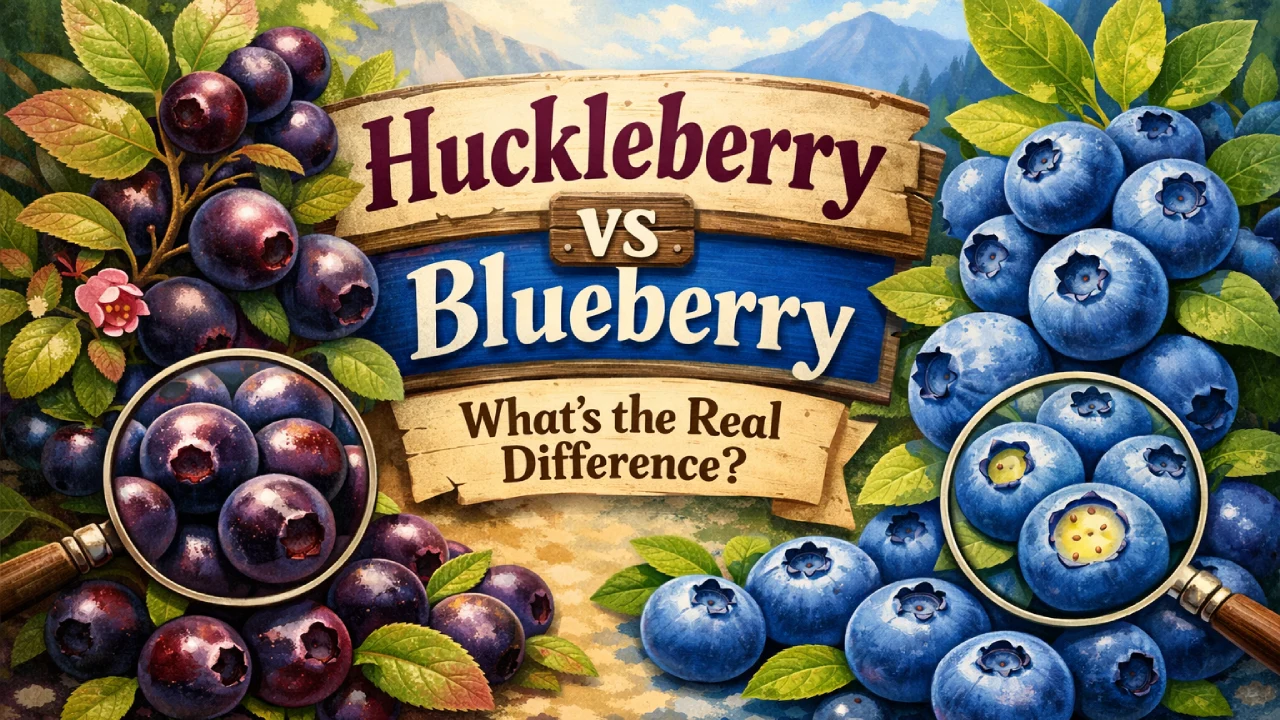
Ask anyone in Montana what their favorite berry is, and most will say huckleberry without hesitating. Ask them what the difference is between a huckleberry and a blueberry, and most will pause. The two berries look similar, grow in similar places, and belong to closely related botanical families — yet they are genuinely different fruits with different flavors, different seeds, different cultivation histories, and different identities in American food culture. This guide settles the comparison once and for all.
This complete comparison covers every meaningful difference between huckleberries and blueberries: taxonomy, appearance, taste, seeds, where each grows across America, antioxidant content, nutrition, cultivation, how to identify them in the wild, what to make with each, and which you should seek out. By the end, you will know exactly what separates these two berries — and why the distinction matters.
The Quick Answer: Key Differences at a Glance
Before diving deep, here is the essential comparison for anyone who wants the short version first:
| Feature | Huckleberry | Blueberry |
|---|---|---|
| Seeds | 10 hard, crunchy seeds | Many tiny, imperceptible soft seeds |
| Taste | More intense, earthy, complex, tart | Milder, sweeter, gentler |
| Where found | Wild only — Pacific NW and Rockies | Wild and widely cultivated nationwide |
| Can you grow them? | No — not commercially viable | Yes — home gardens and farms |
| Genus | Vaccinium or Gaylussacia | Vaccinium only |
| Availability | Seasonal, regional, expensive | Year-round, nationwide, affordable |
| Color | Deep purple-black to dark blue | Blue to purple-black depending on variety |
| Season | July–September (elevation dependent) | Year-round commercially; June–August fresh |
| Price | $10–25/pound fresh or frozen | $3–8/pound fresh |
Taxonomy: How They Are (and Aren’t) Related
The botanical relationship between huckleberries and blueberries is the source of most of the confusion. Here is the truth, clearly laid out.
All blueberries belong to the genus Vaccinium in the heath family (Ericaceae). The main species are Vaccinium corymbosum (highbush blueberry), Vaccinium angustifolium (wild lowbush blueberry), and Vaccinium virgatum (rabbiteye blueberry). When Americans say “blueberry,” they almost always mean one of these three.
Huckleberries are botanically split into two distinct groups — and this is where it gets interesting:
Western huckleberries — the berries people mean when they talk about Montana huckleberries and huckleberry pie in the Pacific Northwest — belong to the genus Vaccinium. The primary species is Vaccinium membranaceum, the thinleaf or black huckleberry. Because these western huckleberries are in the same genus as blueberries, they are essentially wild blueberry cousins — botanically close, but with distinct characteristics.
Eastern huckleberries belong to an entirely different genus: Gaylussacia. These grow across eastern North America and are less celebrated culinarily than their western counterparts, though they have a long history of use among Indigenous peoples and early settlers of the Appalachians and Atlantic coast.
Types of Huckleberries in America
Understanding huckleberry diversity helps explain why the word means different things to people from different parts of the country. Here are the main huckleberry species found across the United States:
| Species | Common name | Range | Berry color | Notes |
|---|---|---|---|---|
| Vaccinium membranaceum | Thinleaf / black huckleberry | Montana, Idaho, Pacific NW, northern Rockies | Deep purple-black | The most prized; what “Montana huckleberry” means |
| Vaccinium ovalifolium | Oval-leaf / blue huckleberry | Pacific Northwest coast, Alaska | Dark blue with waxy bloom | Milder flavor than V. membranaceum; very common in PNW forests |
| Vaccinium caespitosum | Dwarf huckleberry / bilberry | Rocky Mountains, Sierra Nevada | Dark blue-black | Low-growing alpine species; small but intensely flavored |
| Gaylussacia baccata | Black huckleberry | Eastern North America | Black, slightly shiny | Different genus; very hard seeds; tannic flavor |
| Gaylussacia frondosa | Dangleberry / blue huckleberry | Eastern coastal plain | Pale blue, waxy | Sweeter than black huckleberry; found in pine barrens and coastal woods |
When this guide and most American food culture references “huckleberry,” the primary reference is to Vaccinium membranaceum — the thinleaf huckleberry of Montana, Idaho, and the Pacific Northwest. This is the berry that fills restaurant menus in Glacier National Park, gets sold at farmers markets in Missoula, and inspires passionate seasonal devotion across the Inland Northwest. Everything below focuses primarily on this species unless otherwise noted.
Appearance: How to Tell Them Apart in the Field
Side by side, huckleberries and blueberries look remarkably similar — both are small, round, dark-pigmented berries about the same size. Telling them apart requires paying attention to several specific features:
Color
Ripe Vaccinium membranaceum huckleberries are typically a deeper, more intensely purple-black than most cultivated highbush blueberries. They lack the characteristic dusty blue-gray waxy bloom (called a “bloom” or pruinose coating) that gives blueberries their distinctive matte appearance. Huckleberries tend to look shinier and darker. That said, color alone is not a reliable differentiator — some blueberry varieties are just as dark, and some huckleberry species (like V. ovalifolium) do have a waxy bloom.
Crown
Blueberries have a distinctive five-pointed star-shaped crown at the tip — the remains of the flower’s calyx lobes, clearly visible as a small, dry, star-shaped scar. Huckleberries also have a small crown, but it is typically less prominent and star-shaped than a blueberry’s. If you have a clear, distinct five-pointed star at the berry tip, it is more likely a blueberry.
Surface texture
Most blueberries have a matte, slightly waxy surface from the bloom coating. Wild huckleberries tend to be slightly shinier. This is a subtle difference that becomes more obvious when you have both side by side, but is difficult to use as a solo identification feature.
Leaves and plant habit
Vaccinium membranaceum huckleberry leaves are thin, oval, and finely toothed, growing on shrubs 2–6 feet tall in open forest and mountain meadow settings. Lowbush wild blueberry leaves are similar but the plant is much lower (under 18 inches). Highbush cultivated blueberry leaves are larger and the plant taller (4–6 feet). In the field in the Pacific Northwest or Rockies, the mountain meadow or subalpine forest setting itself is a contextual clue — if you are above 3,000 feet in a pine or fir forest understory, the dark berries you are finding are almost certainly huckleberries, not blueberries.
The Seed Test — The Most Reliable Field Difference
When you have a berry in your hand and you are not sure whether it is a huckleberry or a blueberry, there is one test that works every single time: bite into it and pay attention to what you feel.
Huckleberries contain exactly 10 hard, distinctly noticeable seeds. When you bite into a huckleberry, you will feel — and often hear — a definite crunch from these seeds. They are not painfully hard, but they are absolutely noticeable. Some people describe the sensation as similar to eating a berry with tiny watermelon seeds inside.
Blueberries contain many tiny, extremely soft seeds that are completely imperceptible when eating. You will never notice a blueberry’s seeds — they simply do not register as you chew. The inside of a blueberry is uniformly soft throughout.
The one-bite test
Bite the berry. If you feel a definite crunch from hard seeds → huckleberry. If the inside is completely smooth and soft with no noticeable seeds → blueberry. This test works regardless of color, size, location, or season. It is the single most reliable way to tell these two berries apart.
This seed difference also has culinary implications. The hard seeds in huckleberries mean that huckleberry jam, pie filling, and syrup made without straining will have a slightly crunchy texture from the seeds. Many people enjoy this texture; others prefer to strain huckleberry preparations to remove seeds before using. Blueberry preparations never require this consideration.
Taste Comparison: Which Is Better?
This is the question most people actually want answered. The honest answer is that huckleberries taste more interesting than cultivated blueberries — but blueberries are more consistently enjoyable and far more accessible.
How huckleberries taste
Vaccinium membranaceum huckleberries have an intense, complex, deeply berry flavor with a pronounced tartness that cultivated blueberries rarely match. The flavor has a slight earthiness and what many describe as a “wild” quality — a richness and depth that tastes like concentrated wilderness. There is a mild astringency from the tannins, and a clear tartness that makes the sweetness feel earned rather than simply present. The overall impression is of a berry with significantly more personality than a supermarket blueberry.
The flavor is often described as: more intense blueberry flavor + stronger tartness + earthy/wild undertone + slightly winey quality. If a cultivated highbush blueberry is a mild chord, a huckleberry is the same chord played fortissimo.
How blueberries taste
Cultivated highbush blueberries — the standard grocery store variety — are mild, sweet, and pleasant. They have a gentle berry flavor, low acidity, and a clean finish. They are extremely crowd-pleasing and versatile precisely because they do not challenge the palate. Wild lowbush blueberries from Maine are significantly more intense and complex than cultivated varieties, closing some of the gap with huckleberries. For a full breakdown of blueberry taste by variety, see our complete blueberry guide.
The verdict on taste
For raw eating, huckleberries win on complexity and intensity for those who prefer bold flavors. For baking and jam-making, huckleberries produce more flavorful results. For everyday eating and smoothies, blueberries are more practical and consistently pleasant. The wild lowbush blueberry from Maine is the closest rival to huckleberry in flavor intensity — if you want blueberry-level accessibility with huckleberry-level flavor, buy frozen wild blueberries from Maine rather than fresh cultivated ones.
Where Each Berry Grows in the USA
Where huckleberries grow
Vaccinium membranaceum huckleberries have a very specific geographic range centered on the Pacific Northwest and northern Rocky Mountains. They grow in the mountain forests and subalpine meadows of Montana, Idaho, Oregon, Washington, British Columbia, and the northern Cascades and Rockies. They are an elevation-dependent species, typically found between 3,000 and 7,500 feet, in the understory of conifer forests (particularly after disturbance events like fires or logging) and in alpine meadow margins.
The key states and regions for huckleberry foraging:
- Montana: The unofficial huckleberry capital of America. The western Montana mountains — Glacier National Park, the Bitterroot Range, and the Flathead Valley area — are legendary for their huckleberry patches. Montana locals track patch locations with genuine secrecy, treating favorite spots like fishing holes
- Idaho: Northern Idaho, particularly around Coeur d’Alene and the Clearwater National Forest, has exceptional huckleberry habitat. The Priest Lake area is well-known among foragers
- Oregon and Washington: The Cascades range from the Columbia River Gorge north to the North Cascades has abundant huckleberry habitat. Mount Hood, the Cascades in central Oregon, and the Olympic Peninsula all host productive patches
- Wyoming and Colorado: Huckleberries are found at higher elevations in the Rockies of Wyoming and Colorado, though less abundantly than in the Pacific Northwest
- Alaska: Multiple Vaccinium huckleberry species grow abundantly throughout Alaska
Where blueberries grow
By contrast, blueberries grow across the entire country — both as commercial crops and as wild plants. For a full regional breakdown, see our blueberry complete guide. The key commercial states are Michigan, Oregon, Washington, New Jersey, Georgia, and Florida, but wild blueberries grow from Alaska to Florida and coast to coast.
| Feature | Huckleberry range | Blueberry range |
|---|---|---|
| Geographic spread | Pacific NW and northern Rockies (limited) | All 50 states (very wide) |
| Elevation | 3,000–7,500 feet typically | Sea level to moderate elevation |
| Habitat | Mountain forest understory, burns, meadows | Bogs, forest edges, farms, gardens |
| Wild vs farmed | Wild only — cannot be commercially farmed | Both wild and extensively farmed |
| Best states to find | Montana, Idaho, Oregon, Washington | Michigan, Maine, New Jersey, Oregon, Georgia |
Nutrition and Antioxidant Comparison
Both huckleberries and blueberries are nutritionally excellent. Detailed laboratory analysis of Vaccinium membranaceum huckleberries is less comprehensive than blueberry data simply because huckleberries are not commercially produced and thus have attracted less agricultural research. However, the available data and the berry’s characteristics allow for meaningful comparison.
| Nutrient / Property | Huckleberry (V. membranaceum) | Cultivated blueberry (V. corymbosum) | Wild blueberry (V. angustifolium) |
|---|---|---|---|
| Calories (per cup) | ~70–80 kcal (estimated) | 84 kcal | ~80 kcal |
| Anthocyanins | Very high — deep color indicates high pigment | High | Very high — comparable to huckleberry |
| Vitamin C | Good source | 16% DV per cup | High — wild berries often higher |
| Dietary fiber | Similar to blueberry | 3.6g per cup (13% DV) | Similar or slightly higher |
| ORAC antioxidant score | Very high (limited data) | High | Very high — 2× cultivated blueberry |
| Research available | Limited (wild, uncultivated) | Extensive clinical trials | Growing body of research |
The antioxidant question: which wins?
Research on Vaccinium membranaceum published in the Journal of Agricultural and Food Chemistry found that mountain huckleberries contain anthocyanin concentrations among the highest measured in wild berries in North America — comparable to or exceeding wild lowbush blueberries. The deep purple-black color of a ripe huckleberry is a direct visual indicator of its anthocyanin density, and color intensity reliably predicts antioxidant concentration across the Vaccinium genus.
The honest nutritional conclusion: huckleberries and wild blueberries are nutritional equals at the highest tier of berry nutrition. Both are significantly more antioxidant-rich than cultivated highbush blueberries. If you have access to huckleberries, eat them — they are nutritionally outstanding. If you do not, frozen wild Maine blueberries deliver similar antioxidant benefits at a fraction of the cost and are available nationwide.
Cultivation: Why You Cannot Grow Real Huckleberries
The huckleberry’s resistance to cultivation is one of the most fascinating aspects of this berry — and the primary reason it remains rare and expensive despite enormous demand.
Vaccinium membranaceum has a symbiotic relationship with specific mycorrhizal fungi found only in old-growth or mature mountain forest soils. These fungi colonize the roots and are essential for the plant’s nutrient uptake — without them, huckleberry plants survive but produce minimal fruit. Replicating this complex soil ecology outside of native habitat has proven essentially impossible with current agricultural technology.
Researchers at the University of Idaho and Oregon State University have been studying huckleberry cultivation for decades. Periodic breakthroughs in understanding the mycorrhizal requirements have been made, but commercial cultivation remains economically unviable. Transplanted huckleberry plants from nurseries almost always decline in productivity within a few years once separated from their native soil ecosystem.
This is why huckleberries cost $15–25 per pound when you can find them, and why a jar of Montana huckleberry jam carries a price tag that seems improbable for a berry product. Every huckleberry has been hand-picked from a wild plant in the mountains. There is no substitute for that labor.
What about “garden huckleberry”? Products sold as “garden huckleberry” at some garden centers are Solanum scabrum — a completely different plant in the nightshade family with no botanical relation to true huckleberries. The berries are edible when cooked but taste nothing like Vaccinium membranaceum. Do not buy these expecting a huckleberry experience.
Cultural Significance: Huckleberry in American Identity
Few berries in America carry the cultural weight of the huckleberry. The word itself has become shorthand for something authentically, stubbornly American — wild, independent, and resistant to commercialization.
Literary huckleberries
Mark Twain named his most beloved character Huckleberry Finn — choosing the name deliberately for its associations with wildness, freedom, and the margins of respectable society. The huckleberry, growing unreachably in the mountains beyond the reach of farms and markets, was a perfect symbol for a character who could not be domesticated. The name carried instant resonance for 19th-century American readers who understood exactly what kind of boy was being described.
Montana’s unofficial state berry
In Montana, huckleberry fever is a genuine cultural phenomenon. Every August, the mountains around Glacier National Park, the Bitterroot, and the Flathead Valley fill with pickers — families, solo foragers, and commercial harvesters — all pursuing the same berry. Huckleberry pie, huckleberry ice cream, huckleberry jam, huckleberry syrup, huckleberry pancakes, and huckleberry candy fill the menus and gift shops of every tourist destination in western Montana. The berry is not just a food — it is an identity marker that says you are from here, or at least that you understand why here matters.
Indigenous significance
Long before Montana became Montana, huckleberries were central to the food culture of the Salish, Kootenai, Blackfoot, Nez Perce, and many other nations of the Pacific Northwest and Rocky Mountain region. Huckleberry patches were significant communal harvesting sites, and the berry was preserved for winter by drying and mixing into pemmican alongside buffaloberry and other native fruits. For many communities, the huckleberry harvest season remains a living cultural tradition, and access to traditional harvesting areas is a matter of treaty rights and cultural continuity.
Where to Buy Huckleberries
If you are not in the Pacific Northwest or Rocky Mountain region during August and September, finding huckleberries requires some planning. Here is a practical guide:
Fresh huckleberries
Fresh huckleberries are available at farmers markets, roadside stands, and specialty grocery stores in Montana, Idaho, Oregon, and Washington from late July through September. Outside of these states, fresh huckleberries are essentially unavailable — they are too delicate and valuable to ship commercially over long distances.
Frozen huckleberries
Frozen huckleberries ship nationally and retain their full flavor and nutritional value. Several Montana and Idaho producers sell frozen huckleberries online, typically at $15–25 per pound. Frozen huckleberries work perfectly in any recipe that calls for fresh — pies, jams, pancakes, smoothies, and sauces. This is the most practical way for Americans outside the Pacific Northwest to experience the real thing.
Huckleberry products
Huckleberry jam, syrup, candy, chocolate, and baked goods are widely available online from Montana specialty food producers. The jam and syrup retain much of the berry’s distinctive flavor and make excellent gifts. Huckleberry-flavored commercial products (ice cream mixes, pancake mixes, candies) from outside the region are often flavored with blueberry or artificial flavoring — look for products that specify “real huckleberries” as an ingredient.
Recipes: Using Huckleberries and Blueberries
Huckleberries and blueberries are interchangeable in most recipes — any recipe that calls for one will work with the other, though the flavor profile will differ. Here are recipes that showcase each berry’s strengths:
Huckleberry pie (the classic Montana recipe)
Huckleberry pie is the definitive preparation for this berry — the intense, complex flavor shines through in a way that blueberry pie, for all its goodness, rarely achieves. Combine 4 cups of fresh or frozen huckleberries with ¾ cup of sugar, 3 tablespoons of cornstarch, 1 tablespoon of lemon juice, and ¼ teaspoon of cinnamon. Pour into a prepared 9-inch pie shell, top with a second crust or lattice, seal edges, and brush with egg wash. Bake at 375°F for 50–55 minutes until the filling is bubbling and the crust is golden. Allow to cool completely before slicing — the filling will not set until cooled. The deep purple-black filling with its distinctive tart-sweet-earthy flavor is unlike any other berry pie.
Huckleberry pancakes
Fold ¾ cup of huckleberries (fresh or frozen, unthawed) into your favorite pancake batter just before cooking. The berries bleed a stunning deep purple into the batter as they cook. Top with huckleberry syrup (simmer 1 cup huckleberries with ½ cup sugar and ¼ cup water for 10 minutes, strain) and a pat of butter. This is the definitive Montana breakfast, available at diners from Missoula to Whitefish every summer morning.
Wild blueberry overnight oats (everyday nutrition)
For everyday eating when huckleberries are unavailable, frozen wild blueberries deliver the closest nutritional and flavor experience. Layer ½ cup of rolled oats, ¾ cup of milk, 1 tablespoon of chia seeds, 1 teaspoon of honey, and ½ cup of frozen wild blueberries (Maine-sourced if possible) in a jar. Refrigerate overnight. Top with additional wild blueberries and a drizzle of honey. The wild blueberries stain the oats a dramatic purple-blue overnight and deliver concentrated anthocyanins and intense berry flavor that makes cultivated blueberries seem flat by comparison.
Huckleberry / blueberry jam comparison batch
If you have access to both berries, making identical jam batches side by side is one of the most instructive taste exercises possible. Use the same recipe for both — 3 cups of crushed berries, 2 cups of sugar, juice of one lemon, cooked to 220°F. The huckleberry jam will be darker, more complex, and noticeably more tart. The blueberry jam will be sweeter and milder. Both are excellent; tasting them together makes the difference unmistakable.
Frequently Asked Questions
Are huckleberries and blueberries the same thing?
No — they are related but distinct. Western huckleberries (Vaccinium membranaceum) are in the same genus as blueberries but are a different species with different taste, harder seeds, a more limited range, and no capacity for commercial cultivation. Eastern huckleberries (Gaylussacia) are in an entirely different genus. The most reliable test: bite the berry — huckleberries have 10 crunchy hard seeds; blueberry seeds are imperceptibly small and soft.
What does a huckleberry taste like?
More intense, complex, and tart than a blueberry. Huckleberries have a deep, rich berry flavor with a pronounced tartness and a slightly earthy, wild quality. Many describe it as a more intense version of a blueberry with a winey undertone. The flavor is less sweet and more assertive than cultivated blueberries, though closer to wild Maine lowbush blueberries in intensity.
Can you grow huckleberries at home?
Not successfully in most circumstances. True mountain huckleberries (Vaccinium membranaceum) require specific mycorrhizal fungi found only in mountain forest soils and have resisted all commercial cultivation attempts despite decades of research. Transplanted plants survive but rarely produce significant fruit. Plants sold as “garden huckleberry” are a different species (Solanum scabrum) with no relation to true huckleberries.
Where can I buy huckleberries?
Fresh huckleberries are available at farmers markets and specialty stores in Montana, Idaho, Oregon, and Washington from late July through September. Outside these states, buy frozen huckleberries from Montana or Idaho online producers — they ship nationally, retain full flavor, and cost $15–25 per pound. Huckleberry jam, syrup, and other products are also widely available from specialty Montana food producers online.
Are huckleberries healthier than blueberries?
Huckleberries and wild blueberries are nutritional equals at the highest tier of berry nutrition — both have very high anthocyanin concentrations. Wild huckleberries likely contain more antioxidants than large cultivated highbush blueberries, but are comparable to wild Maine lowbush blueberries. The wild vs cultivated distinction matters more than huckleberry vs blueberry: any wild berry will typically outperform a large farm-grown berry on antioxidant density.
What is the seed difference between huckleberries and blueberries?
Huckleberries contain 10 hard, distinctly noticeable seeds that crunch when you bite the berry. Blueberries contain many tiny, extremely soft seeds that are completely imperceptible when eating. This is the single most reliable field test to distinguish the two berries.
Why are huckleberries so expensive?
Every huckleberry is hand-picked from wild plants in mountain forests — there are no huckleberry farms. The berry cannot be commercially cultivated due to its dependence on specific forest soil fungi, so supply is entirely limited to wild harvest. Combined with the remote, often steep terrain of huckleberry habitat and the short season window, this makes huckleberries genuinely labor-intensive to harvest. Fresh huckleberries typically cost $15–25 per pound, and frozen ones are similarly priced.
Conclusion: Two Great Berries, One Clear Difference
The huckleberry and the blueberry are not the same berry wearing different regional names. They are genuinely distinct fruits — different seeds, different flavor, different range, and a profoundly different relationship with cultivation and commerce. The blueberry is democratic and accessible, grown on farms across 30 states and available fresh year-round at any grocery store in America. The huckleberry is wild, regional, and irreducibly itself — you cannot manufacture it, you can only find it.
That distinction is exactly what makes the huckleberry so beloved in the places it grows. In a world of uniform, optimized, year-round produce, a berry that will only be found by those willing to climb a mountain in August, armed with a bucket and good boots, feels like something genuinely rare. Because it is.
If you have never tasted a fresh huckleberry from a Montana hillside, put it on your list. And in the meantime, the frozen wild blueberries from Maine in your grocer’s freezer section are the best available substitute — small, intensely flavored, and full of the anthocyanins that make wild berries worth seeking out wherever they grow.
More from Berry Nation USA
- Blueberry Complete Guide: America’s Native Superfruit
- Salmonberry: America’s Pacific Jewel — Complete Guide
- Wild Blackberries of America: Complete ID & Foraging Guide
- Elderberry Complete Guide: Benefits, Syrup Recipe & Safety
- Raspberry Complete Guide: Native American Berry & Benefits
- Buffaloberry: America’s Most Underrated Native Superfruit
- How Many Berries Should I Eat a Day?
Written by Kirna — Berry Nation USA
Berry Nation USA is America’s dedicated resource for wild, native, and cultivated berries across all 50 states. Learn more about us.