
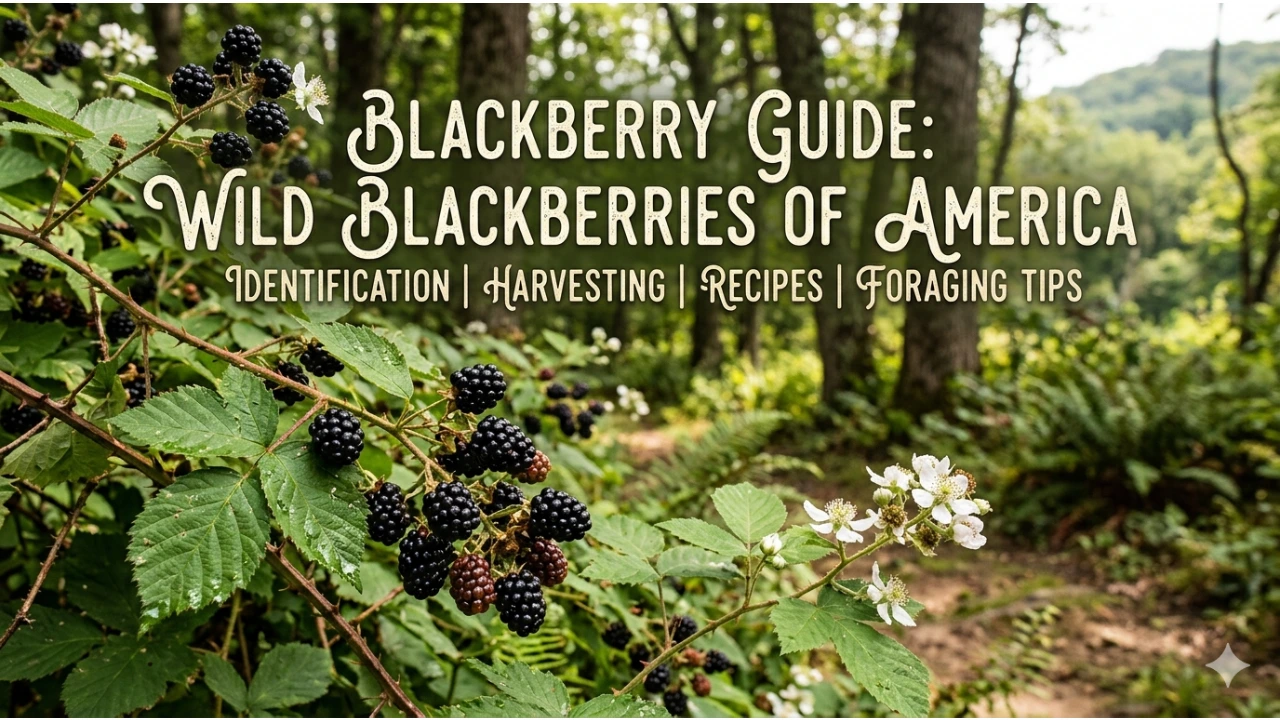
Of all the wild berries growing across America, the blackberry may be the most democratic. It grows in every contiguous state, from the sun-baked roadsides of Texas to the misty forest edges of the Pacific Northwest, from abandoned lots in Brooklyn to mountain trails in Colorado. You do not need to travel to find wild blackberries — in most of America, they find you. This guide shows you how to identify them safely, harvest them wisely, and use them well.
This complete guide covers everything about wild and cultivated blackberries in America: safe identification with look-alike comparisons, full nutritional breakdown, six science-backed health benefits, a regional foraging guide with timing by state, how to grow blackberries at home, storage and freezing, and five recipes. Whether you are a first-time forager or a seasoned berry hunter, this is your definitive American blackberry resource.
Botanical Profile: What Is a Blackberry?
Blackberries belong to the genus Rubus in the rose family (Rosaceae) — the same genus that includes raspberries, salmonberries, and boysenberries. They are aggregate fruits — each berry is composed of many small individual segments called drupelets, each containing its own seed and fleshy pulp, all fused together around a central core.
The critical structural difference between a blackberry and a raspberry: when you pick a blackberry, the central core (receptacle) comes with it, making the berry solid. When you pick a raspberry, the core stays on the plant and the berry is hollow. This single test reliably distinguishes the two fruits in the field with zero botanical knowledge required.
Blackberries are also technically not true botanical berries — like raspberries, they are aggregate fruits. Despite this, they are universally and correctly grouped with berries in every culinary and nutritional context.
Genus: Rubus | Family: Rosaceae | Type: Aggregate fruit
Key native species: R. allegheniensis, R. argutus, R. ursinus, R. cuneifolius
Season: May–September depending on region | Found in: all 48 contiguous US states
Blackberry Species Native to America
North America is home to more than 200 described Rubus species, many of which are native blackberries. Taxonomy in this genus is notoriously complex — botanists disagree on species boundaries, and many populations hybridize freely. For practical purposes, the species most commonly encountered by foragers and gardeners across the country are:
| Species | Common name | Primary range | Notes |
|---|---|---|---|
| Rubus allegheniensis | Allegheny blackberry | Northeast, Midwest, Appalachians | Most common eastern species; upright canes, large berries |
| Rubus argutus | Sawtooth blackberry | Southeast, Mid-Atlantic | Very common in South; first to ripen, often by late May |
| Rubus ursinus | Pacific blackberry / dewberry | Pacific Coast | Native West Coast species; parent of Marionberry and Boysenberry |
| Rubus cuneifolius | Sand blackberry | Southeast coastal plain | Sandy soils; compact shrub; very common in Florida and Georgia |
| Rubus flagellaris | Northern dewberry | Eastern half of USA | Trailing (not upright); grows flat along ground |
| Rubus laciniatus | Cutleaf blackberry | Pacific NW (introduced) | Invasive in PNW; deeply cut leaves, very productive |
| Rubus armeniacus | Himalayan blackberry | Pacific NW (introduced) | The dominant blackberry of Oregon and Washington; large, sweet berries but invasive |
A note on the Pacific Northwest: the blackberries most commonly foraged in Oregon and Washington — the large, sweet berries that line roadsides and fill buckets easily in August — are Himalayan blackberry (Rubus armeniacus), an introduced species from Armenia that has become invasive across much of the Pacific Coast. They are excellent eating but ecologically problematic, outcompeting native plants including the true Pacific blackberry (Rubus ursinus). Eating the Himalayan blackberry is, in a small way, ecologically beneficial — you are consuming an invasive species.
How to Identify Wild Blackberries Safely
Blackberries are one of the most forager-friendly wild plants in North America. Their identification features are distinctive and consistent across species, making them a reliable first berry for anyone learning to forage. Here is a complete identification guide:
The fruit
- Color: Deep purple-black when fully ripe. Any red coloring indicates the berry is not yet ripe — unripe blackberries are sour and astringent and should be left on the plant
- Structure: Made of many small, shiny drupelets clustered tightly together — each drupelet is a distinct segment with its own small seed
- Core test: Pick a berry — it should come off solid, with the white or pale green central core (receptacle) still attached inside. This is the single most important field test that distinguishes blackberries from raspberries
- Size: Typically 1.5–3 cm in diameter for wild varieties; cultivated varieties can reach 4 cm or more
- Ripeness: A ripe blackberry detaches with minimal pressure, feels slightly soft (not mushy), and has a sweet fragrance. If it requires tugging, it is not ready
The canes
- Armed with sharp, stiff, curved thorns — significantly more aggressive than raspberry prickles
- Canes are biennial: first-year canes (primocanes) are green or reddish and vegetative; second-year canes (floricanes) flower and fruit, then die
- Upright species (like R. allegheniensis) form dense, arching thickets 4–8 feet tall; trailing dewberries grow close to the ground
- Cross-section of a cane is angular — not perfectly round — a useful detail for distinguishing from some look-alikes
The leaves
- Compound leaves with 3–5 leaflets (typically 5 on primocanes, 3 on floricanes)
- Each leaflet is oval with sharply toothed edges and a pointed tip
- Upper surface is green and slightly rough; underside is paler, sometimes fuzzy
- Leaflets arranged palmately (spreading from a central point like fingers) on primocanes
The flowers
- Five white or pale pink petals surrounding a central cluster of yellow stamens
- Flowers appear May–June on second-year canes before fruit develops
- Flowers are 2–3 cm across — larger than raspberry flowers
- Grow in loose clusters (racemes) at the tips of lateral branches
Safety rule: always use three features
Never eat a wild berry based on a single identification feature. Before eating any wild blackberry, confirm: (1) solid berry with core attached, (2) thorny cane, and (3) compound leaves with toothed leaflets. All three features together confirm blackberry with a very high degree of confidence.
Dangerous Look-Alikes to Avoid
While blackberries are relatively safe to forage, several toxic or potentially harmful plants produce dark berries that can be confused with blackberries by inexperienced foragers. Knowing these look-alikes is as important as knowing the blackberry itself.
| Plant | Toxicity | How to tell it apart from blackberry |
|---|---|---|
| Pokeweed (Phytolacca americana) | Very toxic — all parts | Berries grow in elongated grape-like clusters on thick magenta-pink stems. No thorns. Large, smooth, simple leaves (not compound). Plant can grow 6–10 feet tall with a large taproot. Berries are juicier and smoother than blackberry drupelets. |
| Black nightshade (Solanum nigrum) | Toxic (raw) | Very small berries (less than 1cm) growing in drooping clusters of 5–10. Small, low-growing plant (1–3 feet). Simple oval leaves — not compound. No thorns whatsoever. Star-shaped white flowers with yellow anthers. |
| Deadly nightshade (Atropa belladonna) | Extremely toxic | Berries are single, shiny, and cherry-sized — not clustered drupelets. Bell-shaped purple-brown flowers. Large simple leaves. No thorns. Fortunately rare in the USA — primarily a concern in parts of the Northeast where it has naturalized. |
| Elderberry (Sambucus canadensis) | Toxic raw; safe cooked | Tiny berries (3–5mm) in large, flat-topped umbrella-shaped clusters. Compound pinnate leaves (not palmate). Distinctive smell. No thorns — smooth stems. Berries are much smaller than any blackberry drupelet. |
| Virginia creeper (Parthenocissus quinquefolia) | Toxic | Dark blue-black berries in loose clusters on a vine (not a cane). Five-leaflet leaves but much larger and distinctly different from blackberry. No thorns. Grows as a climbing vine, not an upright or arching shrub. |
The bottom line on look-alikes: None of the dangerous plants above have all three of the blackberry’s key features — thorny canes, compound palmate leaves, and solid drupelet berries. If all three features are present, you have a blackberry. If any one is missing, stop and re-identify before eating.
Blackberry vs Raspberry: The Definitive Test
The most common identification confusion among beginning foragers is between blackberries and raspberries. Both grow wild across most of America, both have thorny canes and compound leaves, and both produce small red-to-black aggregate fruits. Here is how to tell them apart definitively:
| Feature | Blackberry | Raspberry |
|---|---|---|
| Core test (most reliable) | Solid — core comes with the berry | Hollow — core stays on plant |
| Ripe color | Deep purple-black | Bright red (or dark purple for black raspberry) |
| Flavor | Sweet, rich, deep | Tart, bright, more acidic |
| Cane thorns | Stiff, sharp, curved — very aggressive | Softer, more bristle-like prickles |
| Leaf arrangement | 3–5 leaflets, palmate on primocanes | 3–7 leaflets, pinnate arrangement |
| Unripe color | Green → red → black (passes through red) | Green → red (ripe when red) |
| Season | Slightly later (July–September) | Slightly earlier (June–August) |
| Size | Generally larger | Generally smaller |
One important note for Pacific Northwest foragers: black raspberries (Rubus occidentalis) ripen to a very dark purple-black color that closely resembles a blackberry. The core test remains the reliable differentiator — black raspberries are hollow when picked, blackberries are solid. See our full raspberry guide for a deep dive on black raspberry identification and nutrition.
Where Do Wild Blackberries Grow in the USA?
Wild blackberries grow in every contiguous US state — they are one of the most geographically widespread wild fruits in North America. They thrive in disturbed habitats: roadsides, forest edges, abandoned fields, logged areas, power line rights-of-way, and the margins of trails and paths. Anywhere sunlight reaches the ground and human activity has created open space, blackberries will establish themselves within a few years.
| Region | Peak season | Common species | Best locations |
|---|---|---|---|
| Deep South (GA, AL, MS, LA) | Late May–June | R. argutus, R. cuneifolius | Roadsides, old fields, forest margins |
| Mid-Atlantic (VA, MD, NC, SC) | June–July | R. allegheniensis, R. argutus | Appalachian trails, rural roadsides |
| Northeast (NY, PA, NE, MA) | July–August | R. allegheniensis | Forest edges, power line cuts, old pastures |
| Midwest (OH, IN, IL, MI, MN) | July–August | R. allegheniensis, R. flagellaris | Old fields, forest edges, stream banks |
| Texas and Oklahoma | May–June | R. trivialis (dewberry) | Roadsides, pasture margins, creek banks |
| Pacific Northwest (OR, WA) | July–September | R. armeniacus (Himalayan) | Everywhere — roadsides, trails, urban lots |
| Northern California | July–August | R. ursinus, R. armeniacus | Coast ranges, forest edges, stream corridors |
Where to find the best patches: Power line rights-of-way are among the most productive blackberry foraging spots in eastern North America — the regular clearing maintains the open, sunny conditions blackberries love, while preventing the forest from shading them out. Old logging roads, field edges adjacent to woodlands, and the banks of rural dirt roads are other consistently productive locations.
Blackberry Nutrition Facts
Blackberries are one of the most nutritionally dense fruits available, delivering an exceptional combination of fiber, vitamins, minerals, and antioxidants per calorie. The following data is sourced from the USDA FoodData Central database for one cup (144g) of raw blackberries:
| Nutrient | Per 1 cup (144g) | % Daily Value |
|---|---|---|
| Calories | 62 kcal | — |
| Carbohydrates | 13.8g | 5% |
| Dietary fiber | 7.6g | 27% |
| Sugars | 7.0g | — |
| Protein | 2.0g | 4% |
| Vitamin C | 30.2mg | 34% |
| Vitamin K | 28.5mcg | 24% |
| Manganese | 0.93mg | 40% |
| Folate | 36.0mcg | 9% |
| Potassium | 233mg | 5% |
| Vitamin E | 1.68mg | 11% |
| Copper | 0.24mg | 27% |
Four numbers stand out from this profile. First, 7.6g of fiber per cup (27% DV) — placing blackberries among the highest-fiber fruits available alongside raspberries. Second, 40% of daily manganese — an often-overlooked mineral critical for bone formation, wound healing, and metabolic function. Third, 34% of daily vitamin C at only 62 calories. Fourth, 24% of daily vitamin K — important for blood clotting and bone health, and higher than most other berries.
Beyond the vitamins and minerals, blackberries contain some of the highest anthocyanin concentrations of any commonly eaten berry — the deep purple-black pigments responsible for both the berry’s color and much of its health impact. Research on blackberry anthocyanins has focused on cyanidin-3-glucoside as the primary active compound, which demonstrates strong anti-inflammatory, antioxidant, and potentially neuroprotective effects in peer-reviewed studies.
6 Health Benefits of Blackberries
1. Extraordinary fiber for gut health
At 7.6g of dietary fiber per cup, blackberries match raspberries as one of the highest-fiber fruits in the American diet. This fiber content delivers benefits across the full spectrum of digestive health: feeding beneficial gut bacteria (acting as a prebiotic), promoting regular bowel movements, slowing glucose absorption to prevent blood sugar spikes, and contributing to the sustained fullness that supports healthy weight management. The combination of soluble fiber (which forms a gel that slows digestion) and insoluble fiber (which adds bulk) in blackberries works through both mechanisms simultaneously. For anyone not meeting their daily fiber target — and research suggests fewer than 5% of Americans do — adding a cup of blackberries daily is one of the simplest and most palatable dietary changes possible.
2. Among the highest anthocyanins of any berry
The deep purple-black color of a ripe blackberry is a visual indicator of its extraordinary anthocyanin content. Cyanidin-3-glucoside, the primary anthocyanin in blackberries, has demonstrated potent antioxidant and anti-inflammatory effects in research published in the Journal of Agricultural and Food Chemistry. Anthocyanins neutralize free radicals, reduce systemic inflammation, protect blood vessels from oxidative damage, and may inhibit the growth of certain cancer cells in laboratory studies. The ORAC (Oxygen Radical Absorbance Capacity) value of blackberries is among the highest of any commonly eaten fruit — significantly higher than blueberries in most comparative analyses.
3. Brain health and cognitive protection
Blackberry anthocyanins have demonstrated the ability to cross the blood-brain barrier, where they concentrate in regions associated with learning, memory, and motor control. Research published in Nutritional Neuroscience found that blackberry supplementation improved motor performance and cognitive function in aging animal models. Human studies on berry anthocyanins consistently show associations between higher intake and slower rates of cognitive decline. The anthocyanin and polyphenol profile of blackberries is particularly rich in compounds that reduce neuroinflammation — a key mechanism in the development of Alzheimer’s disease and other neurodegenerative conditions.
4. Heart health — cholesterol, blood pressure, and inflammation
Blackberries support cardiovascular health through multiple concurrent mechanisms. Their anthocyanins reduce LDL cholesterol oxidation — the process that transforms LDL into the form that deposits in arterial walls. Their potassium (233mg per cup) supports healthy blood pressure. Their fiber reduces LDL cholesterol by binding bile acids in the gut. Their vitamin C supports collagen production in blood vessel walls. And their anti-inflammatory polyphenols reduce the arterial inflammation that initiates the atherosclerotic process. This multi-pathway cardiovascular support, delivered through a whole food with only 62 calories per cup, is difficult to replicate with supplements.
5. Blood sugar management
Blackberries have a low glycemic index of approximately 25 — one of the lowest of any fruit. Their combination of high fiber, moderate acidity, and polyphenols that inhibit certain carbohydrate-digesting enzymes makes them one of the most blood-sugar-friendly fruits available. Research published in PLOS Medicine on berry consumption and type 2 diabetes risk found consistent associations between berry intake and reduced diabetes risk, with blackberries and other dark-pigmented berries showing particularly strong protective associations due to their anthocyanin content.
6. Vitamin K for bone health and wound healing
Blackberries provide 24% of the daily recommended vitamin K in a single cup — more than most other commonly eaten berries. Vitamin K plays an essential role in two critical bodily functions that are frequently overlooked in nutrition discussions. First, it activates the proteins required for proper blood clotting — vitamin K deficiency causes uncontrolled bleeding. Second, it activates osteocalcin, a protein essential for incorporating calcium into bone matrix — making adequate vitamin K intake critically important for long-term bone density and fracture prevention. The role of vitamin K2 in bone health is well-documented in research from the National Institute of Arthritis and Musculoskeletal and Skin Diseases.
Foraging Guide: When and How to Pick Blackberries
Blackberry foraging is one of the most accessible and rewarding outdoor activities in America. Here is everything you need for a successful, safe, and ethical harvest.
How to tell when blackberries are ripe
- Color must be uniformly deep purple-black — any red indicates the berry is not ready. Importantly, blackberries pass through a red stage before ripening to black, and red blackberries are sour and astringent. Do not eat red ones
- A ripe blackberry should detach from the cane with almost no resistance — just a light touch. If you have to tug, wait 2–3 more days
- Texture should be slightly soft and yielding, not firm and hard
- The fragrance of ripe blackberries is unmistakable — sweet, rich, and fruity. Lean in and smell before picking any berry you are uncertain about
- Taste one first from each new patch — flavor intensity varies significantly by location, soil quality, and sun exposure
Equipment and technique
- Wear long sleeves and pants — blackberry thorns are aggressive and will scratch exposed skin extensively in a productive patch
- Use a container with a wide mouth — a bucket or wide bowl works better than a bag; blackberries are delicate and crush easily under their own weight when piled deep
- Pick in the morning — berries are coolest and firmest early in the day, before the sun softens them. Morning-picked berries also store better
- Work from the outside of the thicket inward — the most accessible berries are on the outer edges, and pushing into dense thickets damages fruit and plants
- Do not overfill your container — more than 4–5 inches deep and the bottom berries will be crushed by the weight above
Ethical foraging
- Forage only on public land or with landowner permission
- Take no more than one-third of the berries from any single plant — leave the rest for wildlife, which depends heavily on blackberries as a summer food source
- Avoid roadside patches within 30 feet of heavy traffic — vehicle exhaust and road salt can contaminate fruit
- Stay clear of areas that may have been treated with herbicides — many roadsides and utility rights-of-way are periodically sprayed
- Wash all foraged berries before eating
How to Grow Blackberries at Home
Blackberries are among the most productive and lowest-maintenance fruits for the home garden. A single established plant can produce 10–20 pounds of fruit per season, and a well-managed planting will produce reliably for 15–20 years.
Erect vs trailing vs semi-erect varieties
- Erect varieties (e.g., Ouachita, Apache, Navaho) grow upright without support, are cold-hardy, and are the easiest to manage. Best for most home gardeners, particularly in the eastern half of the country
- Trailing varieties (e.g., Marionberry, Boysenberry, Loganberry) produce the largest and most flavorful berries but require a trellis and are less cold-hardy. Best for the Pacific Northwest and mild climates
- Semi-erect varieties (e.g., Chester, Triple Crown) are very productive and somewhat thornless — a significant advantage for home gardens with children or close-access harvesting
Thornless varieties — a game changer for home gardens
Modern thornless blackberry varieties have removed the most challenging aspect of blackberry growing. Chester Thornless and Triple Crown are widely available, produce excellent-quality fruit, and are dramatically easier to prune and harvest than thorny varieties. According to University of Minnesota Extension, thornless erect varieties are now the recommended choice for most home gardeners in the northern half of the country.
Planting requirements
- Sun: Full sun — 6–8 hours minimum. Fewer hours means less fruit and more disease pressure
- Soil: Well-drained, slightly acidic (pH 5.5–7.0). Do not plant in low spots where water pools — root rot is the primary killer of blackberries
- Spacing: 3–4 feet between plants in a row; 8–10 feet between rows
- Planting time: Early spring as soon as the soil can be worked. Bare-root plants establish most successfully
- Avoid: Planting near wild Rubus plants or in soil where tomatoes, peppers, or eggplant grew in the past three years — shared soilborne diseases can devastate a new planting
Pruning — the most important task
Blackberry canes are biennial. First-year canes (primocanes) grow vegetatively; second-year canes (floricanes) flower and fruit in summer, then die. After harvest, cut all fruited floricanes to the ground — they will not produce again. Thin primocanes to the 4–6 most vigorous per plant and tip them at 3–4 feet to encourage lateral branching, which dramatically increases next year’s fruit production. Annual pruning done properly can double yield compared to unpruned plants.
Storing and Freezing Blackberries
Fresh storage
- Do not wash blackberries until immediately before eating — moisture accelerates mold growth rapidly
- Spread in a single layer on a paper-towel-lined tray or shallow container in the refrigerator
- Inspect daily and remove any moldy berries immediately — mold spreads quickly through a container of blackberries
- Fresh blackberries last 3–5 days refrigerated — use them quickly or freeze what you cannot eat
Freezing blackberries
- Sort and discard any soft, overripe, or damaged berries
- Rinse gently in cold water and spread on clean kitchen towels to dry completely — surface moisture causes frost formation and clumping
- Arrange in a single layer on a parchment-lined baking sheet
- Freeze for 2–3 hours until individually solid
- Transfer to airtight freezer bags, removing as much air as possible before sealing
- Label with date — frozen blackberries keep well for 10–12 months
Frozen blackberries retain their anthocyanin and vitamin C content extremely well. Because blackberries contain more structural integrity than strawberries or raspberries, they hold together reasonably well after thawing — making them usable in more applications than softer frozen berries.
5 Blackberry Recipes
1. Classic blackberry cobbler
The definitive summer dessert for anyone with a bucket of fresh blackberries. Combine 4 cups of blackberries with ¼ cup of sugar and 1 tablespoon of cornstarch in a 9-inch baking dish. For the topping, mix 1 cup of flour, ¼ cup of sugar, 1½ teaspoons of baking powder, and ¼ teaspoon of salt, then cut in 6 tablespoons of cold butter until crumbly. Add ⅓ cup of milk and stir until just combined. Drop spoonfuls of topping over the berries. Bake at 375°F for 35–40 minutes until the topping is golden and the berries are bubbling. Serve warm with vanilla ice cream. The deep, jammy blackberry base under a golden biscuit crust is one of the great summer dessert experiences in American cooking.
2. Blackberry jam (with natural pectin from lemon)
Crush 4 cups of blackberries thoroughly and combine with 3 cups of sugar and the juice and zest of one large lemon in a wide, heavy saucepan. Bring to a boil, stirring constantly, then continue cooking at a rolling boil until the mixture reaches 220°F (gel point), approximately 20–25 minutes. Pour into sterilized jars and seal. The lemon provides enough pectin to give a good set without commercial pectin, and its acidity balances the deep sweetness of the blackberries. This jam has a complex, almost wine-like depth that store-bought blackberry jam never achieves.
3. Blackberry smoothie bowl
Blend 1½ cups of frozen blackberries with ½ a frozen banana and ¼ cup of Greek yogurt until thick and smooth — use as little liquid as possible to keep the bowl spoonable rather than drinkable. Pour into a bowl and top with fresh blackberries, sliced banana, granola, a drizzle of honey, and a sprinkle of chia seeds. At 62 calories per cup for the blackberries, this is one of the most nutrient-dense breakfasts possible — fiber, protein, vitamin C, manganese, and anthocyanins before 8am.
4. Blackberry balsamic sauce for meat
Blackberries’ tartness and deep flavor make them exceptional paired with rich meats — pork, duck, venison, or lamb. Sauté one shallot in butter until soft. Add 1½ cups of blackberries, 2 tablespoons of balsamic vinegar, 1 tablespoon of honey, and a sprig of thyme. Simmer for 10 minutes until berries have broken down. Press through a sieve for a smooth sauce or leave chunky. Season with salt and pepper. Spoon over grilled pork chops, roasted duck breast, or pan-seared venison. The sauce takes 15 minutes and elevates a weeknight dinner to restaurant quality.
5. Blackberry lemonade
Muddle 1 cup of blackberries with 2 tablespoons of sugar until juice is released. Strain through a fine sieve, pressing firmly to extract all juice. Combine blackberry juice with the juice of 4 large lemons, 3 cups of cold water, and additional sugar to taste. Serve over ice with fresh blackberries and a sprig of mint. The blackberry deepens the lemonade to a stunning deep purple-red color while adding berry sweetness and anthocyanins to the already vitamin-C-rich lemon base. This is the drink of late summer blackberry season.
Frequently Asked Questions About Blackberries
How do I identify wild blackberries safely?
Use three features together: (1) the berry is solid when picked — the core comes with it, unlike a hollow raspberry; (2) the cane has stiff, sharp, curved thorns; (3) the leaves are compound with 3–5 toothed leaflets. All three features together confirm blackberry with a high degree of confidence. Never eat any wild berry based on a single feature.
What is the difference between a blackberry and a raspberry?
The most reliable test: pick the berry. A ripe raspberry separates leaving a hollow center — the core stays on the plant. A blackberry comes off solid, with the core attached. Blackberries are also larger, deeper purple-black (vs red), sweeter, and have sharper, stiffer thorns than raspberries.
Are there poisonous berries that look like blackberries?
Yes. The most important ones to know are pokeweed (clusters on thick magenta stems, no thorns, simple leaves — very toxic), black nightshade (tiny berries in drooping clusters on a small plant, no thorns — toxic), and Virginia creeper (blue-black berries on a vine, five large leaflets, no thorns — toxic). None of these have all three blackberry features: thorny canes + compound palmate leaves + solid drupelet berries. Confirm all three before eating.
When are wild blackberries ripe in the USA?
Season varies by region: Deep South (late May–June), Mid-Atlantic (June–July), Northeast and Midwest (July–August), Pacific Northwest (July–September). A ripe blackberry is uniformly deep purple-black, slightly soft, fragrant, and detaches from the cane with minimal pressure. Any red color means it is not ready.
Are blackberries good for you?
Yes — blackberries are one of the most nutritious berries available. One cup provides 7.6g of fiber (27% DV), 34% of daily vitamin C, 40% of daily manganese, and 24% of daily vitamin K, at only 62 calories. They also contain some of the highest anthocyanin levels of any commonly eaten berry, giving them powerful antioxidant and anti-inflammatory properties.
Can you eat blackberries every day?
Yes. Blackberries are safe and beneficial to eat daily. One cup per day delivers significant gut health, heart, brain, and immune benefits with no known downsides for healthy adults. See our post on how many berries to eat per day for guidance across all berry types.
Why do blackberries turn red before they ripen?
Blackberries pass through a red stage as they develop before reaching full ripeness. During this stage the berry is firm, sour, and astringent — not good to eat. The red color indicates that anthocyanin production is underway but not yet complete. As the berry finishes ripening, anthocyanins accumulate fully, turning the drupelets deep purple-black and simultaneously making the fruit sweet, soft, and fragrant. Never eat red blackberries — always wait for uniform deep black color.
Conclusion: America’s Wild Berry
No other wild fruit is as universally accessible to Americans as the blackberry. It grows from every corner of the country, demands nothing from the forager except attention and a long-sleeved shirt, and delivers one of the richest nutritional profiles of any berry — extraordinary fiber, powerful anthocyanins, vitamin C, vitamin K, and manganese in a fruit that has fed people on this continent for thousands of years before grocery stores existed.
Learning to identify, harvest, and use wild blackberries is one of the most rewarding skills any food-interested person can develop. The cobbler you make from berries you picked yourself, the jam that captures the exact flavor of a late July morning on a sun-warmed trail — these are the flavors that make wild food worth knowing.
More from Berry Nation USA
- Raspberry Complete Guide: Native American Berry, Benefits & Recipes
- Blueberry Complete Guide: America’s Native Superfruit
- Strawberry in America: History, Varieties & Health Benefits
- Salmonberry: America’s Pacific Jewel — Complete Guide
- Cranberry: More Than a Holiday Staple
- Buffaloberry: America’s Most Underrated Native Superfruit
- How Many Berries Should I Eat a Day?
Written by Kirna — Berry Nation USA
Berry Nation USA is America’s dedicated resource for wild, native, and cultivated berries across all 50 states. Learn more about us.